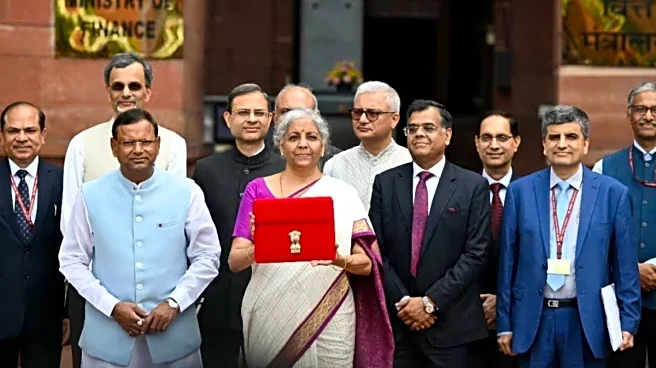




All eyes are on North Block as Finance Minister Nirmala Sitharaman prepares to present her record-breaking ninth consecutive Union Budget on Sunday. This year’s fiscal roadmap is being framed against a backdrop of resilient domestic growth and a shifting global order, where India is increasingly viewed as a primary engine of the world economy. With the “Halwa ceremony” concluded and the documents now in their final lock-in, the Budget 2026-27 is expected to be a masterclass in balancing populist expectations with rigorous fiscal discipline.
The Pivot to Part B
A significant shift in the structure of the speech is anticipated this year. Government sources suggest that the Finance Minister may focus more extensively on Part B of the budget document compared to the traditional
lengthy expositions of Part A.
In the parlance of the Indian Budget, Part A typically deals with the broader macroeconomic vision, scheme-wise allocations, and the “state of the union” report. Part B, conversely, is the section that directly impacts the pockets of citizens and the balance sheets of corporations, as it outlines direct and indirect tax proposals. This strategic pivot suggests that the 2026 Budget may move quickly past the “intent” phase to focus on the “implementation” of specific tax reforms aimed at simplifying the compliance burden and perhaps offering the long-awaited rationalisation of the New Tax Regime.
Fiscal Discipline vs Capital Growth
The overarching theme of the 2026-27 Budget is likely to be “Sustainable Consolidation”. Markets are closely watching the fiscal deficit target, which is expected to be pegged at 4.3 per cent of the GDP. This would be a marginal but significant reduction from the 4.4 per cent target of the previous year, signalling to global investors that India remains committed to its roadmap of reducing the debt-to-GDP ratio to approximately 50 per cent by 2031.
However, this discipline is unlikely to come at the cost of infrastructure. Economists anticipate a double-digit increase in capital expenditure (Capex), with a projected outlay of roughly Rs 13.1 lakh crore. While previous years saw a heavy focus on railways and highways, Budget 2026 is expected to widen the net to include:
Green Energy Infrastructure: Significant allocations for solar grid expansion and battery storage.
Deep-Tech and AI: New incentives for robotics and artificial intelligence to future-proof the “Make in India” initiative.
Digital Agriculture: A push for the Digital Agriculture Mission to boost farm productivity through tech-based monitoring.
The Middle-Class Mandate
For the common man, the focus remains on the “cost-of-living” support. With inflation having moderated but still sensitive to global fuel prices, there is a high expectation for an increase in the standard deduction—potentially from Rs 75,000 to Rs 1 lakh. Salaried taxpayers are also looking for a rationalisation of tax slabs to increase disposable income, which in turn could stimulate the domestic consumption that has shown signs of softening in recent quarters.
As the Finance Minister rises to address the Lok Sabha at 11am on Sunday, the challenge will be to prove that India can maintain its status as the world’s fastest-growing large economy without slipping into the trap of populist overreach. Whether through the “Part B” focus or the continued Capex push, the 2026 Budget is poised to be the definitive blueprint for India’s journey toward becoming a developed nation.