
/images/ppid_a911dc6a-image-177531122953844085.webp)
Nitesh Tiwari’s ambitious retelling of Ramayana is already facing inevitable comparisons with Ramanand Sagar’s iconic television series Ramayan, long regarded as the definitive screen adaptation of the epic. Days after the teaser dropped, a fresh wave of conversation has emerged online, thanks to AI-generated visuals that reimagine the new film’s cast in the aesthetic of the 1987 classic.
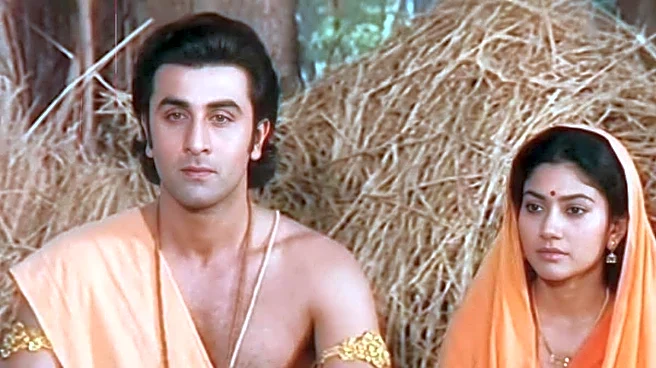
AI Recreates Ranbir Kapoor And Sai Pallavi In Vintage Style
The teaser, which introduced Ranbir Kapoor as Lord Rama and Sai Pallavi as Sita, drew mixed reactions. While many praised its scale and ambition, others felt the visuals leaned too heavily on VFX and lacked the simplicity associated with older adaptations.
Amid this discourse, digital creator Siddhanta
Abhishek shared AI-generated images imagining the film’s cast as part of Ramanand Sagar’s Ramayan. Captioned “Ranbir and Sai Pallavi directed by Ramanand Sagar,” the images present the actors in a vintage television aesthetic reminiscent of the original show.
The set also features Ravie Dubey as Lakshman, further blending the contemporary casting with the nostalgic visual grammar of the 1980s series.
The Legacy Of Ramanand Sagar’s Ramayan
First aired on Doordarshan between 1987 and 1988, Ramayan remains one of the most influential shows in Indian television history. Starring Arun Govil as Lord Rama, Dipika Chikhlia as Sita and Sunil Lahri as Lakshman, the series set a cultural benchmark that continues to shape audience expectations decades later.
Its impact extended beyond viewership, turning its lead actors into household names and cultural icons. The show’s sequel, Uttar Ramayan, aired between 1988 and 1989, further cementing its legacy.
About Nitesh Tiwari’s Ramayana
Backed by producer Namit Malhotra, Ramayana is mounted on a massive ₹4000 crore budget, making it one of the most expensive Indian films ever made. Alongside Ranbir Kapoor and Sai Pallavi, the film stars Yash as Ravana and Sunny Deol as Hanuman.
The two-part epic is slated to release with its first instalment arriving in October 2026, followed by the second part in 2027.
Nostalgia Meets Modern Spectacle
The viral AI visuals have added a new dimension to the conversation around Ramayana, highlighting the contrast between nostalgia-driven simplicity and modern cinematic scale.
As anticipation builds, one thing is clear: the film will not just be judged on its technical prowess, but also on how it resonates with audiences who grew up with a very specific, deeply rooted visual memory of the epic.