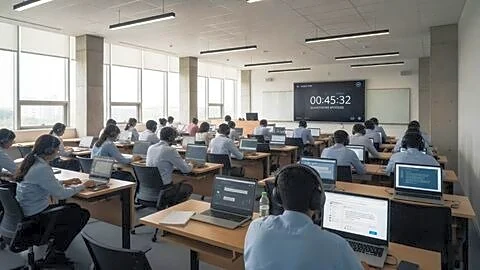




The National Council of Educational Research and Training (NCERT) has developed an introductory module on Computational Thinking (CT) and Artificial Intelligence (AI) for students in Classes 9 to 12. Aligned with the National Education Policy (NEP) 2020, the module aims to develop students’ critical thinking, creativity and problem-solving skills while helping them understand the responsible use of emerging technologies.
Designed for students with no prior knowledge of AI, the module adopts an activity-based learning approach. “Designed for students with no prior knowledge of Artificial Intelligence (AI), the module promotes critical thinking, creativity, problem-solving, and responsible use of emerging technologies. It introduces Computational
Thinking (CT) as a systematic approach to solving problems and helps learners understand how AI works, its applications, possibilities, and limitations,” states the official notice.
According to NCERT, the module places particular emphasis on the ethical and safe use of AI, covering data privacy, misinformation, fairness and digital safety. It also encourages students to critically evaluate and verify AI-generated information rather than accepting it at face value.
The module introduces Computational Thinking as a systematic approach to solving problems. Through practical activities, students will explore AI concepts and examine how emerging technologies are used in everyday life.
The learning approach focuses on understanding and applying concepts instead of relying solely on theoretical instruction. Students are encouraged to experiment, reflect on their observations and develop independent judgement while working with technology.
Another key feature is its emphasis on responsible AI use. Students will be introduced to issues involving personal data, fairness, misinformation and online safety. The module also highlights the importance of checking AI-generated information before relying on or sharing it.
NCERT has stated that the module’s activities can be conducted with or without digital devices. This approach is intended to enable participation across different school settings, including those with limited access to technology.
The experiential learning model combines classroom discussions, practical exercises and reflection to help students build a clearer understanding of computational thinking and artificial intelligence.
The module aims to help students become informed and responsible users of technology. Alongside introducing the possibilities and limitations of AI, it reinforces the importance of human judgement, creativity and ethical responsibility in learning.
By introducing computational thinking and AI at the secondary and senior secondary levels, NCERT seeks to familiarise students with emerging technologies while helping them assess the information and outputs these systems produce.
The initiative is aligned with the broader vision of NEP 2020, which emphasises developing critical thinking, creativity and problem-solving abilities among learners.