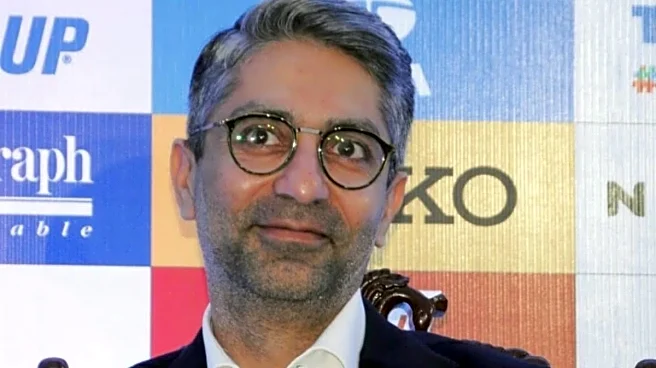

A Sports Ministry-instituted Task Force, chaired by Olympic champion Abhinav Bindra, has rejected a proposal to expand Patiala’s National Institute of Sports into an academy for training sports administrators,
describing it as “restrictive and unsustainable.”
The Task Force on Capacity Building of Sports Administrators was established under Bindra, the 2008 Olympic gold-medal-winning rifle shooter, by the Sports Ministry to design a “future-ready, sustainable, and professional governance system for Indian sport.” It was also tasked with assessing the feasibility of creating a National Academy for Sports at the Netaji Subhas National Institute of Sports (NS NIS) in Patiala, focusing on the “capacity building” of sports administrators.
NS NIS is a highly regarded training facility for boxing, weightlifting, and athletics, and a premier institute for coaching diplomas.
“While the idea of a single National Academy is well-intentioned, it risks becoming restrictive and unsustainable,” the nine-member panel noted.
“NSNIS is rightly regarded as the premier institute for sports coaching, but its privileged status has also led to unintended consequences. Recruiters in Central and State services, as well as PSUs, tend to give preference almost exclusively to NSNIS-trained coaches, limiting opportunities for graduates of other credible institutions,” the panel pointed out.
“In some cases, even internationally certified coaches are not considered eligible for government or PSU roles. Designating NSNIS as the National Academy for Sports Administrators risks replicating this imbalance in the field of sports governance,” it added.
The Task Force argued that such “exclusivity” could hinder the growth of other universities and institutes offering sports management programmes by “concentrating recognition and opportunity too narrowly.”
The panel recommended that instead of turning NS NIS into an academy, it should be “empanelled” as one of the key institutions delivering modules for building administrative capacity.
“India’s scale and diversity demand a networked model where NSNIS plays a leading but not singular role, complemented by multiple institutions that together build a broad, inclusive, and sustainable ecosystem for sports administration,” it stated. “Investing in a network of institutions spreads resources more effectively, creates multiple access points across the country, and ensures far greater impact in both scale and reach.”
Inclusivity and Scale
The Task Force noted that a single National Academy would also risk creating a “monopoly of credentialing.”
“Given the size and diversity of India, and the current maturity of the Indian sports ecosystem, multiple institutions must be empowered to deliver capacity-building programmes to ensure scale, inclusivity, and regional reach,” it said.
Sports Minister Mansukh Mandaviya, speaking about the report, suggested that “a revamp of the course structure at the NIS could definitely be considered” to keep up with the evolving demands of international coaching.
(With Agency Inputs)
/images/ppid_a911dc6a-image-177096923093147220.webp)


/images/ppid_a911dc6a-image-177096864070611136.webp)
/images/ppid_a911dc6a-image-177096857438121179.webp)
/images/ppid_a911dc6a-image-177096852999937942.webp)

/images/ppid_59c68470-image-177096762263013357.webp)

/images/ppid_59c68470-image-177096759058220494.webp)
/images/ppid_59c68470-image-177096752848059885.webp)
/images/ppid_59c68470-image-177096756236953747.webp)