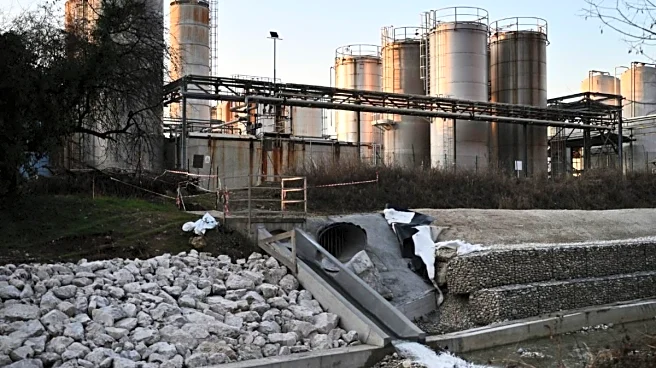

In December 2022, I discussed ‘Fighting climate change the Bharat way – Vedas hold the key’ highlighting how our ancient wisdom teaches us to live in harmony with nature. Today, it is deeply troubling
to see that the same moral grounding that could protect our land and people is being ignored.
The industrial machinery that contaminated aquifers in Italy’s Veneto is now reportedly operating at Ratnagiri in Maharashtra, threatening the ecologically sensitive Konkan coast and the health of its communities.
The site began full production of PFAS-type fluorochemicals in early 2025, used in products like pesticides, pharmaceuticals, dyes, and cosmetics. Essentially, a technology once shut down in Europe for environmental contamination and severe health risks is now active in Bharat, despite the country lacking comprehensive PFAS-specific regulation.
The brutal truth is that human arrogance believes profit and technical cleverness can outrun moral responsibility. Cloaked in technological sophistication and globalised commerce, this arrogance has resurfaced in a more insidious form today, treating human life and ecological integrity as expendable.
Bharat now faces a test: will we allow history to repeat itself, or will the moral wisdom of our dharmic heritage guide us to reject such preventable harm?
The story of Miteni SpA is a travelogue of modern industrial sin, revealing that toxic enterprises do not die when confronted by regulation, public outrage, or courts of law — they just migrate. What began in the industrial valleys of Trissino, near Vicenza in Italy, has cast its shadow on the Konkan coast of Bharat, writing human life off as an acceptable cost of profit.
Founded in the post-war boom, Miteni became a specialist producer of PFAS (per- and polyfluoroalkyl substances) chemicals, prized for their resistance to heat, water, and oil and marketed as indispensable to modern convenience. These were embedded in non-stick coatings, stain repellents, firefighting foams, and countless industrial applications. Known as “forever chemicals”, these carried a known danger; they do not degrade, neither in soil nor in the human body.
From the 1960s onward, Miteni discharged PFAS-laden waste into local waterways and the ground beneath its plant. Over time, these discharges seeped into the aquifers that supply drinking water to large swathes of the Veneto region. Internal documents and later investigations revealed that company scientists and managers were aware of the risks, yet production expanded.
The scale of the disaster emerged in the early 2000s. Routine monitoring began detecting unusual chemical signatures in groundwater. By 2013, regional authorities confirmed what residents had already begun to fear: PFAS contamination across three provinces, exposing approximately 3,50,000 people to polluted drinking water.
Medical screenings soon found exceptionally high PFAS concentrations in residents’ blood, including children exposed from birth. Epidemiological studies linked exposure to kidney and testicular cancers, thyroid disorders, liver damage, immune suppression, infertility, and pregnancy complications — a chronic, invisible assault unfolding over decades. These findings alone were insufficient to prompt immediate action, partly because global regulatory frameworks had already normalised certain PFAS levels as “tolerable”.
In parts of Europe, 8 nanograms per millilitre (ng/mL) of PFOA, one of the most common PFAS, has been officially described as a reference or “safe” level for human blood serum. Tragically, it is the moral failure of a capitalist world that normalises the chronic poisoning of millions as tolerable, measuring human bodies not in health but in thresholds of chemical endurance. In the Veneto region, the blood of residents revealed median PFOA levels around 44 ng/mL, with the most exposed individuals exceeding 1,400 ng/mL, dozens or even hundreds of times above the nominal “safe” limit.
Public outrage eventually followed. Emergency measures were introduced to provide clean water, and Italy tightened PFAS limits.
Under mounting pressure, Miteni was forced to cease operations in July 2018. The closure marked an admission that the plant’s activities were incompatible with public safety, but it did not end the harm.
Criminal investigations expanded between 2019 and 2021, targeting executives and managers for environmental catastrophe and water poisoning. For the residents of Veneto, justice was belated and incomplete; no verdict could erase decades of exposure.
Shut down and facing legal jeopardy, Miteni entered insolvency proceedings and was declared bankrupt in 2022. Here the logic of global capitalism revealed its cold efficiency. While communities bore the health burden, the company’s physical assets, machines, reactors, and proprietary PFAS production processes were treated as neutral commodities.
During 2022-2023, these assets were auctioned and sold. Reports indicate that equipment and production know-how were dismantled in Italy in 2023, packaged not as instruments of harm but as “technology”, and prepared for export. What European regulation had deemed intolerable could, through market mechanisms, be reborn elsewhere.
Guess who the next potential victims in the making of this capitalist recklessness are? In what can only be described as a tragic migration of industrial hazard, these same machines and chemical processes were exported to Bharat between late 2023 and 2024 and reassembled at the Lote Parshuram MIDC in Ratnagiri.
In a region dependent on groundwater and with fragile ecosystems, the invisible threat of PFAS looms anew, carrying the same toxic legacy that decimated aquifers and human lives in Veneto. PFAS are not smoke that clears or spills that evaporate; they are “chemical time bombs” that lodge in blood and soil for centuries.
By early 2025, public concern mounted that PFAS production using the same industrial lineage was becoming operational. How can a chemical system that devastated Europe’s aquifers really be operated safely in a region with fragile ecosystems, critical groundwater reliance, and virtually no PFAS regulation?
The line between progress and peril is thinner than we dare to admit. What makes the Miteni story especially troubling is knowledge, not ignorance.
By the time of closure in 2018, the science was unequivocal. To move the machinery elsewhere after that point is to assert, implicitly, that some lives and landscapes are more expendable than others.
Defenders of such transfers invoke legality, jobs, and development. But legality often lags behind morality, especially in environmental law. Jobs cannot justify irreversible poisoning, and development that destroys water, the basis of all life, is a contradiction.
The market is treating machines as value-neutral, whereas ethics demand otherwise. A reactor that produced “forever chemicals” in Trissino carries its history with it, even when bolted to a new floor thousands of kilometres away. To ignore that history is to repeat it.
If the same industrial logic is allowed to operate — profit first and accountability never — Bharat is poised to inherit the same disaster that devastated Veneto. The Miteni saga is unfinished; its legacy in Veneto will be measured in medical charts for decades.
In Ratnagiri, the future is still being written. This is the moment where the Centre can choose memory over amnesia and restraint over repetition.
(The author professionally is a hospitality entrepreneur. An avid history buff, she perpetually researches episodes where history was faulted to manufacture faux narratives. Views expressed in the above piece are personal and solely that of the writer. They do not necessarily reflect News18’s views)
/images/ppid_a911dc6a-image-177075852740281148.webp)



/images/ppid_a911dc6a-image-177075603605816191.webp)

/images/ppid_a911dc6a-image-17707550296985796.webp)



/images/ppid_a911dc6a-image-177075157301840277.webp)