
/images/ppid_59c68470-image-177095003091564225.webp)
/images/ppid_59c68470-image-177094778070247070.webp)
/images/ppid_59c68470-image-177094774796122738.webp)
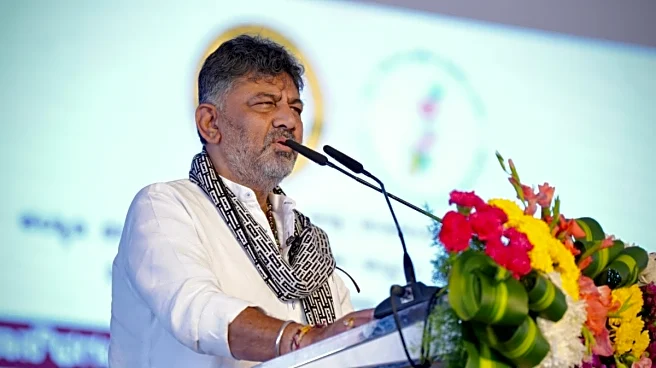
Karnataka Deputy Chief Minister D K Shivakumar, back from the World Economic Forum (WEF) in Davos, has doubled down on Bengaluru’s global pitch — saying the world sees India through Bengaluru — while signalling that Karnataka’s next growth push must move beyond the capital and into two-tier and three-tier cities. Shivakumar said many top global companies are now “seeking and pitching for two-tier and three-tier cities”, pushing Indian states to widen the development map beyond metros. “We have decided that with immediate effect, across the entire state, in every town and city, we will draw up a mobility plan for the next 25 years. It is compulsory that we plan ring roads to connect them. Time is money,” Shivakumar said. “We will work on a grid
plan, decide these peripheral ring roads, and connect them to two-tier and three-tier cities, so that new businesses will be brought into these towns,” he added. At the heart of his post-Davos plan is also his pitch for underground tunnels and mobility infrastructure — ring roads, grid planning and better connectivity to smaller towns — positioned as a long-term investment play for Karnataka.
The 2 challenges
Shivakumar’s Davos pitch appears aimed at solving two challenges at once: keeping Bengaluru positioned as India’s global innovation capital, while signalling to investors that Karnataka can offer new growth centres beyond the city.
But back home, the optics of global meetings will quickly give way to local tests — whether “speed of doing business” translates into faster clearances, whether ring road and grid plans move beyond presentations, and whether the tunnel talk becomes a viable mobility solution or another headline that Bengaluru’s traffic swallows.
Shivakumar said investors were direct about what they wanted to know. “Investors told us that Karnataka has water and power. During the discussions, investors asked about parking, urbanisation, and what we are planning for the next 25 years,” he said, adding that companies even suggested solutions that can be implemented, including staggered parking.
Driving Karnataka’s Success at Davos!
Being in Davos at the World Economic Forum has been a valuable experience, representing Karnataka and India on a global platform. The conversations here reflect strong optimism about Karnataka’s growing role in shaping economic and urban… pic.twitter.com/eP2qiRNfHK
— DK Shivakumar (@DKShivakumar) January 23, 2026
On a question on pollution, and IMF Chief Economist Gita Gopinath saying pollution is a bigger problem for Indian investments than tariffs, Shivakumar reacted by saying, “Karnataka’s pollution is better.”
But the major feedback, according to him, was on the state’s administrative speed. “The investors said that in Karnataka, there is a need for ease of doing business, and that timeframes are a concern. So we have told them we will bring in the ‘speed of doing business’,” he said.
Why tunnels are key
Shivakumar also spoke about learning from Maharashtra’s tunnel-building experience and his own travel from Davos to Zurich. “Maharashtra also told us about their tunnel project. We will go and see it, and learn about the 16 tunnels they are building — the tunnel boring machines and how they are managing the work. We are building one, they are building 16. We will study the best practices and implement them accordingly,” he said.
“I travelled through several tunnels between Davos and Zurich, and later to Milan, and I was very impressed. Those were built 60–70 years ago. There is a lot to learn,” he claimed.
As a government, the Karnataka DCM said they chose not to sign MoUs at Davos, presenting the visit instead as a platform to showcase the state’s strengths in person when companies visit. “We decided not to sign MoUs there. We want to show our strength — clean energy, our talent, our medical sector, youth strength. We must showcase what we have in AI as well,” he said, adding that companies and governments will be visiting Karnataka.
Shivakumar repeatedly returned to selling Bengaluru and Karnataka as India’s global calling card, saying, “World leaders are seeing India through Bengaluru — I would like to reiterate that.” He cited the city’s corporate presence, claiming Fortune 500 companies have their prime CEOs in Bengaluru, and said sectors like data centres, global capability centres, aviation and aerospace, food and beverages, renewable energy and electronics were in focus.
He also said Karnataka is a huge talent powerhouse. “Bengaluru has 22 lakh IT professionals — what more do you want? We also produce the most doctors and nurses and other medical professionals,” he said.
Reacting to Rahul Gandhi’s “dead economy” comment — which has drawn sharp political reactions from the BJP — Shivakumar said, “Don’t create politics over it.”
/images/ppid_59c68470-image-177095256656558605.webp)

/images/ppid_59c68470-image-177095259574929498.webp)
/images/ppid_59c68470-image-177095262800352965.webp)
/images/ppid_59c68470-image-177095252262437422.webp)
/images/ppid_a911dc6a-image-177095173262856210.webp)

/images/ppid_a911dc6a-image-177095176389429444.webp)
/images/ppid_59c68470-image-177095006121036330.webp)
/images/ppid_59c68470-image-17709502481006608.webp)
/images/ppid_59c68470-image-177095003027833058.webp)
/images/ppid_59c68470-image-177095009506748967.webp)