


The Union of European Football Associations (UEFA) has decided that referees in its competitions will not show red cards to players who cover their mouths while speaking to their opponents.
The world governing body, FIFA, came up with the law after the incident between Real Madrid winger Vinicius Junior and Benfica’s Gianluca Prestianni during a UEFA Champions League match last year. Vinicius had accused Prestianni of calling him a monkey after the Brazilian celebrated a goal. UEFA, after a long investigation process, found Prestianni guilty of using a homophobic slur and handed him a six-match ban.
FIFA kept this law, the brainchild of its controversial president, Gianni Infantino, optional for its member leagues across the world, and the European
body, by far the richest and the most popular, has opted against it.
UEFA said referees should judge each incident on a case-by-case basis and decide whether a player should be shown a yellow card if the act is deemed “an attempt to conceal communication as an act of unsporting behaviour.” It added that this would be “without prejudice to any disciplinary investigation or proceedings that may follow as a consequence of, or in connection with, such behaviour.”
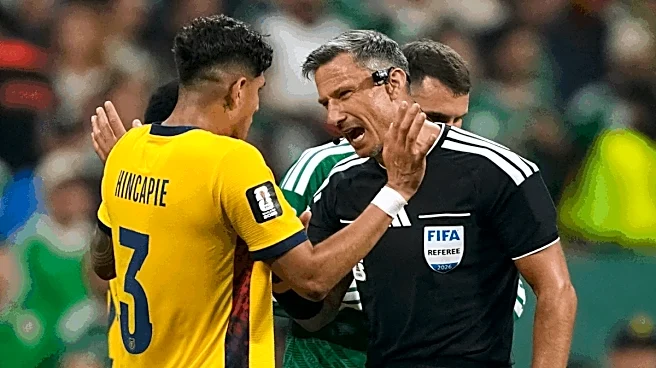
The law is already being applied at the ongoing 2026 FIFA World Cup. Paraguay’s Miguel Almirón became the first player to be sent off under it in the tournament during his side’s World Cup group-stage match against Turkey. Later, Ecuador defender Piero Hincapié was also shown a red card in his team’s Round of 32 defeat to Mexico. Both dismissals came after the referee reviewed the incidents with the assistance of the video assistant referee (VAR).
There have been concerns about the law because it assumes that the player covering their mouth ‘has something to hide’, and thus, guilt, with little chance for them to prove otherwise, leaving it open to misuse.