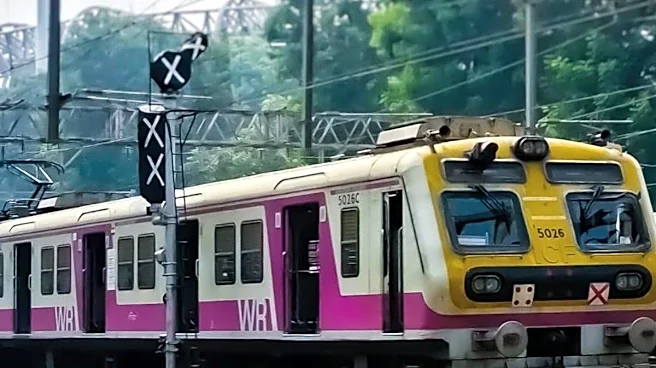



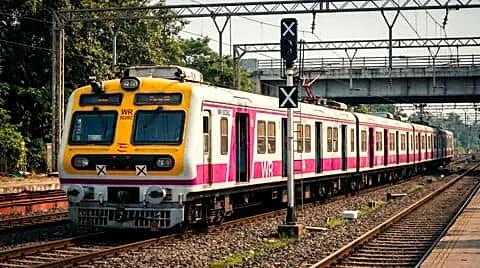
Tensions flared at Maharashtra’s Virar railway station on Monday morning after the introduction of a new air-conditioned (AC) local train triggered protests during peak hours. Commuters, upset over the conversion of a regular service into an AC train, stepped onto the tracks and briefly halted rail movement, raising slogans against the authorities.
The unrest began after the 8.28 am Virar-Churchgate local was converted into an AC service, leading to widespread disruption and chaos at the station.
Commuters Question Need For Additional AC Service
Passengers criticised the decision, pointing out that an AC local train already operates at 8.33 am on the same route. They argued that introducing another AC service just five minutes earlier was unnecessary and had effectively reduced the availability
of affordable non-AC options.
Many daily commuters depend on standard local trains due to their low fares, and the change was seen as limiting access to budget-friendly travel during one of the busiest hours of the day.
Western Railway Defends Move, Cites High Demand
Officials from Western Railway defended the decision, stating that the 8.28 am AC local was running at full capacity despite onboard ticket checks. According to them, the strong response indicates growing demand for AC services and justifies the introduction of additional trains.
They also highlighted that AC local fares, at approximately 84 paise per kilometre, remain relatively economical compared to other modes of transport, such as monthly bus passes.
AC Vs Non-AC Debate Intensifies Among Commuters
The incident has reignited the debate over AC versus non-AC services in Mumbai’s suburban rail network. While some commuters acknowledged the need for more AC trains, many stressed that scheduling should be better balanced to avoid reducing non-AC services.
According to a report in Mid-Day, passengers suggested that authorities consult commuters and stagger AC and regular train timings more effectively to prevent overcrowding and inconvenience.
Rising Demand But Limited Capacity Raises Concerns
Mumbai’s suburban railway system caters to nearly 8 million commuters daily, most of whom still rely on non-AC trains due to their affordability, often described as among the cheapest in the world.
However, there is a gradual shift, with a section of passengers willing to pay more for AC services. As the number of AC trains increases, concerns have emerged that they are being introduced at the cost of existing non-AC services within an already saturated network, intensifying crowding in regular compartments.
Policy Clarity And Service Rationalisation
Rajiv Singal, a member of the Divisional Railway Users’ Consultative Committee, suggested that as demand grows, authorities could gradually convert more services to AC while simultaneously increasing general-class capacity by reducing first-class coaches. He noted that many AC commuters previously travelled in first class, and such adjustments could help balance capacity.
Meanwhile, Shailesh Goyal, a former member of the National Railway Users Consultative Committee, criticised the lack of a clear policy. He pointed out contradictions in introducing more AC trains while also experimenting with non-AC door-closing services, saying it has created confusion among passengers.

/images/ppid_59c68470-image-177807253528384349.webp)