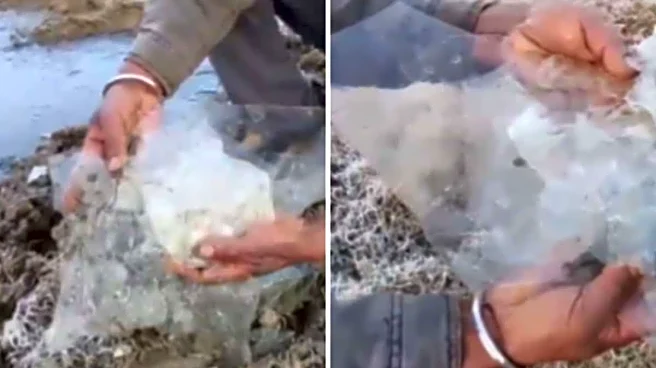

Icy layers were seen covering water bodies, and frost formed on grasslands as extreme winter conditions gripped Rajasthan’s only hill station, Mount Abu, amid a cold wave in northern India.
After a cold
wave on Friday, Saturday morning turned out to be the most bone-chilling day for Mount Abu as temperatures dropped severely.
According to ANI, the minimum temperature plunged to a staggering minus 7 degrees Celsius today, which marked the lowest temperature in this winter season.
#WATCH | Rajasthan | Frost forms on grass and surfaces as the temperature in Mount Abu dips. pic.twitter.com/Xjo51L0dX3
— ANI (@ANI) January 24, 2026
The extremity of winters was evident across the regions as ice sheets formed on water bodies and ponds. In some areas, the water surface completely froze overnight. In the visuals, the frost-covered surroundings were seen in Mount Abu as residents braved the harsh winters.
The residents also saw a thick layer of frozen dew on grasslands in rural pockets of Mount Abu, including Salgaon and the Chand Mari firing range.
The ponds were covered with solid ice sheets, clearly reflecting how low temperatures had dropped through the night and early morning hours.
The cold wave persisted throughout the day as the biting winds further added to the discomfort of the people.
At 9 am in the morning, the locals were seen sitting around bonfires along roadsides as the sun gave them little relief.
The cold wave continued into the evening and night and has been one of the harshest winter phases in recent years.
The tourists, who are in Mount Abu for sightseeing, were surprised at the extreme cold in late January. Many people said that the weather conditions in Mount Abu stood in stark contrast to conditions in their cities.
To brave the chill of winter, several tourists wore heavy warm clothes, kept their hands tucked into their pockets, rubbed their palms together while sipping hot tea and snacks to cope with the frigid temperatures.
Across Rajasthan, night temperatures have dropped sharply again due to a western disturbance, with temperatures in several areas nearing zero.
According to the local meteorological centre, northern winds are expected to cause a further decrease of 3 to 5 degrees Celsius in minimum temperatures and 2 to 3 degrees Celsius in maximum temperatures over the next two to three days, while overall weather conditions will remain mostly dry.
The India Meteorological Department (IMD) stated that the intense cold conditions are linked to widespread snowfall in the western Himalayan region caused by a western disturbance.




/images/ppid_a911dc6a-image-177086355446649864.webp)

/images/ppid_a911dc6a-image-177086352380239409.webp)
/images/ppid_59c68470-image-177086258246560927.webp)

/images/ppid_59c68470-image-177086254430548516.webp)
/images/ppid_59c68470-image-177086265857125048.webp)
/images/ppid_59c68470-image-177086262067478359.webp)
/images/ppid_59c68470-image-177086254645319037.webp)