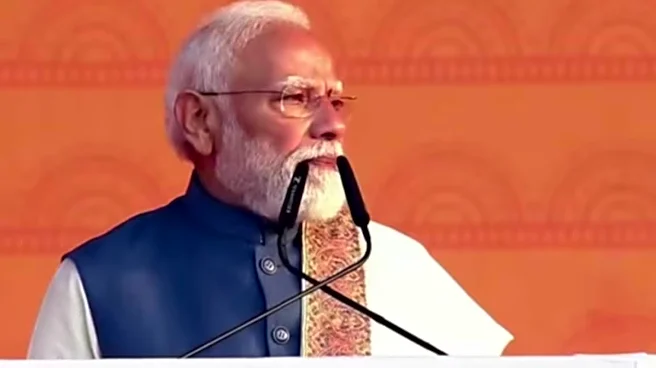

Prime Minister Narendra Modi on Thursday took a veiled dig at the Nehru-Gandhi family of the Congress, saying that previous Congress-led governments had concentrated recognition around one family while
ignoring several national icons.
While addressing a gathering after inaugurating the Rashtriya Prerna Sthal in Lucknow, PM Modi said that leaders who made significant contributions to the nation were not given due respect when the Congress was in power. He said that from books, government schemes, to institutions, roads and public places, all were named to glorify one family.
“After independence, a tendency to connect all the good work that took place in India to the same family emerged. Whether it be books, government schemes, government institutions, streets, roads, or squares, it was all connected to the pride of one family,” he said.
#WATCH | Uttar Pradesh: Prime Minister Narendra Modi says, “… After independence, a tendency to connect all the good work that took place in India to the same family emerged. Whether it be books, government schemes, government institutions, streets, roads, or squares, it was… pic.twitter.com/FWiXfBWRWy
— ANI (@ANI) December 25, 2025
He emphasised that the BJP government had broken away from what he described as an outdated system.
“BJP has also taken the country out of this old system bond to one family. Our government, serving Mother India, is giving respect to every child, to everyone’s contribution,” he added.
Citing examples, PM Modi said that Netaji Subhash Chandra Bose had finally been given his due honour with a statue installed on Kartavya Path in Delhi. He also referred to Dr BR Ambedkar, claiming that attempts were made in the past to undermine his legacy.
He asserted that the BJP government ensured that Ambedkar’s legacy was preserved and celebrated.
“Today, Netaji Subhash Chandra Bose’s statue is on Kartavya Path in Delhi… No one can forget how Baba Ambedkar’s legacy was destroyed. The royal family of Congress committed this sin in Delhi, and here in UP, the Samajwadi Party people also committed the same sin. But the BJP did not let Baba Saheb’s legacy be destroyed. Today, from Delhi to London, Baba Ambedkar’s Panch Teerth is celebrating his legacy…” he added.
PM Modi further claimed that during the UPA government’s tenure, BJP leaders and icons were disrespected. He accused the Congress of consistently undermining the legacy of leaders associated with the BJP and other nationalist movements.
“The opposition ignored national icons, but they have been honoured under the BJP government,” PM Modi said, reiterating that his party believed in recognising the contributions of all leaders who strengthened India’s unity and identity.
Vajpayee Laid The Foundation Of Telecom Transformation: PM Modi
PM Modi highlighted the legacy of former Prime Minister Atal Bihari Vajpayee, saying the foundations of India’s digital and telecom transformation were laid during his tenure. He said the concept of a special identity card initiated under Vajpayee later evolved into Aadhaar, which is now recognised globally. The Prime Minister also credited Vajpayee’s telecom policy for accelerating the spread of mobile phones and internet connectivity across the country.
“Wherever Atal Ji is today, he would be happy to know that in the last 11 years India has become the second-largest mobile phone manufacturer in the world,” PM Modi said, adding that Uttar Pradesh, from where Vajpayee was a Member of Parliament, had emerged as the country’s top mobile manufacturing state.
PM Modi also recalled the philosophy of Pandit Deendayal Upadhyaya, saying the BJP government was committed to fulfilling his vision of Antyodaya, or uplifting the last person standing in the last row. “The progress of India should be measured by the smile on the face of the poorest,” he said.
Referring to national integration, the Prime Minister recalled Dr Syama Prasad Mookerjee’s opposition to the system of two constitutions, two flags and two heads of state, calling it a major challenge to India’s unity after Independence. He said the BJP government was proud to have dismantled the “wall of Article 370” in Jammu and Kashmir.
Rashtriya Prerna Sthal Is A Symbol Of Self-Respect
Describing the Rashtriya Prerna Sthal as a symbol of self-respect, unity and service, PM Modi said the towering statues of Dr Syama Prasad Mookerjee, Pandit Deendayal Upadhyaya and Atal Bihari Vajpayee would inspire generations to dedicate every effort to nation-building. “The collective efforts of all will fulfil the resolve of a Viksit Bharat,” he said.
He noted that the land on which the Rashtriya Prerna Sthal now stands had remained a garbage dump spread over more than 30 acres for decades and was completely cleared over the past three years. He congratulated the labourers, artisans, planners and the Uttar Pradesh government for completing the project.
PM Modi Inaugurates Rashtriya Prerna Sthal
The Prime Minister inaugurated the Rashtriya Prerna Sthal, a landmark national memorial and complex dedicated to former Prime Minister and Bharat Ratna Atal Bihari Vajpayee.
The inauguration coincides with the 101st birth anniversary of the former Prime Minister.
#WATCH | Uttar Pradesh: Prime Minister Narendra Modi inaugurates the ‘Rashtra Prerna Sthal’ in Lucknow.
(Source: DD News) pic.twitter.com/tqTR1AkXxN
— ANI (@ANI) December 25, 2025
The sprawling complex also features 65-foot-high bronze statues of BJP ideologues Syama Prasad Mookerjee and Pandit Deendayal Upadhyaya, alongside Vajpayee.
A state-of-the-art museum, designed in a lotus-shaped structure and spread over 98,000 square feet, allows visitors to explore the contributions of these leaders to nation-building.
The Rashtriya Prerna Sthal, developed at an estimated cost of Rs 230 crore over 65 acres, is envisaged as a permanent national asset promoting leadership values, national service, cultural consciousness, and public inspiration.
The memorial, described as an “inspirational complex of enduring national significance”, is expected to serve as a source of motivation for present and future generations, reflecting the pivotal role of Vajpayee, Mookerjee, and Upadhyaya in shaping India’s political thought and public life.
(With inputs from agencies)


/images/ppid_a911dc6a-image-177101752951095973.webp)



/images/ppid_a911dc6a-image-177101403147018469.webp)
/images/ppid_a911dc6a-image-177101053501199609.webp)
/images/ppid_59c68470-image-177101003680064644.webp)