


/images/ppid_59c68470-image-178150761809951941.webp)


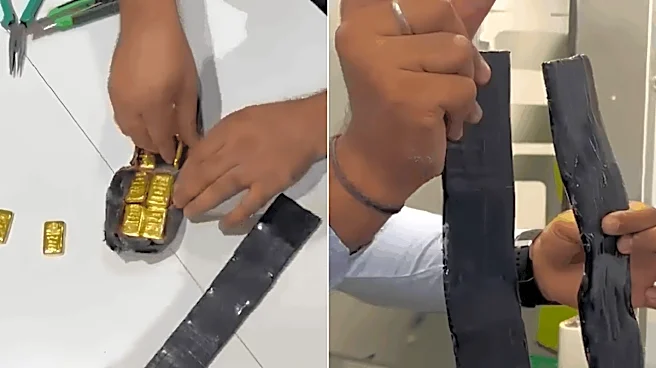
The Directorate of Revenue Intelligence (DRI) on Monday recovered 24 gold biscuits worth approximately ₹4 crore from inside an IndiGo aircraft at Ahmedabad’s Sardar Vallabhbhai Patel International Airport.
The gold was found concealed inside a speaker box in the front lavatory of the aircraft, wrapped in black plastic tape, and had not been found on any passenger or in any checked baggage.
No arrests have been confirmed in connection with the seizure as of the time of reporting.
Gold Hidden Inside Aircraft Structure, Not On A Passenger
Routine airport gold seizures usually involve passengers. Someone is caught at immigration, baggage is flagged at the scanner, or a declaration gone wrong. This case is categorically different.
The gold was inside the aircraft itself, in a structural cavity within the lavatory.
Passenger security checks are built to screen individuals and their luggage at entry points. Customs checks intercept goods at arrival.
Neither process, in standard operations, involve dismantling interior panels or opening the housings of fitted components like speaker boxes.
The question investigators are now puzzled with, is not who tried to carry gold through the airport, but rather how, when did it enter the aircraft in the first place.
The Turnaround Window
Between any two flights, an aircraft goes through a defined operational sequence. Cleaning crews board. Catering is loaded. Baggage handlers work the hold. Maintenance personnel enter depending on scheduled checks.
This period, is when the plane is operationally open and multiple people have legitimate, authorised access.
Crucially, however, that access is functional, not investigative. No one during a standard turnaround checks interior panels or pulls open lavatory speaker housings, unless it is a safety hazard wherein some alarm has been triggered on the flying deck.
Cleaning teams work surfaces. Maintenance teams open internal systems only when there is a specific technical reason to do so.
The gap between surface-level servicing and structural inspection is where concealment of this kind becomes operationally possible.
Why The Lavatory
Aircraft lavatory units are among the more complex interior assemblies on a commercial aircraft. Plumbing, electrical systems, and fitted structural panels are all integrated into a relatively compact space.
Routine cleaning cycles do not require opening any of that. A cleaner wipes surfaces, empties waste receptacles, and moves on.
The speaker housing, specifically, is a component that would ordinarily sit untouched across hundreds of flight cycles unless there was an audio fault or a scheduled maintenance task requiring its removal.
How It Was Found
The recovery raises a question in itself, that the investigation will need to answer at some point. Aircraft-level concealment in internal compartments is not typically detected through standard passenger screening.
The DRI’s recovery from within a lavatory panel suggests that the inspection that found the gold, went well beyond routine turnaround checks.
The discovery may have come through prior intelligence about a specific concealment, a technical inspection that required opening the panel for an unrelated reason, or an anomaly observed during operational checks that prompted further examination.
The DRI has not confirmed the basis for the inspection that led to the recovery.
What Investigators Are Now Reconstructing
The timeline of when the gold entered the aircraft is the thread investigators will pull first. CCTV footage from the aircraft’s ground positions, access logs from the ground handling team, aircraft maintenance records, and crew and cleaning crew schedules during the relevant turnaround windows are all likely to be examined.
The central question is, ‘Which turnaround cycle was the gold placed in, and who had access to the aircraft during that window?’ If the lavatory panel was opened, there would have been a reason, or someone who created one.
What Comes Next?
Had the concealment not been detected, retrieval would have required access during a future turnaround, either by the same personnel or a different contact point at a destination airport.
The aircraft, moving between cities on multiple rotations daily, would have carried the gold silently within the aviation system until that retrieval window opened.
The alternative is that no retrieval was planned and the gold was intended to be collected during maintenance intervention at a base station. Both possibilities however depend on the same condition – having access to the aircraft during ground operations.
/images/ppid_59c68470-image-178149256382347339.webp)





/images/ppid_59c68470-image-178148758161799438.webp)
/images/ppid_59c68470-image-178149012245474022.webp)