
/images/ppid_a911dc6a-image-177078725708786992.webp)
/images/ppid_59c68470-image-177099004901435587.webp)
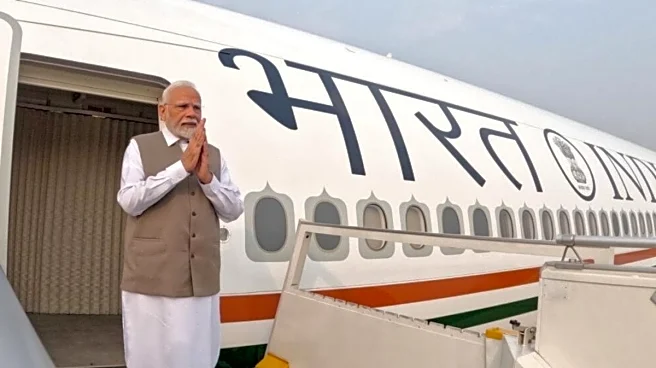
In the upcoming week, Bharat Mandapam in New Delhi will host a tableau of India’s international ambitions. The India AI Impact Summit, the first global artificial intelligence summit convened in the developing world, will draw delegations from over 100 countries, more than 100 global chief executives, and at least 15 heads of state and government. French President Emmanuel Macron and Brazilian President Luiz Inácio Lula da Silva will be among those in attendance, alongside leaders from Europe, Latin America, Asia and the Indian Ocean, and senior representatives from both Washington and Beijing. In the days around the summit, Prime Minister Narendra Modi welcomed Seychelles’ president for an Indian Ocean engagement, travelled to Malaysia to deepen
a semiconductor partnership, and will fly to Israel to advance free trade and defence‑industrial cooperation even as the Gaza conflict continues. February’s calendar has been busy, and this activity distils a broader pattern that has underpinned India’s foreign policy over the past decade. This observation marks a transition to the central argument: India consistently employs a middle‑power method, steering between outright neutrality and super‑power swagger. That method rests on four pillars: strategic autonomy; setting agendas rather than bloc politics; economic hedging through trade corridors and technology coalitions; and a consistent role as first responder and development partner to the Global South. What It Now Means To Be a Middle Power In textbook terms, a middle power is a state without the material heft of a superpower but with enough capacity, credibility and connectivity to shape outcomes beyond its borders. In the 2020s, those attributes are less about troop deployments and more about four things: the ability to keep options open between rival camps; the capacity to convene problem‑solving coalitions; resilience in trade and technology networks; and a reputation for reliability in crises. 2023 was described as a “watershed year” by the Ministry of External Affairs, in which New Delhi pursued a “pragmatic and outcome‑oriented” diplomacy amid a world defined by war in Europe, turmoil in West Asia, supply‑chain disruptions and climate stress. Against that backdrop, India assumed the G20 presidency, hosted more than 200 meetings in 60 cities, expanded its role in the Shanghai Cooperation Organisation and BRICS, and intensified engagement across the Indo‑Pacific and the Indian Ocean. But even with the host of engagements and collaborations, India avoided entering mutual-defence treaties or exclusive security blocs. Instead, it practised “multi-alignment”: working with the United States in the Quad and on advanced technology, with Russia on defence and energy, with Europe on trade and climate, with ASEAN on connectivity, and with the African Union and Latin America on development, not allowing any single relationship to become existential.
This approach, however, is not without its strains. At times, India’s balancing act has tested the patience of key partners. For instance, India’s continued defence ties with Russia have sparked pressure from Washington under the CAATSA legislation, forcing New Delhi to navigate the risk of US sanctions while protecting its strategic autonomy.
Similarly, India has occasionally faced disappointment from partners expecting clearer alignment, underlining that the cost of flexibility is the possibility of diplomatic friction, as seen when India’s abstentions on United Nations resolutions condemning Russia’s actions in Ukraine prompted public criticism from European countries and the United States.
Pillar One: Strategic Autonomy
The Russia-Ukraine war and the Gaza conflict have pushed India’s strategic autonomy doctrine into the open. Since 2022, New Delhi has abstained on most UN resolutions condemning Russia’s invasion, kept defence channels with Moscow open, and increased imports of discounted Russian crude from negligible levels to more than 40 per cent of its oil basket by 2024.
At the same time, PM Modi has used high‑profile meetings, most notably with Vladimir Putin in Samarkand, to state publicly that “today’s era is not an era of war”, which was later embedded in the consensus New Delhi G20 Leaders’ Declaration.
In Gaza, India has followed a similar method with different emphases. It condemned the October 7 Hamas attacks as terrorism, maintained security and technology ties with Israel, and yet supported UN resolutions calling for humanitarian pauses and sent aid to Palestinians. Delhi describes this as “de‑hyphenated” diplomacy: dealing with each bilateral relationship, Israel, the Arab world, Iran, on its own terms, rather than being locked into inherited binaries.
Economic policy has followed the same logic. When the United States imposed steep tariffs that raised effective duties on some Indian exports to around 50 per cent, India did not either capitulate or unleash indiscriminate retaliation. It negotiated a reduction to 18 per cent and quietly bought breathing space by diversifying its trade architecture elsewhere, rather than trading political concessions on Russia or agriculture for short‑term relief.
Pillar Two: Setting Agendas
Middle powers gain leverage when they can convene rivals on their soil and shape the terms of discussion. India’s G20 presidency in 2023 was the clearest demonstration. Despite deep divisions over Ukraine, New Delhi produced a unanimous 83‑paragraph New Delhi Leaders’ Declaration, with no footnotes or chair’s summary. A feat that required more than 200 hours of negotiations and some 300 bilateral meetings among sherpas.
Critically, India used that presidency to insert Global South priorities into the core agenda: accelerating the 2030 Sustainable Development Goals, tripling global renewable energy capacity by 2030, scaling development and climate finance “from billions to trillions”, and defining digital public infrastructure as a global public good. It also championed the African Union’s admission as a permanent G20 member, a move analysts in Brussels openly credit to India’s initiative.
The India AI Impact Summit is an extension of this convening strategy into the technology domain. With more than 100 CEOs and delegates from 100‑plus countries, including both Western and Chinese participants, India is positioning itself as the venue where rules for a contested technology can be discussed without being set exclusively in Washington, Brussels or Beijing.
Pillar Three: Economic Hedging
The third pillar of India’s method is economic: reducing vulnerability not by turning inwards but by building overlapping corridors of trade and technology.
Over the past year, New Delhi has moved, and boy, it has moved fast. It has signed a series of substantial free trade agreements. A deal with the United Kingdom which grants zero or near‑zero tariffs on 99 per cent of Indian exports; Agreements with New Zealand and Oman to open 100 per cent and 98 per cent of tariff lines, respectively, while securing sizable investment and services commitments.
Most significantly, India and the European Union have concluded a comprehensive FTA covering goods, services, investment and intellectual property across a market representing roughly a quarter of global GDP and one‑third of world trade.
These agreements form a “strategic hedging architecture” against the permanence of US protectionism: by locking in privileged access across Europe, the Gulf and the Pacific, India ensures that no single tariff decision in Washington can again hold its export sectors hostage.
At the same time, New Delhi is trying to correct older structural imbalances. Under the ASEAN–India Trade in Goods Agreement, India’s annual trade deficit with ASEAN has ballooned from about US$7.5 billion in 2011 to roughly US$44 billion in 2023, with imports from ASEAN surging faster than Indian exports. The review of that agreement will address tariff inversion, non‑tariff barriers and lax rules of origin that have disadvantaged the Indian industry.
Malaysia chairs the discussion, and PM Modi’s visit to the country to deepen ties added much-needed leverage to that process. An upgraded comprehensive strategic partnership with Malaysia, a proposed Malaysia–India Digital Council, and plans for joint work in semiconductors and AI are intended to showcase what a more balanced ASEAN trade relationship could look like.
Pillar Four: Partner-In-Need to the Global South
The final pillar of India’s middle‑power method is its behaviour in crises and its long‑term development partnerships. The Ministry of External Affairs’ 2023 annual report notes that India “reinforced its credentials as a reliable First Responder in crises both in the region and beyond”. When a powerful earthquake struck Türkiye and Syria, India dispatched search‑and‑rescue teams and relief supplies within hours; when a volcanic eruption hit Papua New Guinea later in the year, New Delhi was again among the earliest providers of assistance.
Under Operation Kaveri, it evacuated 4,097 people from conflict‑hit Sudan in 2023, including 3,961 Indian nationals and 136 foreign citizens, while Operation Ajay brought home 1,309 Indians from Israel as fighting escalated. These operations build on a longer record from Yemen to Ukraine, and send a clear message to the diaspora and partner governments: India sees the safety of its citizens, and often of others, as a core sovereign obligation.
India has extended more than 300 concessional lines of credit worth US$32 billion to 68 countries, financing around 600 projects across railways, roads, ports, power, ICT, hospitals and education infrastructure. About US$12 billion of that supports 196 projects in 42 African states; other major schemes include rail and energy links in Bangladesh and Sri Lanka, a metro in Mauritius, and the Hanimaadhoo airport and social housing in the Maldives.
During the Covid‑19 pandemic, the Vaccine Maitri initiative supplied more than 72 million vaccine doses to 94 countries by late 2021, according to the MEA, and by early 2022, India had delivered around 162.9 million doses to 96 countries through grants, commercial contracts and COVAX.
Taken together, it showcases India in a new light. India wants to be seen as a provider of security and development, particularly to the Global South, even as it resists being counted in any geopolitical camp. That blend of reliability and independence is the currency of middle‑power influence.
Method in Madness
From the outside looking in, whether it be India’s strategic autonomy and interest-driven approach in Ukraine and Gaza, or being able to produce a unanimous 83‑paragraph New Delhi Leaders’ Declaration, it all seems haphazard. Some might even critique it, saying that India is risking long-term partnerships for short-term wins.
But the state organism and the geopolitical system that exists have interest-driven memory. While it’s true that nations do remember the injustices of the past, anything short of an all-out war across the globe will only result in a geopolitical environment driven by self-interest.
Set against this backdrop, February’s AI summit and the “horde” of visiting leaders are not isolated trophies. They are a concentrated expression of the method behind India’s middle‑power moment. Bharat Mandapam will bring together technological rivals to discuss rules for AI under Indian chairmanship.
Macron will arrive seeking industrial relevance in defence aviation and rare earths, negotiating deals that deliberately push manufacturing, maintenance and even engine production onto Indian soil. Lula will use his visit to deepen Brazil–India coordination on trade, energy and minerals that can reduce both countries’ exposure to a more protectionist West.
In each case, India is not being pulled into someone else’s orbit. It is using its convening power, its trade and technology hedges, its record as first responder and development partner, and its insistence on strategic autonomy to shape the terms of engagement.
The approach is not without risks, and the only way to hedge that risk is to build up the state’s own production and manufacturing capacity and consumption appetite.
That is the method behind India’s middle‑power moment. It is measured less by the number of flags that fly at Bharat Mandapam this month than by the number of doors that remain open to India when others start to close.
/images/ppid_59c68470-image-177105753591587522.webp)


/images/ppid_59c68470-image-177104014803952296.webp)

/images/ppid_59c68470-image-177087756975063071.webp)