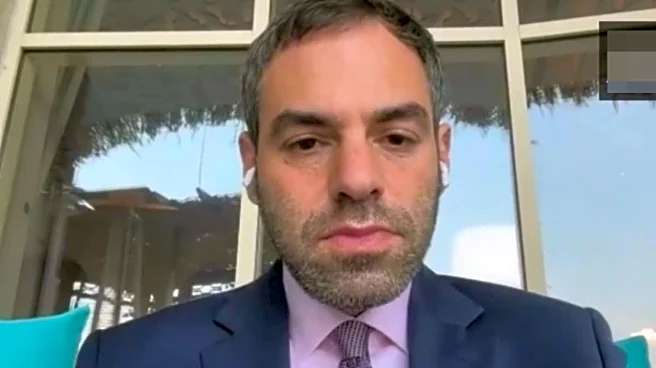

South Asia analyst Michael Kugelman described Russian President Vladimir Putin’s visit to India as “successful” and strategically significant, underlining both its timing and geopolitical implications.
Speaking on the visit, Kugelman noted that this was Putin’s first trip to India in four years since Russia’s invasion of Ukraine, making it particularly noteworthy against the backdrop of ongoing global tensions.
He said the visit came at a “precarious moment,” with India facing sustained pressure from Western countries, especially the United States, to scale back its energy imports from Russia.
According to Kugelman, the meeting between the two leaders sent a clear message that despite mounting Western pressure, the India-Russia relationship continues
to endure.
“It was important for these leaders to show that even in the face of a lot of pressure from the West, this is a relationship that will endure,” he told ANI, highlighting the resilience of bilateral ties amid shifting global dynamics.
Commenting on the joint statement issued after the 23rd India–Russia Annual Summit, Kugelman said the document was notably expansive and reflected the broad scope of bilateral cooperation.
He noted that the statement covered a wide range of areas, including military ties, energy, commercial collaboration and infrastructure. He pointed out that while energy remains one of the most significant and challenging aspects of the relationship, it is equally important for both countries to explore and strengthen other areas of commercial engagement.
“It was indeed quite expansive, which is not a surprise. It highlighted all types of areas of cooperation, from military cooperation, energy and many other aspects of commercial collaborations, as well as infrastructure. Energy is where one of the biggest challenges lies in the relationship. It is important that the two countries look for other aspects of commercial ties to focus on,” he said.
Speaking on the Russian President’s message on oil, Kugelman said the remarks were carefully calibrated for both Indian and Western audiences. He noted that India needs to be particularly cautious in how it engages with Russia on energy in the near term, given the geopolitical sensitivities surrounding the Ukraine conflict.
“It was meant for both Indian and western audience. India has to be very careful about how it engages with Russia on energy level, especially for the immediate term. This will be a challenge for India only so long as the war (Ukraine-Russia) continues,” he said.
On the future of India–Russia ties, Kugelman said the relationship is at a challenging moment amid sustained pressure from the West and India’s recent reduction in imports from Russia.
“With all the pressure coming from the West, it is but of a challenging moment with all the pressure coming from the West and the fact that India has for now, reduced imports from Russia… One could look at the security aspects of the relationship where we’ve seen some delays in getting Russian military equipment to India,” he said.
He pointed to security as another sensitive area, noting delays in the delivery of Russian military equipment to India.
“Energy and arms have been the key aspect of the relationship between the two. India has been trying to increase its access to Central Asia and Russia can be of help in this. China has its own influence in Central Asia. Pakistan has been trying to increase its own access to Central Asia. So with India working with Russia, its good friend, Russia could perhaps help advance India’s goals in that region,” Kugelman added.
Kugelman further said that despite India’s close engagement with Russia, there remains a strong desire in Washington to continue working with New Delhi.
Referring to the Indo-Russia Summit, he said the meeting served as a reminder to the West that Russia cannot be fully isolated, as major global players like India and China continue to maintain close ties with Moscow.
“In Washington, there is a desire to continue to work with India. This Summit was the latest reminder to the West that Russia cannot be isolated. India and China – two of the most critical global players are closed to Russia. This is not going to change the close partnership of India with the countries in the West,” he said.
“One of the big priorities for India’s foreign policy is to get a trade deal with the EU. Even in the US, I think that in Washington there is a desire to continue to work with India, despite everything that’s going on, and this visit by Putin,” Kugelman added.
(With inputs from ANI)

/images/ppid_a911dc6a-image-177105042575465447.webp)

/images/ppid_a911dc6a-image-177105033328862095.webp)
/images/ppid_a911dc6a-image-177105037137039801.webp)



/images/ppid_59c68470-image-177105003415990657.webp)

/images/ppid_59c68470-image-177105003432353455.webp)
/images/ppid_a911dc6a-image-177104902795770968.webp)