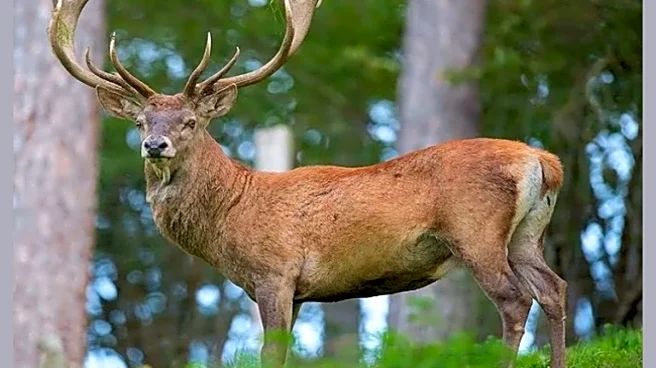

Once teetering on the edge of extinction, the Hangul or Kashmir stag — the only surviving red deer species in the Indian subcontinent — is making a slow but hopeful comeback.
At the 6th meeting of the Jammu
and Kashmir Union Territory Wildlife Board, chaired by Lieutenant Governor Manoj Sinha at Lok Bhavan on Monday, officials reported that the Hangul population has increased from 127 in 2008 to 323 in the 2025 census.
Native to the dense forests of Dachigam National Park and adjoining areas, the Hangul’s numbers had plummeted over the decades due to poaching, habitat loss, and fragmentation caused by human encroachment and livestock grazing. Years of armed conflict in the Valley further disrupted conservation efforts, pushing the species to the brink.
The Hangul, scientifically known as Cervus hanglu hanglu, is the only surviving subspecies of the Red Deer in India. The first efforts to save the species began in the 1970s, when Dachigam was declared a national park.
The meeting reviewed the successful operationalization of the Hangul Breeding Centre at Tral of south Kashmir, a flagship conservation project that aims to strengthen breeding efforts and reintroduce the species into the wild. Officials also shared ongoing measures to restore degraded habitats and reduce human-wildlife conflict, a major challenge in the region.
Wildlife SOS notes that from a population of almost 5000 in the early 1900s, the number of Kashmir stags dropped drastically to about 180 in 1968. Their numbers have been fluctuating ever since; however, since 2017, a gradual rise has been noted.
The modest rise in Hangul numbers may signal a turning point for Kashmir’s ecological identity, though long-term success will depend on continued protection of Dachigam and its fragile corridors that connect to the species’ historical range.
Lieutenant Governor Sinha commended the Forest and Wildlife Department for their sustained efforts and called for the promotion of eco-tourism and wildlife education, especially among school children, to build awareness about the UT’s rich biodiversity. He stressed the importance of balancing development with ecological preservation.



/images/ppid_a911dc6a-image-177073422588955268.webp)

/images/ppid_a911dc6a-image-177073406474645209.webp)
/images/ppid_a911dc6a-image-177073412509241364.webp)
/images/ppid_a911dc6a-image-177073402755726223.webp)
/images/ppid_a911dc6a-image-177073406528147283.webp)
/images/ppid_a911dc6a-image-177073402422810189.webp)