


/images/ppid_a911dc6a-image-177107322672112787.webp)
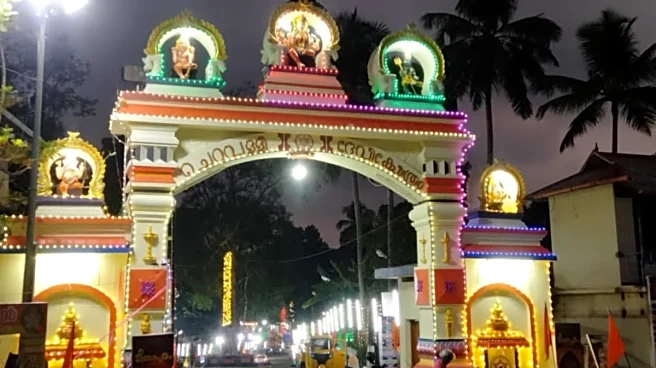
In a country with thousands of gods, there is a temple where the deity is a real judge who lived in the 18th century. At the Cheruvally Devi Temple in Kerala’s Kottayam district, devotees worship ‘Judgiyammavan’ (Judge Uncle), believed to address the prayers of thousands seeking solace in legal troubles, especially court cases.
Though the main deity of the temple, which is under the Travancore Devaswom Board (TDB), is Bhadrakali, devotees — including celebrities from across the south and even members of the judiciary — visit the temple to worship Judgiyammavan.
This time, the temple has come into the spotlight after actor Dileep, who was accused in the 2017 actor assault and rape case, was acquitted by the court on December 8, 2025. Dileep, along
with his brother, had visited the temple in 2019 with offerings after the case was registered against him.
Legend
Nearly two centuries ago, the region of erstwhile Travancore was ruled by Karthika Thirunal Rama Varma, also known as Dharma Raja (the Just King). His reign, from July 7, 1758, to February 17, 1798, was the longest in Travancore’s history. He earned the title for his judicial prudence, following ancient justice and legal systems to govern the state.
The king was ably assisted by a judge at the royal court named Govinda Pillai, who belonged to Ramavarmath in Thalavady near Thiruvalla. A Sanskrit scholar, Govinda Pillai, like the ruler, strictly adhered to the principles of law and justice.
Once, Govinda Pillai’s nephew, Padmanabha Pillai, became accused in a case that came before his uncle’s court. After examining all the evidence and arguments, the judge concluded that his nephew was guilty and, considering the gravity of the crime, sentenced him to death.
However, soon after the hanging, Govinda Pillai received the shock of his life when he realised that his nephew was, in fact, innocent and that his judgment had been flawed.
Overcome with guilt for sentencing his own nephew to death, Govinda Pillai requested the king to punish him. Though the king initially refused, he eventually agreed — but assigned the responsibility of deciding the punishment to Govinda Pillai himself.
The severe punishment Govinda Pillai chose was to have both his feet chopped off and to be publicly hanged. He also decreed that his body should remain hanging at the same spot for three days. The order was carried out.
Some time later, several bad omens were reported in the area, prompting a consultation with an astrologer. According to the astrologer, the souls of both the judge and his nephew were wandering without attaining moksha. As a result, the judge’s soul was entombed at his family house at Payyambally in Cheruvally, while the nephew’s soul was installed at a temple in Thiruvalla, around 50 km away.
Later, an idol of Judgiyammavan was installed at the Cheruvally Devi Temple. In 1978, the descendants of the judge built a sanctum sanctorum for the idol outside the main shrine, within the temple courtyard.
When to visit?
The shrine is open for only about 45 minutes each day. The rituals begin around 8 pm, after the main Bhadrakali shrine is closed. ‘Ada’ — a snack made from raw rice flour, sugar or jaggery, and grated coconut — is the main offering. Another offering includes tender coconut, betel leaves and areca nut.
Where is the temple?
The temple is located at Cheruvally, between Ponkunnam and Manimala, on the Punalur–Muvattupuzha Highway. The nearest railway station is Kottayam, about 37 km away.
/images/ppid_59c68470-image-177107752663443042.webp)






/images/ppid_a911dc6a-image-177107705051568684.webp)

/images/ppid_59c68470-image-177107504779557732.webp)
/images/ppid_59c68470-image-177107504945830607.webp)