
/images/ppid_59c68470-image-178204253159667153.webp)
/images/ppid_a911dc6a-image-178204255847334966.webp)
/images/ppid_a911dc6a-image-178204252611698949.webp)


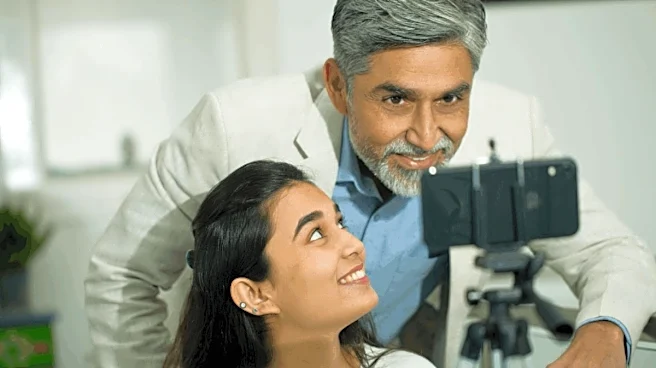
There is something uniquely tender about explaining the internet to your parents. Not because they aren’t curious, but because the world their children inhabit often looks nothing like the one they grew up in. For many fathers who spent decades believing in degrees, stable salaries and conventional career paths, “content creator” wasn’t a profession they had imagined for their children. It was something abstract, until suddenly, it wasn’t.
This Father’s Day, several creators are reflecting on the quiet, unforgettable moments when their dads finally understood what they did for a living. And, perhaps more importantly, when pride quietly replaced uncertainty.
When Success Became Tangible
For Sakchi Jain, whose finance content has earned her a place on the Forbes Asia 30 Under
30 list, the journey towards parental understanding happened in stages.
Her father had always been supportive, but making finance videos online wasn’t exactly something he could easily explain to friends or relatives. Things started changing when she received her first brand payment.
“That was the moment it stopped feeling like a hobby and started feeling like a real career,” she recalls.
But the real shift came later, when her name appeared on the Forbes Asia 30 Under 30 list. Calls from neighbours, relatives and old friends poured in.
“Hearing it from others made it click in a way that my explanations never did,” she says. “He’s not someone who expresses things loudly, but I could see the pride on his face. That moment meant everything to me.”
A Viral Reel Became a Father-Son Memory
For digital lifestyle and fashion creator Pranjal Nehete, understanding arrived in the most unexpected way, through a viral reel featuring his father himself.
Inspired by Samay Raina’s “I Love You Dad” trend, Pranjal included his dad in a video that quickly crossed millions of views.
“For the first time, he wasn’t just hearing about what I did, he was a part of it,” says Pranjal.
The conversations at home changed after that. They were no longer about likes and views, but about opportunities, brand partnerships and the future of the creator economy.
“Seeing him proud of it meant more than any number on the screen.”
“Your Video Is Going Viral!”
For Aryana Dalal, host of The Having Said That Show, support was never lacking, understanding simply took a little longer.
Her parents watched every podcast episode, often wondering whether any of it actually made money. Then one day, a reel began taking off.
“The first time he came to me and said, ‘Your video is going viral!’ was when he saw it being shared on X,” she says.
Even today, her father remains delightfully old-school. He constantly reminds her to save money and is perpetually puzzled by the steady stream of packages arriving from brands. Yet he’s also her biggest supporter, liking her reels, commenting on videos and happily making appearances whenever she asks.
Twenty Thousand People Listen to You?
For Aishwarya Kandpal, the moment was equal parts hilarious and heartwarming. In 2022, while still working a full-time job as a creative director and producer, she had quietly built a community around acne positivity and skincare.
During a visit home, she casually showed her father her Instagram page.
“So you’re saying 20,000 people listen to you?” he asked in disbelief.
She remembers trying to explain social media to him as though “explaining electricity to someone who had just discovered it.”
But what moved him wasn’t just the numbers.
“He realised my videos were actually helping people,” she says.
Eventually, Kandpal left her corporate career to become a full-time creator. For a father who had always valued stability above all else, his unwavering support became the greatest validation. “Not once did he ask me to play it safe.”
From Chartered Accountancy to Content Creation
For Ansh Dhote, convincing his father required an unconventional journey. He had pursued CA, then ACCA, even clearing eight papers before accepting that his heart lay elsewhere.
Initially, his father viewed content creation as a hobby and hoped his son would eventually return to a traditional career.
Everything changed when brands began reaching out.
“I remember showing him my first paid collaboration and explaining that this was something I had built myself,” says Ansh.
Today, his father proudly tells relatives that his son is a content creator.
“That acceptance means more to me than any number on a payslip.”
“I Met Your Follower on the Train”
Perhaps the sweetest story comes from creator Sanika Dewade. One day, her father came home smiling.
“Mala tujha follower bhetla aaj train madhe,” he told her. Translation: I met your follower on the train.
For Sanika, the moment was unexpectedly emotional.
“He uses the word ‘follower’ to mean anyone who remotely knows I exist,” she laughs.
But the interaction meant something deeper.
“The person didn’t just recognise me. They recognised Baba as Sanika’s father too.”
And that, she says, was the day her father truly understood that the videos she made weren’t disappearing into the void.
The Language of Pride
Fathers don’t always say, “I’m proud of you.” Sometimes, they ask if you’ve saved enough money.
Sometimes, they wonder why strangers recognize you in trains.
Sometimes, they watch every episode of your podcast without understanding how it pays the bills.
And sometimes, they simply tell relatives, with unmistakable pride in their voice, “My daughter is on Forbes.”
Perhaps that’s what makes these moments so meaningful. Not because their fathers suddenly understood algorithms, brand deals or follower counts. But because, in understanding what their children had built, they saw something much simpler.
They saw joy. They saw purpose. And they saw their children creating lives they loved.


/images/ppid_a911dc6a-image-178204522643322529.webp)

/images/ppid_a911dc6a-image-178204526958999423.webp)