
/images/ppid_59c68470-image-178114753548543602.webp)



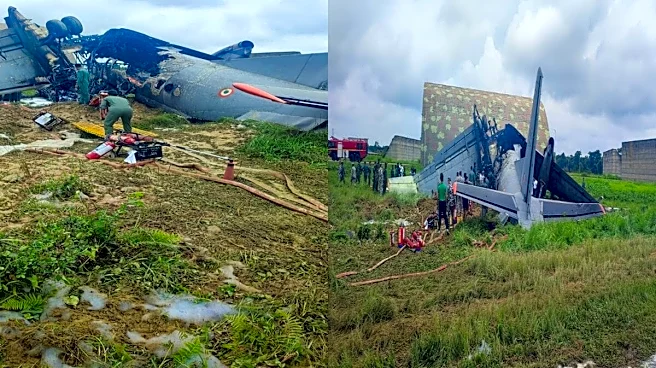
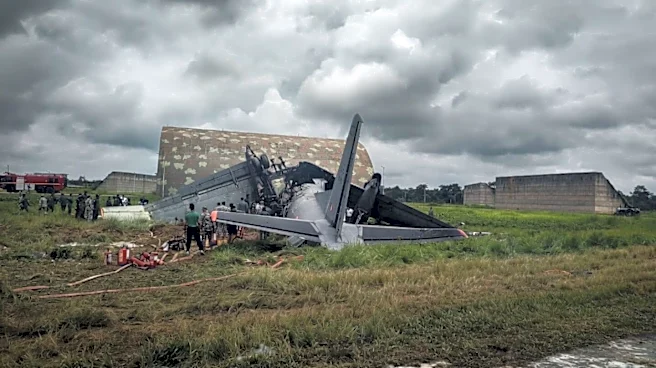
An Indian Air Force AN-32 transport aircraft crashed while landing at Air Force Station Jorhat in Assam on Saturday. Sources said the pilot was feared dead, while details about other crew members aboard the aircraft were not immediately available.
Emergency teams have been rushed to the crash site, and further details are awaited.
The incident has drawn attention to the AN-32, a twin-engine turboprop aircraft that has served the IAF for more than four decades. Used to transport troops, equipment and essential supplies, it remains an important part of military operations in remote and high-altitude regions.
What Is The AN-32?
The Antonov AN-32 is a medium military transport aircraft developed in the erstwhile Soviet Union. It is based on the Antonov AN-26
but was fitted with more powerful engines and modified to operate in hot weather and at high altitudes.
The aircraft was developed specifically for Indian requirements after the IAF sought a transport plane capable of operating in the country’s varied climatic and geographical conditions. India was its launch customer, and the first AN-32 aircraft entered IAF service in the 1980s.
The IAF operates a fleet of around 100 AN-32 aircraft, according to NDTV.
Its engines are mounted above the wings, providing greater ground clearance and reducing the risk of debris entering them while the aircraft operates from rough or semi-prepared airstrips.
Why Is It Called The IAF’s ‘Workhorse’?
The AN-32 is used to transport military personnel, equipment and essential supplies, particularly to remote regions.
The aircraft can carry up to 7.5 tonnes of cargo, around 50 passengers or 42 paratroopers. It is also extensively used for supply drops in areas that are difficult to access.
Designed to operate from high-altitude airfields and in hot tropical conditions, the AN-32 is suited to India’s varied terrain and climate.
Why Is The AN-32 Still In Service?
The IAF had initiated a programme in 2009 to upgrade its entire AN-32 fleet. Some aircraft were upgraded in Ukraine, while the remaining work was to be carried out by the IAF’s No. 1 Base Repair Depot in Kanpur. According to a 2024 report in The Tribune, Defence Minister Rajnath Singh had told Parliament that half of the AN-32 fleet had been upgraded.
The IAF has also drawn up a roadmap to overhaul 60 AN-32 aircraft by the end of the 2028-29 financial year. Parts of the repair and overhaul process are to be outsourced to private industry, while the work will be carried out at the Kanpur repair depot, according to The Tribune report.
The planned overhaul includes structural repairs, refurbishment and studies to extend the technical life of airframes and components beyond 40 years.
AN-32’s History Of Accidents
The IAF has lost several AN-32 aircraft in accidents over the years.
- On June 3, 2019, an AN-32 carrying 13 personnel disappeared shortly after taking off from Jorhat for the Mechuka Advanced Landing Ground in Arunachal Pradesh. Its wreckage was found after an extensive search on a mountain slope in Arunachal Pradesh. All 13 personnel aboard were killed.
- In July 2016, an AN-32 carrying 29 people disappeared while flying from Chennai to Port Blair. The aircraft could not be located despite a major search operation. A Court of Inquiry later concluded that those aboard were “presumed dead”.
- In June 2009, an AN-32 crashed near Rinchi Hill, around 30 km from the Mechuka Advanced Landing Ground in Arunachal Pradesh. All 13 defence personnel aboard were killed.
- Another AN-32 crashed at the Vijaynagar Advanced Landing Ground in Arunachal Pradesh in February 2000.
- In March 1999, an AN-32 crashed near Delhi’s Palam airport, killing 21 people aboard. The accident also caused casualties on the ground.
- In 1992, two AN-32 aircraft collided in mid-air during formation flying.

/images/ppid_a911dc6a-image-178133282743131334.webp)

/images/ppid_a911dc6a-image-178117242588999231.webp)

/images/ppid_a911dc6a-image-178133022345811984.webp)
/images/ppid_a911dc6a-image-178117701590777312.webp)