
/images/ppid_59c68470-image-17699200718365651.webp)
/images/ppid_59c68470-image-176992017048391626.webp)
/images/ppid_59c68470-image-17699201045602338.webp)
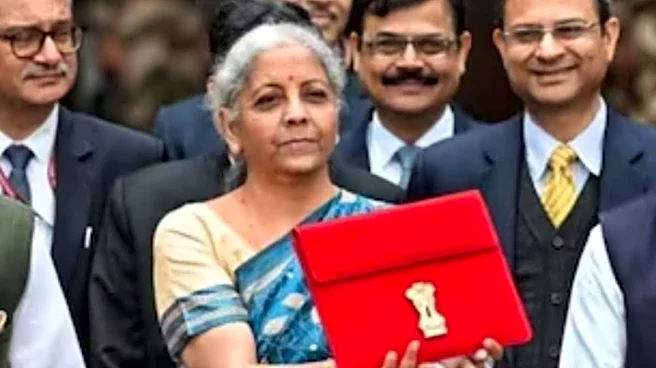
Union Budget 2026 Live Updates: As India awaits Finance Minister Nirmala Sitharaman’s ninth Union Budget, the usual atmosphere of expectation has set in, accompanied by the confidentiality that marks every Budget season.
The document is drafted inside secure offices, with officials barred from carrying devices and movement inside key areas of the finance ministry heavily restricted.
The elaborate confidentiality surrounding the Budget is not new; it has been part of the exercise for decades. But what often goes unnoticed is that the Budget has, in fact, been leaked before, not once but twice in India’s early years.
Those incidents, separated by just three years, occurred in 1947 and 1950.
The 1947 Budget Leak
India’s first Budget after Independence
was set to be presented on 26 November 1947. Finance Minister Sir R K Shanmukham Chetty was preparing to outline the financial plans for the period from 15 August 1947 to 31 March 1948, with the speech scheduled for 5 pm so that counterparts in Britain could follow it easily.
But before Chetty could begin, the proposals had already appeared in the press abroad. The leak took place in London, where the United Kingdom’s Chancellor of the Exchequer, Hugh Dalton, disclosed key tax changes to a Daily Star journalist, John Carvel, while walking to the House of Commons.
According to a report by The Guardian, Dalton told Carvel: “No more on tobacco; a penny on beer; something on dogs and pools but not on horses; increase in purchase tax, but only on articles now taxable; profits tax doubled.”
Carvel published the information within roughly twenty minutes, causing a political uproar. Dalton apologised and resigned shortly afterwards.
Although the leak did not originate in India, it remains one of the two instances in which Budget details entered the public domain ahead of time.
The 1950 Budget Leak
The second leak occurred in 1950, during the tenure of Finance Minister John Matthai. At the time, the printing of Budget papers took place inside Rashtrapati Bhavan, the official residence of the President of India. The arrangement had functioned without incident in previous years.
In January 1950, however, pages from the Budget were leaked while the document was being printed. The disclosure created considerable unease, as Budget papers contained sensitive information on proposed taxes and expenditure. Matthai, the second finance minister of the country, faced criticism and was accused of allowing the interests of influential groups to shape or access confidential details. He later resigned.
This episode prompted a major administrative shift. To prevent such breaches, the government moved Budget printing out of Rashtrapati Bhavan and transferred it to a government press on Minto Road in Delhi. The location remained in use until 1980, when printing was shifted again to the basement of the Secretariat Building in Delhi’s North Block, where it continues today.
How Secrecy Operates Today
The secrecy surrounding Budget today is the product of long-established procedures that have hardened with time and technological change.
As the presentation date approaches, the finance ministry gradually enters a quarantine-like phase. Weeks before the Budget is announced, parts of the ministry are placed out of bounds for visitors and the media, and only authorised personnel are permitted near the offices where drafting is taking place.
Around 15 days before the presentation, corridors inside North Block begin to be patrolled by the Central Industrial Security Force and the Intelligence Bureau. Their presence is meant to prevent any unauthorised movement inside the areas where the Budget is being prepared. Officials directly involved in the process work in controlled rooms, do not leave the premises, and are not allowed to meet their families. They are placed under quarantine during this period.
If an emergency arises, families can leave a message on a number provided to them, but they cannot speak to the officials directly. Only the finance minister is permitted to visit the quarantined team.
Devices are also tightly controlled. The phones of those involved in preparing the Budget are tracked by an intelligence team, and access to personal communication is restricted. This prolonged period of isolation is intended to prevent any flow of information before the formal announcement in Parliament.
Printing remains one of the most tightly held stages of the exercise. The finance minister’s speech is the most closely guarded part of the document and is given to the printers only two days before Budget Day. Until that moment, it remains secured, accessible only to a limited set of officials. Any leak of Budget documents remains punishable under the Official Secrets Act.
These practices have become an annual ritual, even as some question whether such extensive confidentiality is still required at a time when major policy announcements often occur outside the Budget. Others argue that the potential impact of even minor fiscal changes means that the document must remain confidential until the moment it is presented.
/images/ppid_a911dc6a-image-176992485794410172.webp)



/images/ppid_59c68470-image-176992259573993206.webp)

/images/ppid_59c68470-image-176992252892464227.webp)
/images/ppid_59c68470-image-176992256174895979.webp)
/images/ppid_59c68470-image-176992263464464618.webp)
/images/ppid_59c68470-image-17699225649165937.webp)


