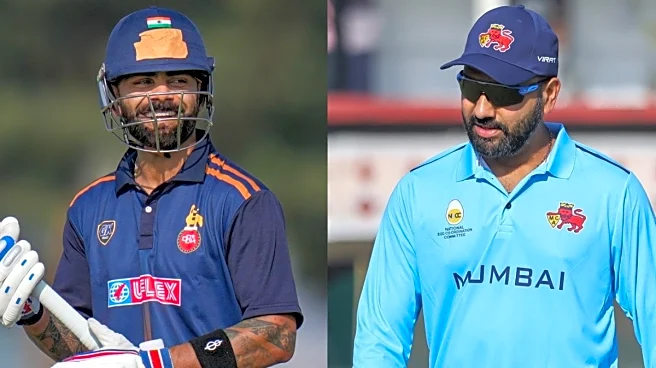

Ace Indian batter Virat Kohli and Rohit Sharma featured in the first two rounds of the Vijay Hazare Trophy earlier this week, a spectacle that drew thousands of fans to the grounds, with some even hanging
on to trees to get a glimpse of their favourite cricketers.
Though the tournament does not match the glamour or financial scale of IPL, it remains a cornerstone of India’s domestic white-ball cricket.
The participation of Rohit and Kohli has not only spotlighted the games but also raised discussions about the competition’s structure and player remuneration.
Unlike the IPL, where salaries are determined through auctions, Vijay Hazare Trophy earnings follow a structured framework. For the 2025-26 season, match fees are set as per a tiered system based on a cricketer’s number of List A appearances.
In the Vijay Hazare Trophy, experience, rather than star power, dictates pay, placing veterans like Kohli and Rohit in the top-earning bracket.
Cricketers with more than 40 List A games fall into the senior category, earning Rs 60,000 per match in the playing XI and Rs 30,000 if listed as a reserve.
Players with 21 to 40 List A games fall into the mid-level category, earning Rs 50,000 per match in the playing XI and Rs 25,000 as reserves. The junior category, for cricketers with up to 20 List A appearances, receives Rs 40,000 per match when playing and Rs 20,000 when on the bench.
This season, Kohli for Delhi and Rohit for Mumbai earn the same match fees as other experienced domestic cricketers. Having gone past 40 List A matches, both are classified as seniors and receive Rs 60,000 per game.
This amount pales in comparison to their international pay, with the BCCI awarding Rohit and Kohli Rs 6 lakh per ODI.
Match fees are not the only earnings in the Vijay Hazare Trophy. Cricketers also get daily allowances to cover travel, meals and accommodation throughout the tournament.



/images/ppid_59c68470-image-177100753350744656.webp)

/images/ppid_a911dc6a-image-17710070301901476.webp)

/images/ppid_a911dc6a-image-177100572282276854.webp)