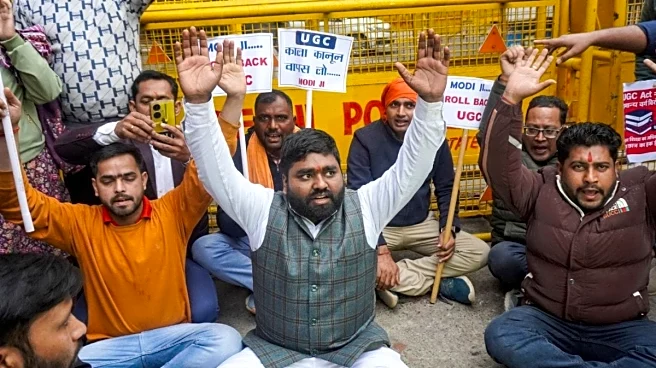



The decision of the University Grants Commission (UGC) to notify a fresh set of rules to arrest caste-based discrimination in colleges and universities has triggered massive pan-India protests, with several sections raising concerns over the possibility of the rules being misused and the absence of a provision to penalise false complaints.
What Do The Guidelines Say?
On January 13, UGC—an autonomous statutory body established by the government under the Ministry of Education—notified a fresh set of rules titled the “Promotion of Equity in Higher Education Institutions Regulations, 2026”, making it compulsory for all higher education institutions to set up Equal Opportunity Centres, Equity Committees, and 24/7 grievance helplines to deal with complaints
of discrimination—particularly for students belonging to the SC, ST and OBC categories.
The UGC’s Promotion of Equity Regulations apply to every stakeholder within an institution—students, teaching and non-teaching staff, as well as administrative authorities. The rules define discrimination broadly, encompassing not only overt acts but also subtle or indirect practices that undermine equal treatment or infringe upon human dignity. The regulations place particular focus on protecting members of Scheduled Castes, Scheduled Tribes, Other Backward Classes, Economically Weaker Sections, and persons with disabilities.
Institutions are required to put in place systems to receive, record and address complaints related to discrimination. Regular monitoring and internal reporting mechanisms are mandatory under the regulations.
The regulations are legally binding, and institutions that do not comply may face consequences, including refusal of approval for academic programmes, ineligibility for UGC funding schemes, or withdrawal of institutional recognition.
Why Did UGC Issue The Guidelines?
In recent years, complaints of caste-based discrimination in higher education institutions have risen sharply, with UGC data showing a 118.4 percent increase in such cases over the past five years. In response to judicial directions and growing concerns about student welfare, the commission has highlighted persistent upper-caste dominance in educational institutions, noting that while SC-ST reservations are constitutionally mandated and OBCs have benefited from reservations in admissions since 1990 and in recruitment since 2010, their overall participation remains below 15 per cent. The regulations seek to address these disparities and strengthen mechanisms to prevent discrimination across higher education.
Why Has The Move Triggered Protests?
According to critics, the new rules discriminate against General Category students, positioning them as potential perpetrators of harassment.
The regulation has drawn criticism over what some see as an imbalance between swift enforcement and procedural fairness. While it places strong emphasis on speed, compliance and responsiveness, questions have been raised about the adequacy of safeguards, clarity of processes and guarantees of due process. Critics argue that the framework does not sufficiently account for the possibility of false or malicious complaints and the consequences such allegations can have for those accused.
Although the regulation allows an aggrieved party to appeal a committee’s findings within 30 days, with the Ombudsman required to decide the appeal within a further 30 days, it does not clearly spell out penal consequences for proven false complaints. This, protesters say, leaves room for misuse and creates apprehensions about fairness and protection for all parties involved, particularly in the absence of explicit evidentiary or accountability provisions.
What is worrying is that the rules acknowledge that discrimination can affect individuals of any gender, but leave significant gaps when it comes to caste neutrality. It does not adequately recognise that students from the general category can also face discriminatory treatment. Critics point out that the framework places a heavy burden on the accused, as a complainant is not clearly required to establish proof of discrimination, effectively shifting the onus onto the respondent to demonstrate innocence.
Sections of the general category students have also raised their voice against the rule that states the equity committees will have representation only from reserved categories, pointing to a kind of “reverse bias”.
Concerns have also been raised about the grievance redressal mechanism, which is seen as insufficiently independent. Considerable authority rests with the institution itself, as the head of the institution is responsible both for constituting the Equity Committee and for acting on its recommendations, raising questions about impartiality and checks and balances.
Political Storm Triggered
The controversy assumed a political hue after Senior Divisional Magistrate in Uttar Pradesh, Alankar Agnihotri, as well as BJP’s Yuva Morcha Noida vice-president Raju Pandit resigned from their positions, calling the policy “discriminatory”.
Shyam Sundar Tripathi, the district president of the BJP’s Kisan Morcha in Salon (Rae Bareli), also wrote a letter to Prime Minister Narendra Modi and resigned from his party post. Speaking to ThePrint, he said: “I have resigned from my post as a mark of protest. I am still a primary member of the party, but the regulations that have been introduced are completely unjust and against the general category students.”
Devendra Pratap Singh, a senior Uttar Pradesh Legislative Council member, also objected to the regulations. In a letter to UGC on January 22, he warned that the move could “fracture social harmony and intensify caste conflict” across the country.
Several media reports also said Mrigendra Upadhyay from Balrampur in Uttar Pradesh, yet another BJP leader, had resigned, terming the UGC norms anti-Brahmin and against the general category.
Rajput organisation Karni Sena, which alleged that the rules had been brought to suppress the ‘Savarna’ society, threatened to launch large-scale protests if the regulations are not rolled back.
All Sections Step In
Not just politicians but experts working in the field of education have also called out the rules, saying safeguards for general category students had been overlooked.
Urging UGC and PM Modi to take a relook at the rules, author Anand Ranganathan said the definition of caste discrimination excludes the general category and there is no provision for penalising false complaints. Financial expert Mohandas Pai called the regulations “draconian” and sought their withdrawal. Critics have also cited suicide data indicating near-equal numbers among students from general and reserved categories, arguing that harassment is not confined to any one group. They warn that if grievances are handled without adequate balance and safeguards, university campuses risk turning into spaces of fear rather than learning, affecting students across communities.
Author and poet Kumar Vishwas, sharing a poem by late poet Ramesh Ranjan on X, underlined the anxiety and anger felt by sections of society: “Chahe til lo ya taad lo raja, raai lo ya pahad lo raja, main abhaga ‘savarn’ hoon mera, rounya rounya ukhad lo raja”.
Social Media Anger
The hashtag #ShameOnUGC gained traction on social media as students and users voiced opposition to what they termed uneven enforcement and inadequate consultation before the rules were notified. Reports have also emerged of campus protests in parts of Uttar Pradesh, Rajasthan and Bihar.
Some critics have flagged the broad and loosely defined language used in the regulations, particularly around terms such as “discrimination”, arguing that it creates ambiguity about what actions may be penalised. The pushback has also moved to the courts, with a Public Interest Litigation (PIL) filed in the Supreme Court, seeking a review of, or a stay on, the implementation of the regulations.
Government Steps In
Concerned over the protests both within and outside the party, BJP MP Nishikant Dubey took to X to allay fears. “Modi ji, on becoming the prime minister, secured recognition from the Supreme Court for the upper caste society and provided 10 percent reservation – this is the truth,” he posted on January 24.
Dubey reiterated the point in multiple posts on X and questioned the “misunderstanding” being created. “Rest assured, the UGC’s rule will apply equally to Scheduled Castes, Scheduled Tribes, Backward Classes, as well as the general category. This is not politics; the country runs on the Constitution of Babasaheb Ambedkar ji.”
“Modi hai toh mumkin hai. All misconceptions regarding the UGC notification will be cleared. According to Articles 14 and 15 of the Constitution, there is no difference between the Scheduled Castes, the Scheduled Tribes, the Backward Classes, and the General Category,” he wrote on X on Sunday.
The Ministry of Education is also preparing to address the “misconceptions” regarding the new UGC rules. Sources said the government is working to ensure that all relevant facts about these rules are made available to the public.




/images/ppid_a911dc6a-image-177092774715746114.webp)

/images/ppid_a911dc6a-image-177092767520012684.webp)
/images/ppid_a911dc6a-image-177092763347449403.webp)
/images/ppid_a911dc6a-image-177092652580356823.webp)