


/images/ppid_59c68470-image-177003502744159629.webp)
The Mahabharata
is regarded as one of India’s greatest epic poems. Beyond its tales of war and destiny, it preserves India’s philosophical traditions, many of which remain relevant even today. Concepts discussed in this ancient text continue to influence modern thinking, including recent initiatives such as Madhya Pradesh’s decision to introduce Garbh Sanskar rooms in hospitals and related studies in universities.This initiative, known as the Divya Santan Project or the Abhimanyu Experiment, focuses on shaping and empowering future generations.
What Is ‘Garbh Sanskar’ And Why Is It Being Discussed Today?
Garbh Sanskar refers to the belief that a mother’s thoughts, emotions, conversations and experiences during pregnancy influence the mind, intelligence and personality of the unborn child.
Indian philosophical
texts such as the Mahabharata, the Upanishads and Ayurvedic literature clearly state that a child in the womb can hear, understand and be affected by the mother’s mental state. Among all such references, the story of Abhimanyu is considered the most authentic and powerful example of Garbh Sanskar.
The Mahabharata: More Than War And Religion
The Mahabharata is not merely a narrative of religion or battle. It is a profound exploration of human consciousness, moral values and the evolution of knowledge in Indian civilisation. One of its most intriguing episodes is the story of Garbh Sanskar linked to Abhimanyu’s understanding of the Chakravyuh, a tale that continues to highlight the importance of mental and intellectual development during pregnancy.
Lord Krishna, the king of Dwarka, was the central guiding force of the Mahabharata. His sister Subhadra was married to Arjun, the greatest archer and military strategist among the Pandavas. Their son was Abhimanyu, whose destiny would later become one of the most tragic chapters of the epic.
What Was The ‘Chakravyuh’?
In the Mahabharata war, the Chakravyuh was an extremely complex military formation arranged in circular layers. While it was possible to identify the entry point, escaping from it was extraordinarily difficult.
Only a few exceptional warriors, including Arjun and Krishna, possessed complete knowledge of both entering and exiting this formation.
Learning Inside The Womb
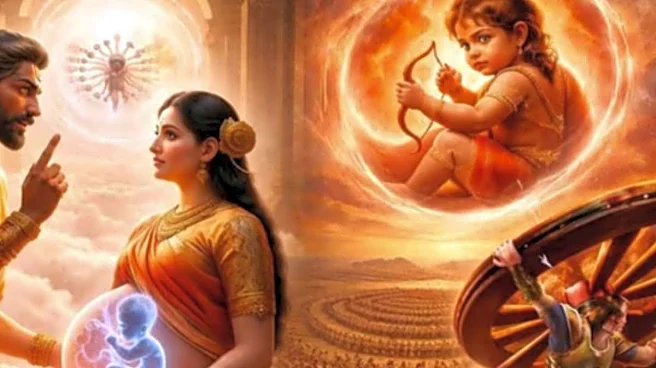
Soon after Arjun and Subhadra’s marriage in Dwarka, Subhadra became pregnant. During this time, an incident occurred that would later shape the course of the war. According to the Mahabharata, one day Arjun began explaining the strategy of entering the Chakravyuh to his pregnant wife. Subhadra listened attentively as he described the layers, directions and tactics involved.
What no one realised was that the unborn Abhimanyu was also listening from within the womb.
The Moment That Changed Destiny
The turning point came when Arjun was about to explain how to exit the Chakravyuh. At that moment, Subhadra fell asleep. Believing she was no longer listening, Arjun stopped his explanation. It is believed that while Subhadra slept, the unborn Abhimanyu remained awake. As a result, he learned how to enter the Chakravyuh but never learned how to come out. This incomplete knowledge would later prove fatal.
After nine months, Abhimanyu was born with remarkable qualities. From a young age, he showed exceptional skill in weaponry, intelligence and fearlessness, along with a natural understanding of warfare.
Arjun and Krishna recognised his brilliance but were also aware of the limitation in his knowledge.
The Thirteenth Day Of The War
On the 13th day of the Mahabharata war, the Kaurava army formed the Chakravyuh to trap the Pandavas. Arjun was deliberately kept away from the battlefield, and the remaining Pandavas were unable to penetrate the formation. In this desperate situation, Abhimanyu stepped forward.
Although Yudhishthir and Arjun knew that Abhimanyu could enter the Chakravyuh but not exit it, the circumstances of war left them with no other choice.
Courage Against All Odds
Abhimanyu single-handedly broke into the Chakravyuh and fought bravely, defeating several great warriors. His valour astonished figures such as Dronacharya, Karna, Ashwatthama and Kripacharya.
However, as the battle progressed, Abhimanyu was isolated and left without support inside the formation.
A Grave Injustice
In a blatant violation of the rules of war, multiple Kaurava warriors attacked Abhimanyu together. Surrounded and overpowered, the 16-year-old warrior was brutally killed.
His death is remembered as one of the greatest acts of injustice in the Mahabharata.
Deeper Message Of ‘Garbh Sanskar’
The story of Abhimanyu carries profound lessons:
- Knowledge gained in the womb can have lasting effects, but incomplete knowledge can be dangerous.
- Courage and talent alone are not enough; complete understanding is essential.
- The Mahabharata also emphasises the importance of a mother’s mental state, with Subhadra’s moment of sleep becoming a decisive factor in Abhimanyu’s fate.
Even today, practices such as positive communication, music, mantras and mental balance during pregnancy are encouraged. Abhimanyu’s story offers historical and cultural support to the concept of Garbh Sanskar in Indian tradition.
A Lesson That Begins Before Birth
The Garbh Sanskar narrative of the Mahabharata is not merely a mythological tale. It reflects a deep understanding of knowledge, consciousness and human development. Abhimanyu’s life demonstrates the power of words, thoughts and values, reinforcing the idea that preparation for life does not begin after birth, but within the womb itself.