


‘Parivartanmev Sthiramasti’, meaning change is the only constant, is one of the core sutras of the Bharatiya Knowledge Tradition. The Upanishads, the Bhagavad Gita, and Buddhist teachings explicitly mention the need to bring about and accept change as per the requirements of time and place. Famous American President John F Kennedy echoed the same thought when he said, “Time and the world do not stand still. Change is the law of life. And those who look only to the past or the present are certain to miss the future.”
Considering the rapidly changing 21st century, the needs and aspirations of Young Bharat, and the goal of a developed Bharat – while advancing Gandhian ideals and plugging corrupt practices – the Narendra Modi government passed the Viksit
Bharat Guarantee for Rozgar and Ajeevika Mission (Gramin) Bill (VB – G RAM G). However, opposition parties, rather than accepting this progressive reform, have begun opposing VB – G RAM G, smelling blood in a bid to regain power.
Every long-term policy needs to be reviewed and evaluated after 15 to 20 years. Families, society, and the nation witness an entire generational change in two decades. A new generation arrives with new needs and aspirations. Present-day Bharatiya society is moving forward simultaneously encompassing Millennials, Gen Z, and Gen Alpha. Over the past 15 years, we have transitioned from the pen-and-paper world to the digital age and have now entered the era of artificial intelligence. It is but natural to adapt and transform old long-term plans to suit the modern milieu and emerging needs.
For these very reasons, the Modi government launched the ‘VB-G RAM G’ scheme, replacing ‘NREGA’ (renamed ‘MGNREGA’ in 2009 by adding the prefix MG, ie Mahatma Gandhi), which had been in operation since 2005. It must be noted that rural employment schemes have consistently evolved according to requirements. In the 1960s, Rural Labour Programmes were implemented.
Successive governments made adjustments or introduced new schemes according to the demands of the time, resulting in programmes such as the National Rural Employment Programme, Rural Landless Employment Guarantee Programme (Jawahar Rozgar Yojana, 1993), and the Comprehensive Rural Employment Programme. In 2005, the National Rural Employment Guarantee Act (NREGA) was launched as a legal entitlement to work and was renamed in 2009 as the Mahatma Gandhi National Rural Employment Guarantee Act (MGNREGA).
In the new and rapidly changing economic, social, and technological landscape, the MGNREGA scheme is no longer proving to be fully effective. At the same time, large-scale corruption was occurring within the scheme. Moreover, MGNREGA remained limited as a welfare-oriented poverty alleviation programme, whereas today’s rural youth are determined to realise the dreams of Viksit Bharat 2047. Keeping all these factors in mind, the Modi government has introduced the ‘G RAM G’ Act.
The new scheme, apart from addressing various shortcomings of the old programme, has been designed to realise the vision of a developed Bharat. It will be aligned with regional realities through Gram Panchayat plans, and to achieve this goal, Global Positioning System (GPS) technology has been incorporated. The new Bill for a corruption-free initiative provides that the Centre will set standards, while states will implement the policy with accountability, resulting in a collaborative partnership. Coordination between the Centre and the states is crucial to improving efficiency and strengthening outcomes.
The total annual funding estimated for the implementation of the new Bill is Rs 1,51,282 crore, of which the estimated central share is Rs 95,692 crore. It will not, therefore, impose an undue financial burden on the states.
The most significant feature of the ‘G RAM G’ scheme is that it ensures proper alignment with agricultural cycles and provides increased employment guarantees. While MGNREGA guaranteed only 100 days of wages, G RAM G guarantees 125 days of employment to rural households. Additionally, keeping in mind coordination between labourers and farmers, there is a provision for 60 days of leave during crop harvesting and sowing periods. Combining this period with agricultural employment, workers can now secure up to 185 days of employment annually.
MGNREGA has often been criticised for being limited to short-term relief and for creating less durable assets. As a result, expected benefits and rural development outcomes have not fully materialised. In fact, over Rs 10 lakh crore has been spent under MGNREGA so far, yet basic infrastructure capable of pushing development to a higher level remains largely invisible on the ground. Addressing this gap, the G RAM G Act emphasises the creation of durable assets.
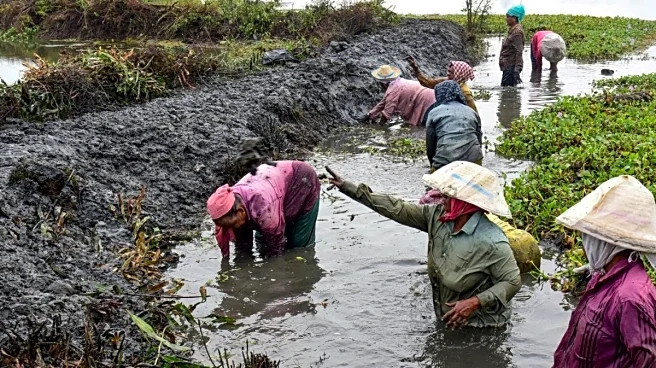
Unlike MGNREGA, which was implemented without pre-determined standards and goals—leading to misuse of resources and slower rural development—the G RAM G scheme targets four broad areas. First, water security activities, including canal construction, conservation of dams and ponds, and tree plantation. Second, strengthening core rural infrastructure through roads, bridges, community buildings, and solid waste management facilities.
Third, expanding employment and livelihood frameworks through agricultural assistance, food preservation, and dairy infrastructure. Fourth, addressing natural calamities through activities such as forest fire management and flood shelter construction. This four-dimensional work design has been ordained after thorough research and planning, ensuring optimal utilisation of labour and expansion of public assets.
Under the new plan, 50 per cent of expenditure will be on construction materials instead of 40 per cent earlier. Importantly, decisions regarding the nature and execution of work will not be made by officials sitting in Delhi, but by Gram Committees at the local level.
Another major problem with MGNREGA was delays in wage payments, which left labourers feeling cheated. The G RAM G scheme mandates weekly or bi-weekly wage payments. The adoption of digital technologies further eliminates delays and corruption. Media reports have suggested that contractors benefited disproportionately under MGNREGA in states such as Bengal and Punjab. G RAM G introduces biometric attendance, geo-tagging of assets, and real-time dashboards, significantly reducing corruption and fake beneficiaries. The scheme also retains provisions for unemployment allowance, balancing rights-based entitlements with administrative efficiency.
MGNREGA also suffered from weak coordination between the Centre and the states and limited accountability at the state level. Under the new scheme, the Centre will contribute 90 per cent of funds in hill and north-eastern states, with states contributing the remaining 10 per cent. In other states, the Centre will provide 60 per cent of the funding, thereby inducing states to be more accountable. Political psychology suggests that when one’s own stake is involved, the quality of work improves.
Amid opposition protests, there is also a sentiment questioning why the new scheme has been named ‘Ram’ rather than Mahatma Gandhi. It must be noted that ‘Ram’ here refers to Shri Ram, the protector of the poor and deprived—the Gareeb Nawaz, as referred to by Tulsidas. The country has a longstanding tradition of giving new names to new schemes.
Moreover, the name ‘G RAM G’ does not disrespect Gandhi, as it is rooted in the very deity he revered. Additionally, the acronym ‘G RAM G’ (pronounced ‘Ji Ram Ji’ in Hindi), designed specifically for rural Bharat, closely resembles the traditional greeting ‘Jai Ram Ji Ki’, which remains common in rural India even today.
The G RAM G Act is resolute in taking employment and rural development to new heights by expanding employment guarantees, strengthening financial discipline, ensuring timely payments, aligning work with agricultural cycles, and shifting the focus from short-term relief to sustainable rural development. There is little doubt that G RAM G will prove to be a milestone in the journey towards a Viksit Bharat.
Prof Niranjan Kumar is Dean of Planning at Delhi University, and Dr Gunjan Agrawal teaches Economics at Lakshmibai College. Views expressed in the above piece are personal and solely those of the authors. They do not necessarily reflect News18’s views.
/images/ppid_a911dc6a-image-177100042462595765.webp)

/images/ppid_a911dc6a-image-177098224616495837.webp)
/images/ppid_59c68470-image-177087752988933095.webp)