
/images/ppid_a911dc6a-image-177104464363699291.webp)
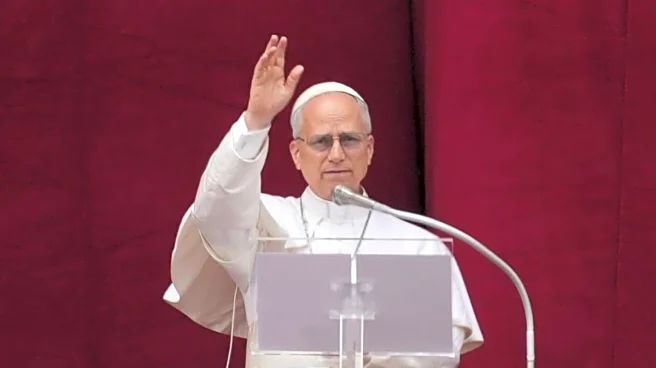
In his first Christmas “Urbi et Orbi” address, Pope Leo XIV made a direct and poignant appeal for peace, urging the leaders of Ukraine and Russia to find the “courage” to engage in sincere dialogue. Speaking from the central balcony of St Peter’s Basilica to a crowd of approximately 26,000 faithful, the American-born pontiff called for an end to the “senselessness” of a war that has now entered its fourth year.
A Call for Direct Dialogue
Pope Leo, who was elected in May 2025 following the death of Pope Francis, used his inaugural Christmas blessing to specifically target the stalemate in Eastern Europe. “May the clamour of weapons cease,” the Pope declared, “and may the parties involved, with the support and commitment of the international community, find the courage to engage
in sincere, direct, and respectful dialogue.” His remarks are particularly significant as they come at a time when international negotiators are working on draft peace frameworks, yet direct high-level talks between Moscow and Kyiv remain elusive.
The ‘Fragile Tents’ of Gaza and Beyond
The Pope’s message was not limited to Ukraine. In a deeply evocative homily delivered earlier during Christmas Day Mass—reviving a tradition of morning liturgy that had lapsed for 30 years—he reflected on the fragility of human life. He drew a sharp parallel between the biblical story of Jesus being born in a stable and the current humanitarian catastrophe in Gaza. “How, then, can we not think of the tents in Gaza, exposed for weeks to rain, wind, and cold?” he asked, noting that the inhabitants of the territory “have nothing left and have lost everything.”
A Return to Tradition
Pope Leo XIV, born Robert Francis Prevost in Chicago, has already begun to distinguish his papacy with a blend of quiet diplomacy and a return to certain traditional forms. During his address, he revived the custom of wishing the world a “Merry Christmas” in multiple languages—a practice his predecessor had set aside—receiving a warm reception when he spoke in his native English and fluent Spanish.
The “Urbi et Orbi” (to the city and the world) message served as a wide-ranging survey of global suffering. Beyond Ukraine and West Asia, the Pope implored for “justice, peace, and stability” in Lebanon, Syria, and Yemen, while also naming “forgotten” conflicts in Sudan, Myanmar, and Haiti. He concluded by challenging the global community to stop “accusing others” and instead stand in solidarity with the weak and the oppressed to effect true change in the world.
/images/ppid_a911dc6a-image-177104732085633794.webp)

/images/ppid_a911dc6a-image-177104723254381314.webp)
/images/ppid_a911dc6a-image-177104739040071015.webp)



/images/ppid_a911dc6a-image-177104554006886045.webp)