



The US State Department denied visas to five people, including a former top European Union official and two British social media campaigners, and imposed sanctions after accusing them of seeking to “coerce” US social media platforms for alleged “censorship”.
“The State Department is taking decisive action against five individuals who have led organised efforts to coerce American platforms to censor, demonetise, and suppress American viewpoints they oppose,” US Secretary Of State Marco Rubio said in a statement announcing the sanctions.
Rubio characterised the individuals as “radical activists” who had “advanced censorship crackdowns” by foreign states against “American speakers and American companies”.
“For far too long, ideologues in Europe have
led organized efforts to coerce American platforms to punish American viewpoints they oppose,” he said in a post on X.
For far too long, ideologues in Europe have led organized efforts to coerce American platforms to punish American viewpoints they oppose. The Trump Administration will no longer tolerate these egregious acts of extraterritorial censorship.
Today, @StateDept will take steps to…
— Secretary Marco Rubio (@SecRubio) December 23, 2025
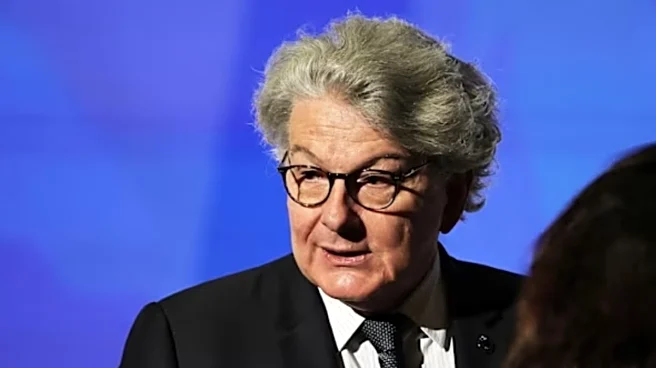
The measure targeted Thierry Breton, the former top tech regulator at the European Commission, who often clashed with tech tycoons such as Elon Musk over their obligations to follow EU rules. Breton was described by the State Department as the “mastermind” of the European Union’s Digital Services Act (DSA), a major piece of legislation that imposes content moderation and other standards on major social media platforms operating in Europe.
The Trump administration has scaled up its attacks on EU regulations after Brussels earlier this month fined Musk’s X for violating DSA rules on transparency in advertising and its methods for ensuring users were verified and actual people. Last week the US government signaled that key European businesses could be targeted in response, listing Accenture, DHL, Mistral, Siemens and Spotify among others.
The visa ban announced by Washington also included Imran Ahmed of the Centre for Countering Digital Hate, a nonprofit tackling online hate, misinformation and disinformation that came under attack from Elon Musk following his acquisition of Twitter, later rebranded as X.
Anna-Lena von Hodenberg and Josephine Ballon of HateAid, a German group described by the State Department as a trusted flagger under the DSA, were similarly targeted, along with Clare Melford, who heads the UK-based Global Disinformation Index.
Trump administration officials have in the past accused European nations for alleged censorship, and one of the reports by the State Department human rights alleged “significant human rights issues” with countries like the United Kingdom, France, and Germany over “serious restrictions on freedom of expression,” CNN reported.
Washington is also attacking the UK’s Online Safety Act, Britain’s equivalent of the DSA that seeks to impose content moderation requirements on major social media platforms. The White House last week suspended implementation of a tech cooperation deal with Britain, saying it was in opposition to the UK’s tech rules.
Breton Slams Washington
Meanwhile, Breton, who left the European Commission in 2024, slammed the ban as a “witch hunt,” comparing the situation to the US McCarthy era when officials were chased out of government for alleged ties to communism.
“Is McCarthy’s witch hunt back? As a reminder: 90% of the European Parliament — our democratically elected body — and all 27 Member States unanimously voted the DSA. To our American friends: “Censorship isn’t where you think it is,” he said in a post on X.
Is McCarthy’s witch hunt back? 🧹
As a reminder: 90% of the European Parliament — our democratically elected body — and all 27 Member States unanimously voted the DSA 🇪🇺
To our American friends: “Censorship isn’t where you think it is.”
— Thierry Breton (@ThierryBreton) December 23, 2025
EU, UK Slam Move
The European Union and some member states also slammed the US move. The Union’s executive also warned that it would take action against any “unjustified measures” by Washington.
The European Commission, the EU’s powerful executive branch and which supervises tech regulation in Europe, said that it “strongly condemns the US decision to impose travel restrictions” and that it has requested clarification about the move.
A statement from the Commission said, “We have requested clarifications from the US authorities and remain engaged. If needed, we will respond swiftly and decisively to defend our regulatory autonomy against unjustified measures.
“Our digital rules ensure a safe, fair, and level playing field for all companies, applied fairly and without discrimination,” it added.
French President Emmanuel Macron called it “intimidation”, while the UK government said it is “fully committed” to upholding free speech.
A statement from HateAid called the US government decision an “act of repression by an administration that increasingly disregards the rule of law and tries to silence its critics with all its might”.
A GDI spokesperson said the measures were “an egregious act of government censorship” as well as “immoral, unlawful, and un-American”.
(With inputs from agencies)



/images/ppid_59c68470-image-177097752876693648.webp)