
The Centre is now in full action mode against IndiGo. A show-cause notice has been served to the airline’s CEO, Pieter Elbers, and people inside the civil aviation ministry are openly saying his job is on the line.
After days of chaos at airports across India, the message from the top is unmistakable: the government wants to fix this mess, once and for all.
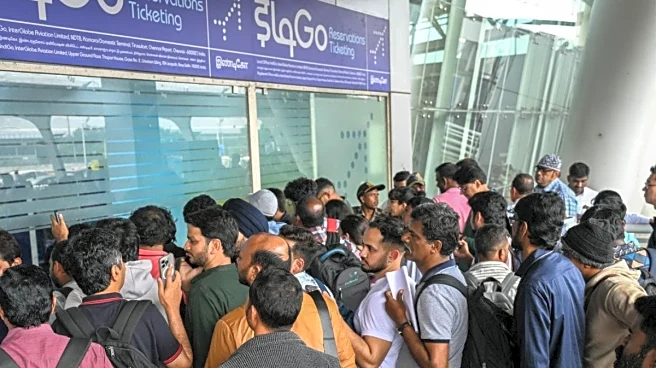
It’s a crisis that has unfolded in full public view: terminals overflowing with passengers chanting in frustration, flight boards blinking red with endless cancellations, children lying on suitcases, elderly passengers sleeping on the floor, security staff struggling to control swelling crowds, and bags gone missing in the avalanche of disruption.
This is India’s aviation system in 2025 – brought to its knees not by bad weather, conflict, or natural disaster but by the failure of a single private airline. IndiGo, the carrier that operates 60 percent of India’s domestic flights, shut down more than 2,000 flights this week.
Airports from Delhi to Chennai, Bengaluru to Srinagar witnessed a level of paralysis unseen in recent aviation history. And today, the question that hangs in the air is simple but brutal: how did India’s biggest airline fail so completely and so publicly? And how did the government, regulator, and airline’s leadership allow this crisis to explode in slow motion?
The roots of the meltdown go back to 2024, when the government took the decision to bring India’s flight duty time regulations in line with global safety norms. These revised rules – meant to protect pilots from fatigue – expanded rest periods, restricted night landings, capped consecutive night duties, and extended what counted as “night”.
The Delhi High Court upheld these norms in April 2025. Implementation was structured in two phases – July 1 and November 1 – giving airlines almost two years to prepare.
Every other airline did. Air India prepared. Even Akasa and SpiceJet did. Smaller operators also complied.
But IndiGo – the airline with the most night flights, most red-eye routes, and tightest schedules – did not. And this week, that negligence detonated.
Late on December 5, long after the meltdown had consumed the country, Pieter Elbers finally appeared with an apology. But what he said stunned the aviation community even more: “We misjudged crew requirements…the actions taken in the last few days were futile…we are rebooting all systems.”
Those are not the words an airline CEO should ever use. “Futile”, “reboot”. At a company that runs 2,300 flights a day, these words sound like the language of failure.
The show-cause notice to IndiGo from the Directorate General of Civil Aviation (DGCA) is even more damning. The regulator has accused the airline of ignoring repeated instructions, failing to forecast crew availability, not realigning rosters, delaying training, and displaying major gaps in planning and oversight.
Then came the most controversial moment of the crisis. As airports ran out of space to seat stranded passengers, the government launched a high-level probe.
But within minutes, the DGCA took an extraordinary step: it suspended key fatigue norms – temporarily – and only for IndiGo’s A320 fleet. Night periods were shortened, night landing limits expanded. Weekly rest for pilots was reinterpreted.
Effectively, the regulator weakened the very safety rules it had spent two years refining, all to give IndiGo breathing room. Pilots’ bodies reacted with anger, calling it a dangerous precedent and accusing it of compromising safety to rescue a private airline that had failed to plan responsibly.
Sources in the aviation sector said the timing of IndiGo’s collapse – five weeks after the new norms kicked in – raises a deeply uncomfortable question: was this a genuine operational breakdown, or a pressure tactic? Was a crisis allowed to inflate to force the government to dilute rules that increased cost and demanded more pilots?
With IndiGo down, airfares shot into the stratosphere. A return ticket from Delhi to Mumbai crossed Rs 50,000. Delhi-Bengaluru? Rs 55,000. Delhi-Goa? More than Rs 60,000.
One airline collapses – and the entire country pays. The government acted on Saturday (December 6), capping fares for different distances.
IndiGo has now announced full refunds, hotels for stranded passengers, food, alternate transport, and a complete waiver on cancellation and rescheduling charges. But refunds do not fix ruined holidays, missed weddings, cancelled medical appointments, or business losses that cannot be recovered.
And they certainly do not fix trust. What has finally become public – and what pilots have been warning for months – is that IndiGo simply did not have enough trained crew to run the aggressively expanded network it built.
It was a knife-edge operation: maximum flying hours, maximum utilisation, minimum slack. Any disruption – a bout of sickness, a weather delay, a rule change – could cause the entire system to snap. And that is exactly what happened.
This crisis is not just about IndiGo. It is about what happens when one airline becomes too big to fail. When a regulator bends rules to save a single operator. When safety norms are seen as negotiable. When market concentration becomes a national vulnerability.
IndiGo says normalcy will return by December 15. But trust will take far longer. And unless the government demands accountability – from the airline, from its leadership, and from the regulator – India risks walking into the next crisis with its eyes wide open.
Because this meltdown is more than an operational failure. It is a warning. A warning that ambition without planning is dangerous. That dominance without responsibility is harmful. And that a country’s aviation system cannot be built on a single pillar, especially one that is now visibly cracking.
/images/ppid_59c68470-image-177095006121036330.webp)

/images/ppid_59c68470-image-17709502481006608.webp)
/images/ppid_59c68470-image-177095003027833058.webp)
/images/ppid_59c68470-image-177095009506748967.webp)
/images/ppid_59c68470-image-177095012453419827.webp)
/images/ppid_59c68470-image-177095021221980535.webp)
/images/ppid_59c68470-image-177095015935897162.webp)
/images/ppid_59c68470-image-177095003091564225.webp)
/images/ppid_59c68470-image-177094778070247070.webp)
/images/ppid_59c68470-image-177094774796122738.webp)