


India’s macroeconomic trajectory presents a stark geopolitical paradox as the nation remains the world’s fastest-growing large economy, printing an annual real GDP growth rate between 7.1% and 7.3%. However, this domestic path to a $5 trillion economy is heavily contested on the global stage and supported by elements within India.
An analysis of the policy landscape suggests that recurring street protests, narrative shifts, and regulatory stalemates are developing into a coordinated asymmetric mechanism designed to slow the country’s growth. By targeting critical legislation, leveraging global billionaires, and deploying trade pressures, external and internal actors appear to be forming a joint front to limit India’s rise.
Central Thesis: Sustained
unrest, particularly violence, communal killings, intimidation, prolonged blockades and deliberate disruption of essential infrastructure acts as a direct tax on India’s growth. It interrupts production and logistics, strands capital, weakens social trust, delays investment and raises the risk premium attached to the Indian economy.
Section I: The Legislative Chokehold — Targeted Reforms Stalled by Design
The Indian Parliament has increasingly become a battleground for legislative gridlock. During recent legislative pushes, low productivity—such as the Lok Sabha registering 19% productivity and the Rajya Sabha registering 39%—has stalled bills critical to national security, capital accumulation, and demographic stability.
The opposition strategic playbook relies heavily on forcing bills into Joint Parliamentary Committees (JPCs) or demanding the resignation of key institutional heads to freeze the administrative machinery.
Target List of Systemically Blocked Legislation
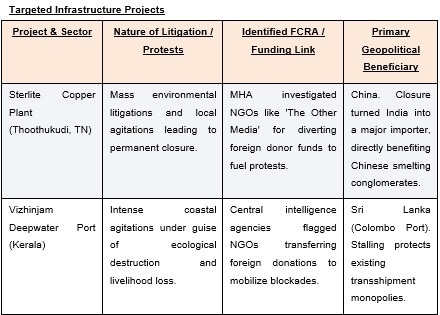
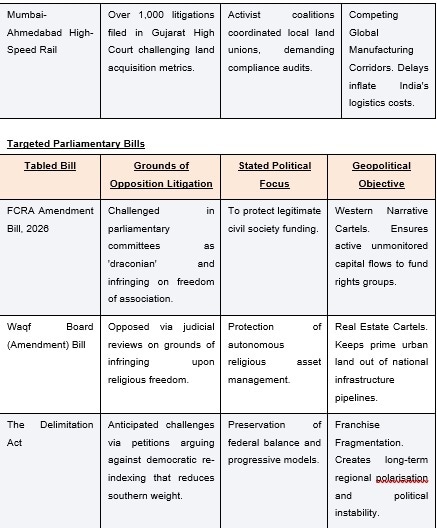
The Foreign Contribution (Regulation) Amendment Bill (FCRA), 2026: Designed to impose strict state oversight on foreign funding flowing into non-governmental organisations (NGOs). Protests claim it targets civic freedoms, freezing the bill in a JPC while untraceable foreign funds continue to drive regional agitations.
The Special Intensive Revision (SIR) Process & Electoral Bills: Aimed at digitising, cleaning, and securing electoral rolls against discrepancies. Opposition groups have launched mass protests alleging voter list deletions, successfully stalling the elimination of fraudulent identities.
The Delimitation Act Implementation: The upcoming redistricting of parliamentary seats based on population shifts faces intense resistance from regional parties. Critics exploit a North-South narrative to create a regional rift, threatening political stability right when India needs unified economic planning.
The Waqf Board (Amendment) Bill: A major reform to audit and optimise prime urban real estate held under opaque, untaxed frameworks. Opposition is framed around religious freedom, which actively prevents the commercial unlock of thousands of acres for infrastructure.
The Corporate Laws (Amendment) Bill, 2026: Under review by the Standing Committee on Finance, this bill modernises compliance and penal frameworks but faces corporate and political resistance over accountability clauses.
Section II: Strategic Mapping of Infrastructure Subversion and Legislative Roadblocks
To understand how asymmetric pressure materializes, it is vital to map the specific industrial nodes, ports, and regulatory bills that have been systematically targeted by litigation. This gridlock delays domestic output and creates direct commercial vacuums that foreign economic competitors step in to exploit.
Section III: Strategic Analysis of the Core BJP Manifesto
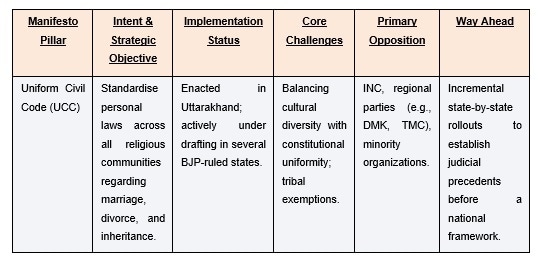
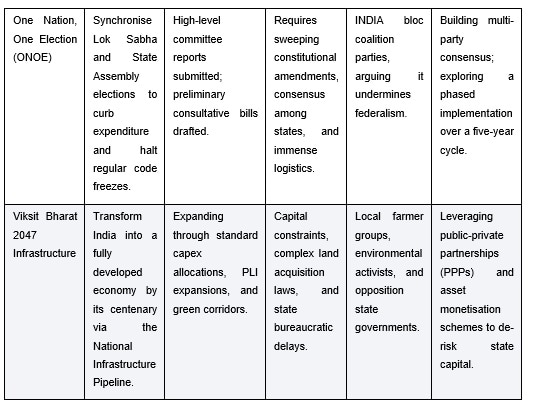
The ruling party’s agenda bridges highly sensitive civil reforms with long-term macroeconomic structural shifts. Achieving these objectives requires navigating sharp ideological opposition and structural bottlenecks.
“The relationship between the government and citizens should be based on trust, not suspicion.”
— Prime Minister Narendra Modi
A two-thirds (2/3rd) majority in both houses of Parliament (under Article 368) is the constitutional threshold (362 seats in the Lok Sabha) required to pass these structural changes without relying on issue-based support from swing parties.
Government Vector: The government must secure sweeping victories in upcoming state assembly elections to boost its numbers in the Rajya Sabha while systematically winning over unaligned regional parties during critical votes.
Opposition Counterstrategy: The opposition coalition coordinates floor management, stages unified walkouts to lower voting quorums, demands that complex bills be referred to JPCs to delay votes, and leverages state-level federal structures to block the ratification of constitutional amendments.
Section IV: Sovereign Credit Ratings Under Asymmetric Stress
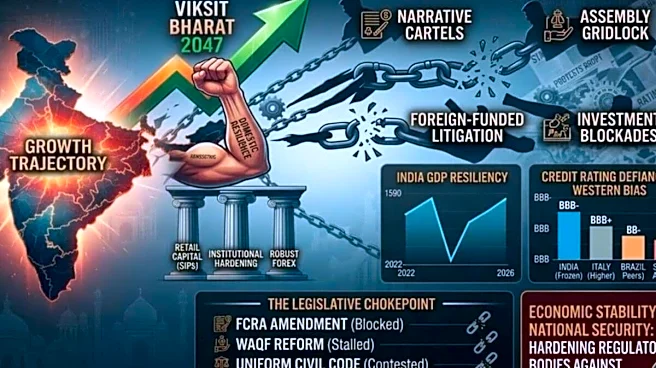
A key node in this ecosystem is the subjectivity of global sovereign credit rating agencies. Historically, domestic policy disruption or street warfare has been weaponised by international rating cartels to freeze a developing nation’s credit position. However, India’s recent performance represents a defiance of this trend, showing institutional hardening under intense macroeconomic and narrative stress tests.
“Economic growth and political stability are deeply interconnected.”
— Zahid Hussain, World Bank
Comparative Peer Stress Analysis
India (2020–2026 Baseline): Faced a strict pandemic contraction followed by global supply chain shocks. Despite keeping debt-to-GDP around 80% and cutting its fiscal deficit from 9.2% to a projected 4.4%, global Western agencies kept India static at BBB- for nearly 15 years. This ceiling was broken through aggressive resilience, resulting in S&P upgrading India to BBB in August 2025 and Japan’s JCR upgrading India to A- in September 2026, citing solid fiscal consolidation.
Italy & Spain (Western Peer Comparison): Despite carrying structurally weaker growth metrics and massively elevated public leverage—with Italy’s debt-to-GDP ratio averaging 118%—these Eurozone nations routinely receive higher baseline investment grades (BBB/BBB+) from Western rating agencies. This underscores systemic bias.
Nepal (Regional Fragility Model): Under similar asymmetric pressure, Nepal experienced severe political instability and youth-led agitations in September 2025. Lacking institutional safety nets, Nepal’s projected real GDP growth collapsed from 4.6% to 2.1%, demonstrating how localised civil unrest can quickly cripple a fragile frontier economy.
Section V: The Billionaire-Opposition Frontier — The Starlink Narrative Convergence
A highly visible development in this narrative warfare is the recent friction surrounding the entry of Starlink into India’s satellite communications sector. The commercial dispute quickly transformed into a geopolitical and political debate.
The Starlink Clash: Tesla and SpaceX CEO Elon Musk publicly attacked India’s satellite licensing process, claiming Starlink is being blocked by domestic oligarchs seeking to maintain a monopolistic chokehold. Musk took to social media platform X to ask: ‘Is Ambani the real boss of India?’—directly challenging the influence of Reliance Industries chairman Mukesh Ambani.
Political Amplification: Leader of the Opposition Rahul Gandhi quickly amplified Musk’s narrative, responding on X: ‘Welcome to India, Elon. Wait till you discover the other guy,’ implying preferential state treatment for corporate figures like Gautam Adani.
The Regulatory Sovereignty Reality: The Government of India and the Telecom Department rejected these claims as baseless. Officials clarified that all foreign satellite operators must comply with mandatory national security assessments and data-localisation norms. Labeling domestic wealth creators as oligarchs mirrors the language historically used against geopolitical adversaries, with the strategic intent to make Indian conglomerates toxic to Western institutional investors.
Section VI: Geopolitical Actors & Asymmetric Economic Pressures
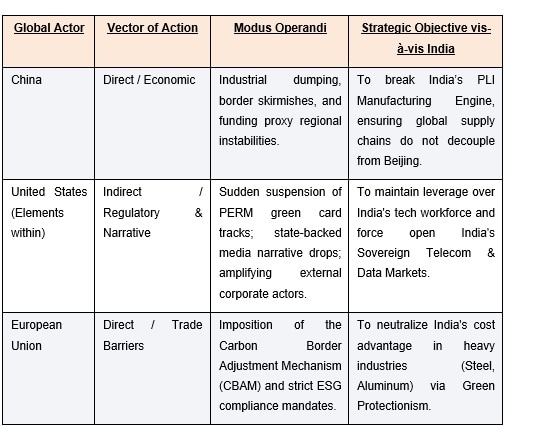
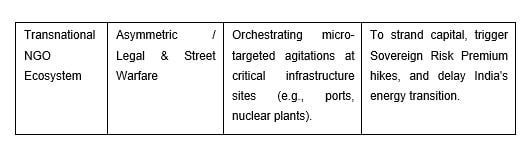
National Security Advisor Shri Ajit Doval has frequently noted that India’s growing economic, military, and technological global influence has drawn scrutiny from multiple international actors. A mix of Western institutions and regional adversaries benefit from internal friction in India through distinct actions:
Section VII: The Mechanics of Friction — ESG & Capital Realities
Global capital allocation has increasingly shifted toward sustainability frameworks. Critics often point to domestic socio-political friction as a factor that could negatively affect India’s international risk ratings. However, data indicates that India’s local ESG landscape is maturing independently.
The Securities and Exchange Board of India (SEBI) has formalised the ESG sector by approving 18 dedicated ESG Rating Providers (ERPs) (such as CRISIL and CareEdge) to counter inconsistent scoring from unregulated global platforms. Compliance under the Business Responsibility and Sustainability Report (BRSR) framework grew to 88% among the top 1,000 listed firms, driving a 12% increase in India’s average ESG index scores. Efficient ESG compliance has translated directly into a 20-30% lower cost of capital for top-tier Indian firms.
Despite these domestic regulatory strides, structural volatility can still impact capital markets. When global rating firms see massive street protests on Western news channels, they artificially inflate India’s Sovereign Risk Premium. This higher risk premium forces Indian corporations to borrow at higher interest rates globally, retarding private capital expenditure (CapEx) and driving short-term Foreign Institutional Investor (FII) outflows back to traditional Western havens.
Section VIII: Socio-Economic Impacts and the Illusion of ‘Colour Revolutions’
The domestic execution of asymmetric warfare relies heavily on weaponising a nation’s vulnerabilities. In India, foreign inimical actors systematically channel resources through cooperative elements of the political class and tap into a pool of misled youth. By amplifying structural grievances—such as exam leaks, employment friction, and sectoral transitions—narrative cartels orchestrate severe disruptions that yield compounding economic damage.
The Concrete Cost of Unrest: IMF research finds that social unrest lowers confidence and raises uncertainty, while a major unrest event is associated with GDP being about 1 percentage point below baseline six quarters later. Strong institutions and adequate policy space can mitigate the damage, reinforcing the economic value of institutional resilience.
“When violence erupts, capital flees, services collapse and poverty deepens.”
— António Guterres, Secretary-General of the United Nations
Why Destabilization Fails in India: External strategists frequently look to smaller regional models, such as the youth-led uprisings in Nepal, as blueprints for systemic disruption. In Nepal, intense agitations successfully toppled the established political class, bringing the economy to a grinding halt and causing its projected GDP growth to drop sharply. However, attempts to duplicate a ‘Nepal-style’ collapse or a classical Western-backed ‘Colour Revolution’ in India are structurally bound to fail due to unique domestic shock absorbers: (1) Scale and Diversity Dampener across 28 states, (2) Institutional Hardening of independent courts, SEBI, and RBI, and (3) Indigenous Wealth Generation through a massive domestic retail investor ecosystem that easily absorbs global outflows.
Section IX: Information Warfare as an Economic Headwind
Delaying Key Infrastructure: Coordinated campaigns targeting land acquisition and infrastructure projects amplify local anxieties, leading to legal delays and project standstills. This leaves project finance capital stranded and underutilized.
Creating Supply Chain Vulnerabilities: False narratives surrounding labour conditions or community health can trigger sudden wildcat strikes or localised unrest. These disruptions can break supply chain links, causing manufacturing facilities to temporarily halt operations.
Increasing the Sovereign Risk Premium: Artificially amplified reports of instability can alter the sentiment metrics used by algorithmic global funds. This can result in short-term capital flight or higher borrowing costs for Indian firms in international debt markets.
Policy Priorities for Protecting Growth
India should combine faster grievance redressal and transparent project consultation with intelligence-led prevention, accountable policing and time-bound judicial review. Essential transport, energy and digital corridors must remain operational during unrest, while verified institutional communication should counter disinformation without constraining lawful democratic dissent. The objective is not to suppress disagreement, but to prevent violence, intimidation and prolonged disruption from imposing lasting costs on workers, small businesses, investment and national growth.
An Ambition for India: National Security Advisor Ajit Doval has called for India to become great again not only in border security, but also in its economy, social development and every other dimension of national strength. This ambition requires peace, cohesion and institutional resilience so that disruption cannot divert the country from its developmental trajectory.
Conclusion: Securing the Indian Century
India’s path to a $5 trillion economy is no longer just an internal legislative journey; it is a sophisticated geopolitical balancing act. The convergence of domestic political opposition, critiques from international tech billionaires, and sudden regulatory pressures from Western partners indicates that India’s economic rise faces active external headwinds.
Slowing India’s regulatory updates and infrastructure projects serves competing global economies by keeping India reliant on imports and limiting its potential as a global manufacturing hub. To secure its development goals toward Viksit Bharat 2047, India must treat economic stability as a core element of national security. This requires hardening regulatory bodies against external pressure, improving parliamentary resilience against deliberate gridlock, and ensuring that public narratives are anchored in transparent institutional facts rather than coordinated disinformation.
India’s growth engine depends not on the absence of disagreement, but on ensuring that disagreement never becomes sustained violence, paralysis or economic sabotage.
Colonel Rohit Dev is a veteran of the Indian Army, a prominent geo-strategic analyst, and a vocal commentator on national security, governance, and socio-cultural frameworks affecting Indian society, besides being a Bioenergy Thought Leader and an ardent socialite.
Views expressed are personal and solely those of the author, and do not necessarily reflect News18’s views.