
/images/ppid_a911dc6a-image-177107002875928030.webp)
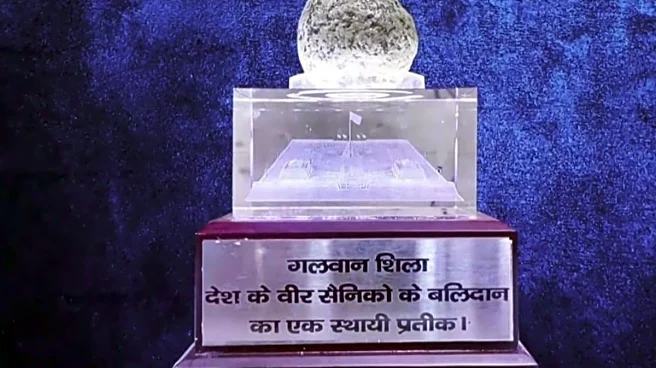
The world’s highest war memorial will now stand, where five years ago 20 Indian soldiers were killed in hand-to-hand combat with Chinese troops during the deadly Galwan Valley clash.
The memorial near the KM-120 post on the strategic Durbuk-Shyok-Daulat Beg Oldie Road in Ladakh, is located at one of the harshest military deployment zones in the world. Built in Sector North, amid sub-zero temperatures, low oxygen levels and unforgiving terrain, it also holds the distinction of being the world’s highest war memorial.
It was inaugurated by Defence Minister Rajnath Singh on Sunday. It has been developed under the ‘Bharat Ranbhoomi Darshan’ initiative, a vision announced on Army Day, and allows the public to visit key battlefields, pay their respects,
and comprehend the gravity of the sacrifice made in the service of the nation.
Constructed using red and black granite symbolising sacrifice and valour, the memorial is modelled in the form of a trishul and damru. At its core stands a triangular installation representing energy and the mountains flanked by an eternal flame and the National Flag. Encircling the monument are 20 bronze statues representing the soldiers who fell defending Galwan Valley.
The war memorial complex includes a museum and digital gallery capturing the Galwan encounter, Ladakh’s military history and the legacy of courage across generations. An auditorium has also been built to showcase narratives of valour.
To facilitate visitors and boost tourism, the Indian Army has developed amenities including the Tiger Brave Café at KM 23, another café at KM 56, and a Braveheart Bistro at the memorial site. A souvenir shop, ‘selfie’ point, and an army model briefing zone have also been set up.
The Galwan clash on the night of June 15, 2020, marked one of the most brutal confrontations between India and China in decades, which was fought without firearms under prior border agreements. The encounter altered the security dynamics along the Line of Actual Control (LAC) triggering a prolonged military buildup and will be remembered as a defining moment in modern Sino-Indian relations.
/images/ppid_a911dc6a-image-177107283185623053.webp)





/images/ppid_a911dc6a-image-177107062796921011.webp)