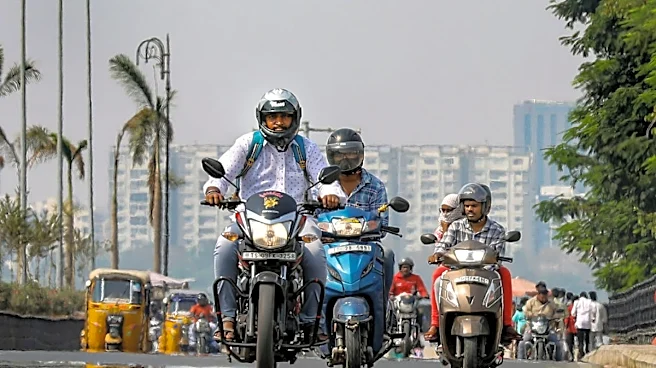






A social media post comparing travel conditions in Hyderabad and Bengaluru has reignited the debate over infrastructure and traffic management in two of India’s biggest technology hubs.
According to a report by Siasat, the discussion began after a Hyderabad resident shared his experience of travelling across the city’s Outer Ring Road (ORR), arguing that Hyderabad’s road network offers a significant advantage over Bengaluru’s congested streets.
Google Maps Screenshot Goes Viral
According to the report, Hyderabad-based X user Ashish Kumar posted a screenshot from Google Maps showing that he had covered a distance of 82 km on the city’s Outer Ring Road in 72 minutes.
Drawing a comparison with Bengaluru, Kumar suggested that achieving a similar travel time in the Karnataka capital
would require “at least 10 more years of development”, pointing to what he viewed as a stark difference in infrastructure between the two cities.
Bangalore needs at least 10 years of development to cover 82 km in 1 hour 12 minutes pic.twitter.com/Q6c4cSGzWu
— Asish Kumar (@asishcodes) June 6, 2026
The post quickly gained momentum online, attracting more than 3.5 lakh views and over 1,400 likes, while prompting a wider conversation about urban mobility and city planning.
Hyderabad’s Infrastructure Praised
Kumar argued that Hyderabad has invested heavily in road infrastructure over the years, leading to smoother traffic movement across key corridors. He contrasted this with Bengaluru’s traffic conditions, claiming that even short journeys in the city can often take an hour because of increasing congestion and poor road conditions.
The post echoed a common perception among some commuters that Hyderabad’s wide roads, planned expansion and ring-road network have helped ease traffic pressure.
Social Media Users Divided
The comparison drew mixed reactions from social media users. Several people agreed with Kumar’s observations, arguing that Hyderabad’s infrastructure development has made commuting relatively easier compared with Bengaluru. Some users pointed to the city’s extensive road network and planned growth as factors contributing to better traffic flow.
Others, however, challenged the comparison, with Bengaluru residents sharing their own Google Maps screenshots to demonstrate instances of smooth traffic movement within the city.
Some users argued that comparing a high-speed access-controlled ring road with Bengaluru’s urban road network was not a fair assessment and failed to reflect typical travel conditions in either city.
One commenter reportedly noted that maintaining an average speed of nearly 68 kmph within a major metropolitan area would be difficult in most Indian cities, including Hyderabad, unless the journey was made on dedicated expressways or ring roads.
Bengaluru’s Traffic Woes Back In Focus
The viral debate comes at a time when Bengaluru continues to face scrutiny over its traffic congestion and growing pressure on urban infrastructure. The discussion has resurfaced even as the Karnataka government moves ahead with several infrastructure projects aimed at improving connectivity, reducing travel times and addressing the city’s long-standing mobility challenges.
The online exchange has once again highlighted the contrasting approaches to urban development adopted by India’s major technology hubs, while underscoring the broader challenge of balancing rapid growth with efficient transport infrastructure.


/images/ppid_a911dc6a-image-178124811720019309.webp)

/images/ppid_59c68470-image-178116253002776035.webp)

/images/ppid_59c68470-image-1781090034048707.webp)
/images/ppid_a911dc6a-image-178099156464598439.webp)