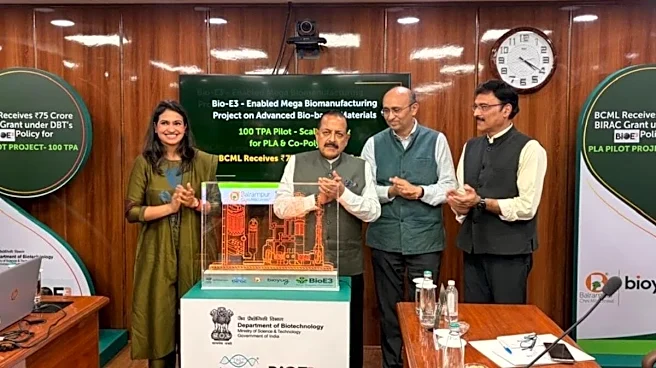




Balrampur Chini Mills Limited (BCML) has secured a ₹75-crore grant from the Biotechnology Industry Research Assistance Council (BIRAC), under the Department of Biotechnology (DBT), to establish a 100-tonne-per-annum (TPA) research and development facility for PLA co-polymers.
The grant has been awarded under the government’s BioE3 initiative — Biotechnology for Economy, Environment & Employment — which aims to strengthen India’s capabilities in biomanufacturing and bio-based technologies.
The pilot-scale R&D facility will be established at BCML’s integrated manufacturing complex in Kumbhi, Uttar Pradesh. The site is also being developed as the location for the company’s planned 80,000-TPA PLA manufacturing facility.
The new facility will focus
on developing specialised PLA grades and advanced PLA co-polymers for high-value applications. Its activities will include technology indigenisation, product development, customer validation and scaling up processes for commercial production.
According to BCML, the facility will generate techno-economic data and process know-how needed for commercial-scale manufacturing. It will also support the development of skilled manpower for India’s growing biomanufacturing sector.
The facility is designed to bridge the gap between laboratory research and commercial production. Its work will cover multiple stages of product development, including understanding customer requirements, developing new PLA formulations, producing pilot samples and validating product performance.
The project will also facilitate collaboration between industry and research institutions to accelerate the development and commercialisation of sustainable bio-based materials.
Speaking at the event, Union Minister Jitendra Singh highlighted the growth of India’s bioeconomy and stressed the need to translate scientific research into commercially viable products, technologies and employment opportunities.
Singh also emphasised a “waste-to-wealth” approach, under which biological resources and materials traditionally treated as waste can be converted into economic value through science and technology.
He said the time taken to move innovations from research laboratories to commercial markets needs to be reduced, with pilot-scale facilities, technology validation, skilled manpower and industry participation playing a key role in the process.
BCML Executive Director Avantika Saraogi said the ₹75-crore BioE3 grant represented an endorsement of the role advanced biomanufacturing could play in India’s future.
She said the facility would help develop indigenous technologies, next-generation bio-based materials and the scientific and technical capabilities required for sustainable manufacturing.
The event was attended by senior officials from the DBT and BIRAC, including Dr Rajesh S Gokhale, Secretary, DBT, Director General of BIRAC and Chairman of BIRAC, and Dr Dhananjay K Tiwary, Scientist, DBT and Managing Director, BIRAC.
BCML is one of India’s major integrated sugar companies, with operations spanning sugar, distillery and power cogeneration. The company operates 10 sugar factories in Uttar Pradesh with an aggregate sugarcane crushing capacity of 80,000 tonnes crushed per day (TCD).
The company is also setting up an 80,000-TPA PLA manufacturing facility, marking its expansion into bio-based materials and sustainable manufacturing.