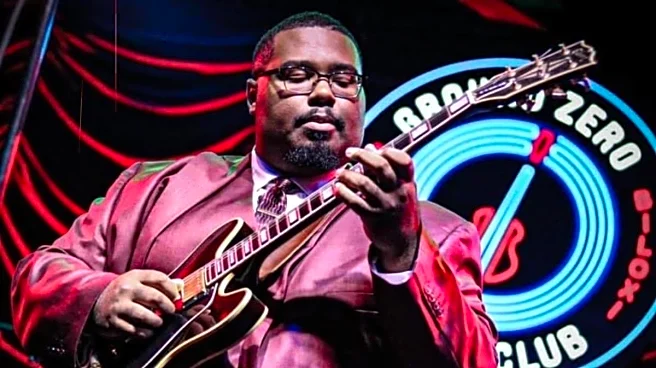

At just 27, D.K. Harrell stands at a rare crossroads where the blues’ deep, bruised past meets an unafraid, forward-looking present. Rooted in Ruston, Louisiana, and shaped by lived experience rather than inherited privilege, Harrell’s music carries the weight of truth without wearing it like a costume. His songs do not dramatise hardship for effect; they testify to it, transforming neglect, survival, faith and resilience into a sound that feels both ancient and urgently alive.
As he prepares to make his debut at the Mahindra Blues Festival 2026, one of the world’s most vital global blues gatherings, Harrell enters a space that celebrates lineage while daring artists to carry the genre forward. In this exclusive conversation with News18 Showsha,
the young bluesman reflects on isolation, homelessness, gospel roots, and the responsibility of being an emerging voice in a form built on honesty. From channeling pain without romanticising it to believing that emotion matters more than technique, Harrell speaks with the clarity of someone who understands that the blues is not nostalgia. It is life, faced head-on, one note at a time.
Here are the excerpts:
Making your Mahindra Blues Festival debut, what does it mean to enter a space that honours both blues history and its future?
Every chance I get to play somewhere I’ve never been and they enjoy the blues, it makes very happy to know that it will continue to live on and have a successful future.
Mahindra Blues Festival audiences are known to embrace emerging voices alongside legends. How does that inclusivity impact you as a performer?
Well it makes me a little concerned in a good way. I hope as a new artist there they are accepting of the first time there and accepting of the music I bring.
Born in Ruston, Louisiana, with an unconventional start—your mother being only 13 and your father absent—how has channeling those early hardships into songs like “No Thanks to You” served as a form of catharsis, and do you worry it might romanticize pain for listeners?
My mother gave birth to me at the age of 21. My grandfather’s mother gave birth to him at the age of 13. Yes, my biological father was absent in my life. No Thanks To You is supposed to deliver the message to listeners that as a neglected child you can still be a positive influence or person and for parents, grandparents, guardians to be careful on how they treat the children they are rearing.
Discovering B.B. King’s music at age two and receiving your first guitar at 12—reflecting on being teased for preferring blues over hip-hop in school, how did that isolation foster your self-taught style, and what parallels do you see between Ruston’s modest roots and the blues’ historical underdog narrative?
Well the city I’m from still praises hip-hop and pop and country more than the blues but I’ve been able to create a blues society and a blues festival in Ruston. I feel in due time it will get the majority’s attention. With being different at a young age it is difficult especially when you love people but I am grateful for that isolation spent with my guitar and music.
Winning the 2022 B.B. King of the Blues Award and the 2024 Blues Music Award for Best Emerging Artist— how has this rapid validation conflicted with your “less-is-more” approach, and do you feel pressure to accelerate your maturation in a genre that values lived experience?
The best way to answer this is that I feel taking advantage of time and pacing yourself is a beautiful way to express yourself. It’s like a one on one reflecting moment with yourself. The only pressure I have is when its time to make another record because I pray that it is good.
Experiencing homelessness around 2020-2022, living out of your car— in what ways has that period reshaped your definition of “the blues is life,” and how do you balance sharing these vulnerabilities without letting them define your artistry?
Life is definitely going to have its ups and downs. It’s not karma or bad behavior, it’s just how life can be at times. For example if a person is minding their business and someone wounds them violently and they are disfigured, they have to make a conscious decision on how to continue on with life. Will they go on to be bitter or accept that unfortunate things happen and still try to grateful for their life? Im so grateful for life that I am scared of what is on the other side when the time comes. The only pressure i have is when its time to make another record because I pray that it is good.
Your first major exposure at the 2019 B.B. King Symposium, performing “The Thrill Is Gone” on one of King’s Lucille guitars— what internal doubts did that moment surface, and how has it influenced your philosophy of emotion over technique in live shows?
The only negative thoughts I had in that moment was my father disapproving of my music career and doubting it, but in the end I still came out okay. Being human on live shows gives the audience the most relatable experience than any song. When you speak to them and remain vulnerable and honest they appreciate it.
Signing with Alligator Records after your debut on Little Village Foundation— reflecting on mentors like Jontavious Willis advising to “drag it out” in singing, how have these relationships challenged you to innovate within traditional blues boundaries?
It has broadened my ears to other artists and how they approach their music and I take from them and add it to myself.
Idolizing B.B. King’s tone, stagecraft, and leadership, alongside figures like Albert King and John Lee Hooker— in a modern era dominated by distortion, how do you advocate for the “raw giants'” sound, and what risks do you take in blending gospel fervor with contemporary R&B to attract younger audiences?
In my opinion the best sound to me is the guitar going straight through the amp and the amp cranked about halfway or almost to max volume and letting that wood sing its heart out. I’ve only been criticized one time about playing blues and gospel but i feel if the music doesnt hurt anyone than its God’s music or Allah’s music or the Sun God’s music. Im here to heal not to hurt, to love and not destroy.
Drawing from church choir experiences for your robust vocals— how does infusing spiritual intensity into secular blues provoke philosophical tensions, especially when addressing societal “heaviness” in your music?
The blues is the sinners’ gospel as the Gospel is the Safed man’s redemption. They are the same. Whether it;s topics such as politics or religion, there always is going to be a pro and con to it.
Different feelings and opinions. Its never to provoke anyone or anything. We should all be able to express.
Peers like Quise Knox and Toronzo Cannon have shared chords and inspiration— what unspoken rules of collaboration in the blues community have you learned, and how do they contrast with the competitive dynamics in other genres like hip-hop?
I really feel there aren’t any unspoken rules. Jontavious and Toronzo have always been open to teaching and giving their wisdom and skils of Blues to the world. Now hip-hop is more popular due to the heavy bass lines or immature beefs between one rapper and another. Society loves gossip and mess.
Your debut The Right Man (2023) with emotional tracks like “Get These Blues out of Me”— how did crying through takes for “No Thanks to You” reveal vulnerabilities in the studio, and have fan reactions to these personal narratives shifted your songwriting boundaries?
The process of recording and writing should always be to put your feelings out there as genuinely as possible. There may be other artists who struggle with this because they are taught to just perform and make the money. But there are those out there who display their emotions.
Talkin’ Heavy (2025) with 12 originals like “Vibe With Me” using modern terms— what internal debates arose in modernizing blues language to bridge generations, and do you fear alienating purists who prefer traditional motifs?
Mixing contemporary subjects with traditional blues I think is a positive move because the older generation still understands and the new generation understands. I feel what I’m doing is definitely getting things over in a good way.
Popular songs such as “Grown Now” (2025) and “Liquor Stores and Legs” (2025)— how do you craft grooves that provoke joy amid heaviness, and what surprises have emerged from how audiences interpret these upbeat shuffles in live settings?
Grown Now and Liquor Stores and Legs have both been songs requested from the audience since we released them. The way I write these lyrics is just from thinking about my childhood or friends or my surroundings.
Releasing Talkin’ Heavy in June 2025, produced by Kid Andersen after your debut’s success, how did this sophomore album test your growth, especially in themes of life’s lessons and praising the blues?
Well, I pushed myself to play different guitars and amps to set the tone of each song, and I feel it was successful because even my manager questioned if it was me playing or Kid.
Touring Europe (Bilbao Blues Festival, North Sea Jazz) and North America in 2025, including unique spots like Svalbard— how has global exposure challenged your southern-rooted sound, and what cultural fusions have you contemplated incorporating from these travels?
I wouldn’t say it’s challenged it I would say it’s assisted my southern rooted sound because many of the rhythms or beats are African inspired just like southern black gospel comes from the African beats.
Advocating for blues’ relevance with a “showman at heart” ethos— in an age of digital music, how do you see your generation reviving the genre’s uniformed stage presence and emotional authenticity, perhaps through technology or cross-genre blends?
Everyone has a look mine is suits or nice fashion shirts while rappers have sagging pants and t shirts or puffy jackets etc. The young people are impressionable and if they like something alot they will be encouraged the wear the same thing . Everyone wants to be a trend.
Gear choices like your vintage ES-355 and tube amps echo B.B. King’s Lucille— what philosophical stance do you take on equipment’s role in soulful expression, and do you envision signature gear to pass on your “stinging single-note bends” to aspiring players?
You know, Albert King and Freddie King and even Ike Turner were straight to amp from guitar guys and I feel if doing it inspires others to appreciates these greats, then I’m grateful and maybe I’m doing something right. I hope someone out there enjoys this style or technique.
As a 27-year-old bridging blues’ past and future— what provocative message do you hope to impart to younger listeners facing their own “heaviness,” and how might addressing issues like inequality evolve in your next projects?
Actor Morgan Freeman said “the best way to get rid of racism is to stop talking about it and to stop teaching it.” Now this is easier said than done but possible if we all got on the accord that we are all human. I want the younger people to understand that this life we have is precious and violence, racisim, greed and more will never fulfill them emotionally or mentally. Being able to be true to yourself and food to yourself then good to others is the only way we can make it through this life.
Viewing blues as “waking up and facing what the world hands you”— in a polarized world, how does your optimism in music provoke resilience, and what legacy do you envision as a “blues hero” for the next generation?
This is a hard one… i just hope when im a lot older that I will see I was able to add real emotion to music and not just fabricate tales for a dollar.
/images/ppid_59c68470-image-177077261155977594.webp)

/images/ppid_59c68470-image-177077268877789072.webp)
/images/ppid_59c68470-image-17707726531682045.webp)
/images/ppid_59c68470-image-177077254224536754.webp)
/images/ppid_a911dc6a-image-177077043838376354.webp)