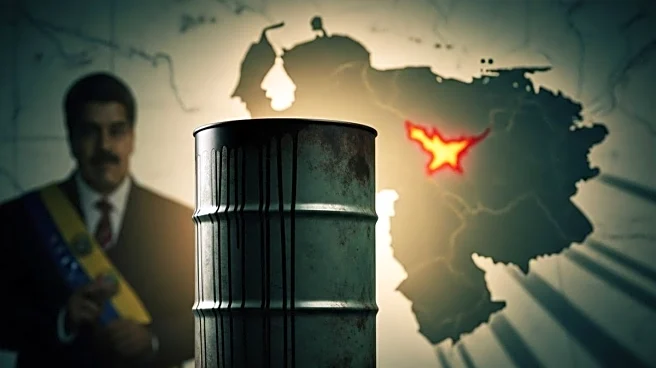

Global oil markets are closely tracking developments in Venezuela after the United States said it had “captured” President Nicolás Maduro in a military operation, raising concerns about possible disruptions
to crude supply from the oil-rich nation.
Venezuela has some of the world’s largest proven oil reserves. However, its impact on global oil prices has remained limited in recent years because exports have been restricted by long-standing US sanctions
. For now, international crude prices have stayed relatively steady, hovering near the $60-a-barrel level despite the political shock.US President Donald Trump said Washington would be “very strongly involved” in Venezuela’s oil sector following the operation. Speaking to Fox News, Trump said American oil companies would play a major role in the country’s energy industry, calling them the biggest and greatest in the world.
Oil Operations Continue
According to a report by Reuters, Venezuela’s state-run oil company PDVSA said its production and refining activities were running normally on Saturday. The company said its key oil facilities had not been damaged during the US strikes.
Reuters added that the port of La Guaira, close to the capital Caracas, suffered serious damage, though the port is not used for oil exports.
In December, Trump had announced a blockade on oil tankers entering or leaving Venezuela. The US later seized two cargoes of Venezuelan crude. These steps led many ship owners to avoid Venezuelan waters, causing a sharp rise in oil inventories held by PDVSA. The company was forced to slow deliveries at ports and store crude on tankers to keep production and refining going.
Production Trends
Venezuela’s oil output collapsed to record lows in 2020, falling to about 192 million barrels for the year, according to data from the International Energy Agency and Trading Economics. Production began to recover in 2021, reaching around 550,000 to 630,000 barrels per day.
Output continued to rise in 2022 and 2023, helped by Iranian diluent swaps and the partial easing of sanctions under US General License 44. Annual production increased to about 217 million barrels in 2022 and 264 million barrels in 2023.
What It Means For India
The situation is also important for India. While China remains the largest buyer of Venezuelan oil, India had been a key importer in the past. Indian purchases dropped sharply in 2021 and 2022 due to US sanctions.
Oil trade picked up again in 2023–24, with India’s petroleum imports from Venezuela rising to nearly $1 billion. In December 2023, India briefly became the top buyer of Venezuelan crude, according to The Financial Express.
Data from India’s trade agencies and the UN COMTRADE database shows imports rose to around 63,000–100,000 barrels per day in 2024, a sharp increase from the previous year. The IEA said India remained the third-largest buyer for much of 2025, though imports later declined as geopolitical tensions returned and US sanctions tightened.
As of Saturday evening, the Indian government had not issued an official response to the developments in Venezuela.





/images/ppid_59c68470-image-177104254494215325.webp)

/images/ppid_a911dc6a-image-177104210287325129.webp)

/images/ppid_a911dc6a-image-177104202793221357.webp)
/images/ppid_a911dc6a-image-177104206710214315.webp)
/images/ppid_a911dc6a-image-177104202907093694.webp)
/images/ppid_59c68470-image-177104014803952296.webp)