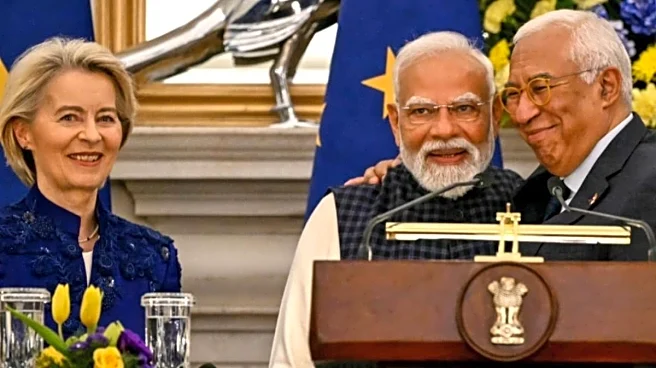




Stocks To Buy: India has concluded a landmark free trade agreement with the European Union — a pact Prime Minister Narendra Modi described as the “mother of all deals” — setting off a rush among investors to pinpoint companies poised to benefit as tariffs fall and regulatory hurdles ease across the 27-nation bloc.
Textiles, pharmaceuticals and specialty chemicals have emerged as early favourites, with several export-focused counters rallying up to 12% on Tuesday on hopes that lower duties and smoother approvals could unlock billions of dollars in incremental trade. Beyond these, opportunities are widening across shrimp exporters, auto component makers and jewellery players, as analysts assess what could be India’s most significant trade reset
in years.
Emkay Global said the agreement signals a structural shift in India’s export landscape rather than a short-term trading trigger. While the India–EU deal is positive for sentiment, it added that progress on a US–India trade pact, currency stability and a calmer global backdrop remain important. Sectorally, the brokerage sees textiles along with select pharma and chemical names as the key gainers.
The FTA is expected to provide a strong push to labour-intensive sectors such as textiles, apparel, leather, footwear, marine products, gems and jewellery, handicrafts, engineering goods and automobiles, with tariffs of up to 10% on nearly $33 billion of exports likely to fall to zero.
Which stocks could benefit?
Market experts believe export-oriented firms in textiles, gems and jewellery, auto components, pharmaceuticals, IT and defence stand to gain the most from improved EU market access.
Ross Maxwell, Global Strategy Operations Lead at VT Markets, said the agreement could strengthen India’s trade competitiveness and improve investor confidence over the medium term. Lower tariffs and simplified regulations should help sectors such as pharma, textiles, auto components and IT services tap one of the world’s largest consumer markets more effectively, he noted.
Sugandha Sachdeva, Founder of SS WealthStreet, named Samvardhana Motherson International, Apex Frozen Foods, Infosys, TCS, Cipla, Privi Speciality Chemicals and PCBL among preferred plays. She said these companies are well placed to benefit from stronger export demand, improved pricing power and diversification beyond traditional markets like the US and Asia, with tariff rationalisation potentially supporting volumes and margins.
However, she cautioned that the deal could create near-term pressure for some domestic auto manufacturers as European vehicles become more competitive in India. Certain liquor companies could also face headwinds from increased competition from European wines after duty adjustments.
Mahesh M. Ojha, AVP – Research at KC Securities, said export-focused companies with meaningful EU exposure are likely to be the biggest beneficiaries of what he termed the “mother of all deals,” though he stressed that gains will play out over the long term.
He highlighted the following stocks as long-term beneficiaries of the India–EU trade pact:
Apex Frozen Foods (30%), Avanti Feeds (17.2%), Aequs (49.45%), Aeroflex Industries (23%), Rishabh Instruments (68.1%), AXISCADES Technologies (37%), Dynamatic Technologies (55.83%), RACL Geartech (58.09%), Bharat Forge (35%), Tata Motors (35–40%), Precision Camshafts (23.14%), Sona BLW Precision Forgings (22%), Samvardhana Motherson International (31%), Endurance Technologies (23%), Anthem Biosciences (55%), Acutaas Chemicals (38.7%), Supriya Lifescience (41%), Rain Industries (40%), Hikal (28.5%), Marksans Pharma (39%), Indoco Remedies (49%), Divis Laboratories (33%), Gland Pharma (20%), Emcure Pharmaceuticals (20%), Aurobindo Pharma (29.7%), Solara Active Pharma Sciences (20.24%), Aimtron Electronics (23.61%), Blue Jet Healthcare (79%), M M Forgings (21.4%), PTC Industries (54.06%), KPR Mill (24.32%), PDS (71%), Trident (18–20%), Gokaldas Exports (30–35%), Welspun Living (20–22%), Vardhman Textiles (22–25%), TCS, HCL Technologies, Wipro, Tech Mahindra, Cipla and Privi Speciality Chemicals.
Analysts broadly agree that while the agreement improves the structural outlook for exporters, the full benefits are likely to materialise gradually as tariff cuts, regulatory alignment and trade flows evolve over time.




/images/ppid_a911dc6a-image-177092774715746114.webp)

/images/ppid_a911dc6a-image-177092767520012684.webp)
/images/ppid_a911dc6a-image-177092763347449403.webp)
/images/ppid_a911dc6a-image-177092652580356823.webp)