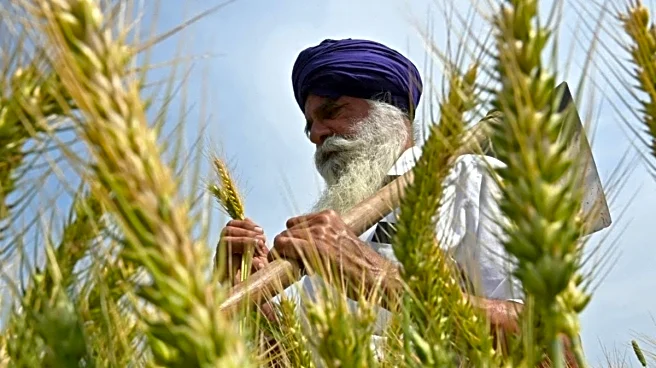

In its landmark trade agreement with the United States, which was finalised over a phone call between Prime Minister Narendra Modi and President Donald Trump on Monday night, India has stood firm in shielding
its “sensitive” farming sector — agriculture and dairy — while being poised to reaping benefits of a massive reduction in tariffs on Indian products from 50 percent to 18 percent.
According to Commerce Minister Piyush Goyal, the Centre has established strict guardrails to ensure that its sensitive agriculture and dairy sectors remain “completely protected” from foreign competition.
At a press conference on Tuesday, Goyal assured that the agreement will provide huge opportunities for people of the country and “will protect the sensitive sectors, the interests of our agriculture and our dairy sectors in full respect”.
He said the two countries have reached a framework for a bilateral trade agreement and a joint statement will be issued by both countries “shortly”, which will spell out the details.
“We will be shortly issuing a joint statement…along with the details which we will be shortly inking with the US. And as soon as the final understanding of the deal is inked and the joint statement is finalised, technical processes are completed, full details will be shared,” Goyal said.
ALSO READ | Why Did Donald Trump Announce India-US Trade Deal First? Piyush Goyal Responds
By protecting the agriculture and dairy sectors, India has ensured there will be no compromise on farmers’ interests, explicitly excluding items such as dairy, rice, wheat, meat, poultry, cereals, and maize from the ambit of the trade concessions. While the deal allows for duty concessions in certain areas similar to other free trade agreements, it mandates that no duty-free imports will be permitted for crops and agricultural products vital to the country’s food security.
The most flashy aspect of the deal is a major reduction in reciprocal tariffs, which will see duties on Indian goods plummet from 50 percent to 18 percent. This sharp reduction is expected to provide a massive boost to Indian exports and job creation, particularly in labour-intensive sectors previously hit by punitive levies. By lowering these trade barriers, the pact aims to restore India’s price advantage in the American market and significantly increase order flows for domestic manufacturers.
ALSO READ | ‘Rahul Gandhi Trying To Mislead’: Piyush Goyal Hits Back At India-US Trade Deal Criticism
Here is all you need to know:
- Significant Tariff Reduction: US reciprocal tariffs on Indian goods sharply reduced from 50% to 18%, making Indian exports competitive.
- Big Boost for Exports and Jobs: Labour-intensive and export sectors to gain strongly, creating large employment opportunities. Includes textiles, apparel, leather, footwear, gems and jewellery, plastics, machinery, aircraft components, marine products.
- Agriculture and Dairy Protected: Sensitive sectors like agriculture and dairy safeguarded; no compromise on farmers’ interests.
- MSME and Engineering Growth: Small and medium enterprises (MSME), alongside auto component and engineering manufacturers, will receive expanded access to the US market.
- Technology and Investment Inflows: The deal is designed to attract advanced technologies and investment into semiconductors, AI, data centres, and global capability centres.
- Marine Sector Relief: Fishermen and seafood exporters in coastal regions are set to benefit from improved tariff access for marine products, including shrimp.
- Infrastructure and Manufacturing: India is positioned to become a global supply chain hub, integrating deeper into international value chains for machinery and aircraft components.
- Phased Concessions: While some duties will be eliminated immediately, others will be phased out over time or managed through quota-based concessions to protect domestic industries.
HOW DID THE TRADE DEAL COME ABOUT?
To secure this agreement, India has committed to a significant strategic shift by halting its purchases of Russian oil in favour of American energy sources.
This commitment effectively nullifies a previous 25 percent punitive tariff, helping to lower the overall export duty to 18 percent.
India has promised to purchase $500 billion worth of American goods over the next five years. This massive procurement plan includes energy, technology, coal, and aircraft parts, with an estimated $20 billion per year allocated for data centre equipment alone.
WHAT WILL IT DO FOR INDIA?
This trade agreement significantly enhances the competitiveness of Indian exports by providing better market access than regional rivals.
The new 18 percent levy undercuts the tariffs faced by competitors such as Vietnam and Bangladesh (both at 20 percent), as well as Malaysia, Thailand, and Cambodia (all at 19 percent).
This restores a vital price advantage for labour-intensive industries such as textiles and jewellery, particularly benefiting manufacturing clusters in Tirupur and Surat that were previously hampered by high duties.
While full technical details are pending a formal joint statement from both countries, the pact is widely expected to stimulate massive job growth across the subcontinent. It is expected to modernise India’s manufacturing landscape and provide the “best-in-class” technologies required to power the next stage of India’s economic growth story.
(With agency inputs)



/images/ppid_a911dc6a-image-177014503577377007.webp)

/images/ppid_a911dc6a-image-177014508474738947.webp)






/images/ppid_59c68470-image-177014254985920163.webp)
