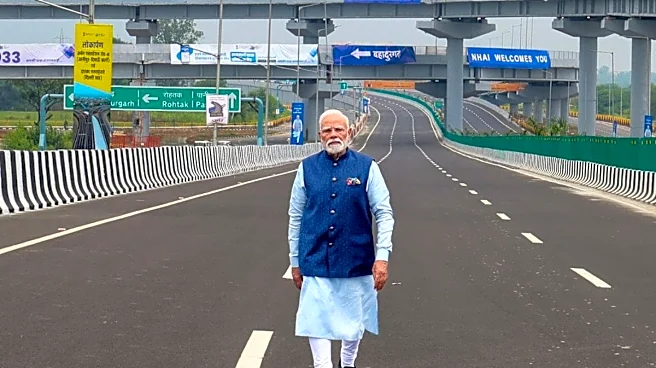



When Prime Minister Narendra Modi stepped into Dehradun on Tuesday to inaugurate the Delhi-Dehradun Expressway, he was opening more than a road. The 210-kilometre, six-lane corridor cuts the drive from the capital to Uttarakhand’s state seat from over six grinding hours to something closer to a morning’s commute, two and a half hours on a good run.
At roughly Rs 12,000-13,000 crore, the project passes through Rajaji National Park on a 12-kilometre elevated deck, only the second such wildlife-protection corridor on an Indian national highway.
The government calls it an economic corridor rather than a highway.
The Build-Out And the Dividend
The numbers behind India’s decade-long road push are striking when taken together. When Modi took office, the country had about 91,000 kilometres
of national highways. That network now exceeds 146,000 kilometres, which is roughly a 60 per cent increase in 10 years. Where high-speed corridors barely registered at 93 kilometres in 2014, they now stretch to 2,474 kilometres. A decade ago, construction teams were laying about twelve kilometres of highway a day. By 2023-24, they were doing between 28 and 30. The National Highways Authority of India committed Rs 2.07 lakh crore to construction in that single year, a record outlay that eclipsed every previous round of spending. The new Delhi-Dehradun corridor now locks into the Delhi–Mumbai Expressway and the Eastern Peripheral Expressway, pulling western Uttar Pradesh and the hill state of Uttarakhand into a widening lattice of access‑controlled roads that runs from the Himalayas to the Arabian Sea. Behind this concrete and asphalt sits a blunt economic logic. For years, India’s logistics bill hovered around 16 per cent of GDP, a silent tax on every factory, farm and retailer, and a built‑in handicap against Chinese manufacturers operating at 8-10 per cent. At the BME Conclave 2026 earlier this month, Road Transport Minister Nitin Gadkari pointed to a joint study by IIT Chennai, IIT Kanpur and IIM Bangalore: logistics costs have fallen to around 9 per cent of GDP, a drop he linked directly to the expressway build‑out. A separate NCAER assessment, commissioned by the government, put the figure for FY24 even lower at 7.97 per cent, compared with the 13-14 per cent estimates that prevailed through much of the previous decade. Each percentage point of reduction releases real cash along the supply chain — better margins for manufacturers, sharper pricing power for exporters, lower costs at the retail counter. The gains are uneven: road freight still carries the bulk of India’s goods, and last‑mile links remain unreliable in too many districts. But the direction of travel has changed in a way that simply was not visible five years ago.
The GQ template
The clearest evidence for what expressways actually do to an economy comes not from rosy forecasts but from a World Bank study of the Golden Quadrilateral, the 5,846-kilometre highway system that tied Delhi, Mumbai, Chennai and Kolkata together in the early 2000s. The research by the World Bank and Harvard University followed manufacturing districts within ten kilometres of that network over the following decade to see what changed.
Output in those districts grew by 49 per cent. Districts sitting 10-50 kilometres from the same road saw no such effect. Nor did districts along a comparable highway that had been scheduled for simultaneous upgrade but were pushed back, a near-perfect natural experiment confirming it was the infrastructure, not some underlying regional advantage, that drove the result.
The highway roughly doubled new firm formation rates in neighbouring districts and drew in land-intensive industries, sorting economic activity more efficiently between city centres and their surrounding areas. Allocative efficiency improved: capital and labour moved toward more productive plants rather than persisting in less competitive ones.
Taken together, the researchers estimated the GQ upgrades may have accounted for up to a fifth of all organised manufacturing growth in adjacent districts across that decade. The constraint was not the model; it was the failure of the previous government to sustain the development.
The Multiplier: 3.21 Times Over
An IIM Bangalore study conducted with NHAI, covering 2013 to 2022, found that every rupee spent on national highway construction contributed a Rs-3.21 increase in India’s GDP. Across more than 100 surveyed districts, highway development had raised household incomes by 9 per cent, lifted household expenditure by 6 per cent, and generated a 10.4 per cent surge in car sales. Transport costs between factories and raw material suppliers fell by close to 3 per cent; costs between factories and end customers dropped by 1.33 per cent.
The implication is significant. NHAI’s record Rs 2.07 lakh crore outlay in 2023-24, applied at a 3.21x multiplier, implies a potential GDP contribution of over Rs 6.6 lakh crore from a single year’s construction programme. Even under conservative assumptions, highway spending is among the highest-return categories of public investment available to the Indian government.
Rewriting the Real Estate Map
Along the Dwarka Expressway in Haryana, property values surged roughly 3.5 times in the five years to late 2025, from around Rs 6,300 per square foot to upwards of Rs 21,700–24,000. The Yamuna Expressway corridor witnessed a six-fold jump in land prices over a similar period.
Further afield, JLL India projects appreciation of 15–20 per cent in well-connected zones along emerging Bharatmala corridors, and Colliers has singled out five Gurugram micro-markets, each expressway-linked, as candidates for 1.5x to 1.6x capital gains by 2030.
What rising land values signal, in practice, is the arrival of sustained economic activity. Warehousing clusters appear first, then light manufacturing, then service businesses that need workers within commuting range, then the housing those workers require.
The Delhi-Dehradun Expressway is expected to set this cycle in motion along its Uttar Pradesh corridor, with industrial and logistics nodes already planned for Shamli and Saharanpur — towns that were, until this morning, three hours and a difficult drive from the capital.
Distance Compression and the Tourism Effect
Pilgrim footfall to the Char Dham sites — Badrinath, Kedarnath, Gangotri, Yamunotri — has tripled since the Char Dham highway programme got underway.
The Delhi-Dehradun Expressway, which spurs towards Haridwar and feeds into the Char Dham network, will only help boost it. Rishikesh and the lower Himalayan foothills are now a realistic day trip from Delhi for tens of millions of people. The Buddhist Circuit project, built at a cost of Rs 22,000 crore, has seen a measurable increase in visitors from South and South-East Asia.
The tourism sector is labour-intensive in the specific way that policymakers targeting regional development actually need: hospitality, transport, and retail jobs distributed across smaller towns, rather than concentrated in the large cities that already absorb too much of India’s economic growth.
The Compounding
India’s expressway revolution is not yet complete. The Bharatmala Pariyojana targets 65,000 kilometres of roads, including economic corridors and port connectivity, at a projected outlay of Rs 5.35 lakh crore. Under NMP 2.0 targets, the government aims to attract Rs 5.8 lakh crore in private-sector investment through the monetisation of existing highway assets.
What makes this moment structurally significant is the compounding dynamic. The GQ example shows that a single highway network — even in an era of much slower construction — could lift manufacturing output in adjacent districts by nearly half over a decade. India is now laying multiple such networks simultaneously, interlocking them, and drawing them through regions that have never before had high-speed road access.
The effects do not operate in isolation. A fall in logistics costs makes exports more competitive, which attracts industrial investment, which raises land values, which draws in housing and services, which generates taxable income, which finances further infrastructure, and so the loop tightens.
The Delhi-Dehradun Expressway, which opened today, is one of dozens of corridors now under construction or in planning. Its full economic footprint will take years to read. But the pattern established by India’s own experience over the past two decades, and confirmed by the World Bank’s district-level evidence, leaves little ambiguity about the direction of travel: in this country, roads of this quality do not merely carry traffic. They carry the economy with them.

/images/ppid_a911dc6a-image-177656196105859162.webp)








/images/ppid_a911dc6a-image-177655453998520808.webp)
/images/ppid_a911dc6a-image-177655402780160321.webp)