

/images/ppid_a911dc6a-image-178187022020494259.webp)
/images/ppid_a911dc6a-image-178188505632843808.webp)


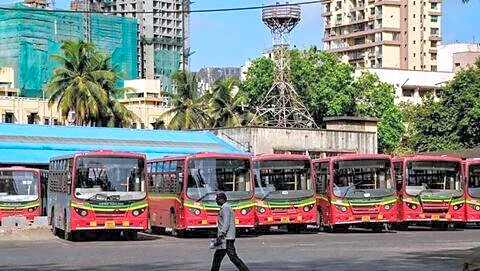
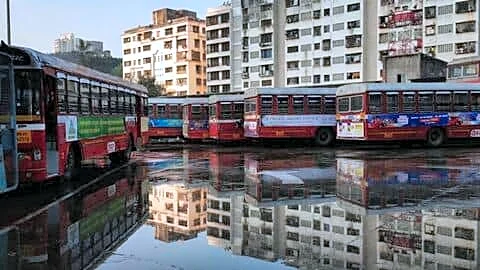
Mumbai, Jun 19 (PTI) Lakhs of commuters in the country’s financial capital faced a tough time on Friday as a strike by BEST employees almost brought the civic-run bus service to a halt, forcing them to depend on Metro, cabs and auto-rickshaws.
While fewer than 50 out of 2,766 buses of the Brihanmumbai Electric Supply and Transport undertaking plied on the roads, several commuters said they learnt about the strike only after reaching the bus stop.
Many of them alleged that taxi and autorickshaw drivers charged exorbitant fares, particularly outside railway stations.
Patients and their relatives travelling to major hospitals were among the worst-affected.
A commuter said patients visiting hospitals such as KEM Hospital generally travel by suburban
trains to Dadar or Parel and then take a BEST bus to reach the hospital. Many were forced to wait in long queues for shared taxis on Friday.
“A patient with his leg bandaged was waiting in the queue with me to catch a cab to reach KEM as he was unable to get a separate cab at Dadar station. I really felt sad for them,” said a nurse working at Tata Memorial Hospital in Parel.
School students also faced difficulties as, in the absence of buses, their parents or relatives were forced to drop them off at schools.
BEST is the second-largest mode of public transport in Mumbai after the suburban railway network which ferries more than 75 lakh passengers daily. BEST buses provide the crucial last-mile connectivity to nearly 25 lakh passengers every day.
According to a BEST spokesperson, the undertaking has a fleet of 2,766 buses, including 2,517 buses hired on wet lease from private operators. However, only 48 buses remained operational throughout the day.
In the first half of the day, only 38 buses hit the roads, but six were forced to return to depots due to incidents of stone pelting, the spokesperson said.
Commuters travelling to the Bandra Kurla Complex (BKC), one of Mumbai’s key business districts, also faced considerable inconvenience. Many were forced to walk long distances in the scorching heat to reach metro stations or railway stations, while others complained of being overcharged by autorickshaw drivers.
“Shared autorickshaws usually charge Rs 30 from Bharat Nagar to Bandra or Kurla, but today drivers were charging as they pleased. Some were demanding Rs 40 to Rs 50,” an employee of the Securities and Exchange Board of India (SEBI) said.
“I usually depend on BEST buses for travel within the area. However, I waited for a long time at a bus stop early this morning, but no buses were operating from the Shivaji Nagar depot due to the strike. Left with no alternative, I had to use my personal vehicle to reach my destination,” said Zameer Qureshi, corporator and member of the BMC standing committee.
The BEST spokesperson said the undertaking recorded 26 incidents related to the strike till evening, including 10 cases of stone pelting, 10 incidents of threats to staff, three cases of bus mirrors being damaged and three instances of air being let out of bus tyres.
Metro services witnessed a rise in ridership. MahaMumbai Metro Operation Corporation Limited (MMMOCL) said total ridership across its metro corridors stood at 2,48,453 passengers till 7 pm, compared to 2,34,593 passengers the day before, reflecting an increase of 13,860 commuters, or nearly 6 per cent.
Ridership on the underground Metro Line 3, operated by the Mumbai Metro Rail Corporation (MMRC), also registered a sharp increase during the day.
The corridor recorded 1,81,716 passengers till 7 pm on Friday, up from 1,51,502 commuters on Thursday, an increase of 30,214 passengers, or nearly 20 per cent, an MMRC spokesperson said.
A spokesperson for Mumbai Metro One said the Ghatkopar-Andheri-Versova corridor too recorded a significant surge.
“To cater to the increased commuter demand, Mumbai Metro One planned to run 486 trips, including 10 additional services, ensuring smoother commuter movement and enhanced convenience,” the spokesperson said.
The official said Mumbai Metro One had carried around 38,000 additional commuters till 5.30 pm compared to a normal working day, and expected the figure to touch nearly 60,000 by the end of service hours. PTI KK KRK



/images/ppid_59c68470-image-178189254107434813.webp)




/images/ppid_a911dc6a-image-178195432978141514.webp)