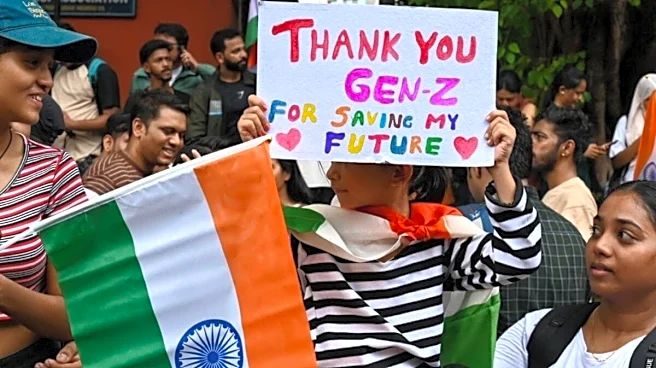



Rahul Gandhi’s latest outreach to India’s Gen Z is being packaged as a campaign for women’s empowerment, youth rights and individual freedom. But beneath the fashionable vocabulary of liberation lies a far older political instinct: selectively presenting Hindu civilisation as the source of India’s social ills while applying an entirely different standard when it comes to other religious practices.
That is not progressive politics. It is selective secularism. And increasingly, it looks like a sophisticated form of Hinduphobia dressed up as social justice.
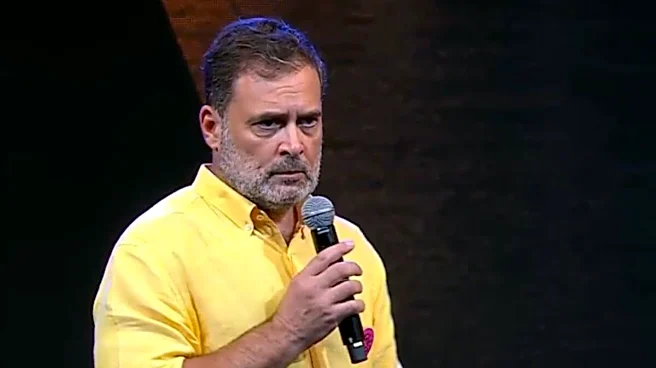
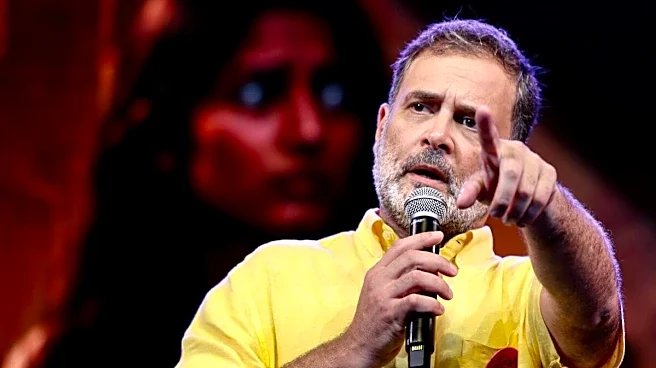
At his recent “Chhatron Ki Goonj” programme in Pune, Rahul Gandhi attacked the Manusmriti and described its supposed prescription of women’s subordination to male relatives as shameful. There
is nothing objectionable about debating ancient texts or criticising practices one considers regressive. Hindu civilisation itself has an extraordinarily rich tradition of such debate.
The problem begins when one selectively extracts from Hindu scripture to construct a caricature of an entire civilisation.
Consider the contrast. When Rahul Gandhi was asked about the hijab, his answer was unequivocal: what a woman wears is her decision and her responsibility; nobody else should decide what she wears.
Fair enough. Choice is indeed a legitimate principle.
But why does the principle of individual choice become sacred when discussing one’s religious practice, while Hindu traditions are routinely subjected to sweeping judgments about patriarchy and oppression?
Why is the Hindu woman to be “liberated” from her civilisation, while the Muslim woman’s religious attire is automatically placed beyond scrutiny in the name of choice?
If freedom of choice is the principle, apply it universally. If cultural practices are open to criticism, let every faith be subjected to the same intellectual scrutiny. That consistency is conspicuously absent.
And the contradiction becomes even more glaring when one examines Congress’s record on the very women and young people Rahul Gandhi claims to champion.
If the political empowerment of women is genuinely a priority, why has Congress opposed the present delimitation framework through which the constitutional promise of women’s reservation is to become operational? The very mechanism that could dramatically reshape the representation of women in Parliament and Assemblies is being caught in partisan confrontation.
And this is not an abstract constitutional question. Women’s reservation can potentially transform Indian politics more profoundly than almost any slogan about empowerment.
The same contradiction is visible in Congress’s approach to personal-law reform. The party and its leaders have opposed or resisted the Uniform Civil Code, with Congress leaders arguing that a UCC is unnecessary or potentially divisive. Congress also staged a walkout during the 2019 triple-talaq legislation debate while demanding that the legislation be sent to a parliamentary committee.
One can legitimately debate the design of these reforms. But the question Rahul Gandhi should answer is simple: why is reformist zeal directed so energetically at Hindu traditions, while reform involving other personal-law systems is approached with far greater caution?
Then comes the question of representation.
Congress’s rhetoric on women’s empowerment does not always sit comfortably with its own record in states where it is in power. Karnataka’s Congress government, even after its August 2026 cabinet expansion, had no woman minister after its sole proposed woman inductee was dropped at the last moment.
The contrast between rhetoric and reality is difficult to ignore.
And what message is Congress sending to young Indians when its response to a serious debate about students and examinations descends into personal mockery?
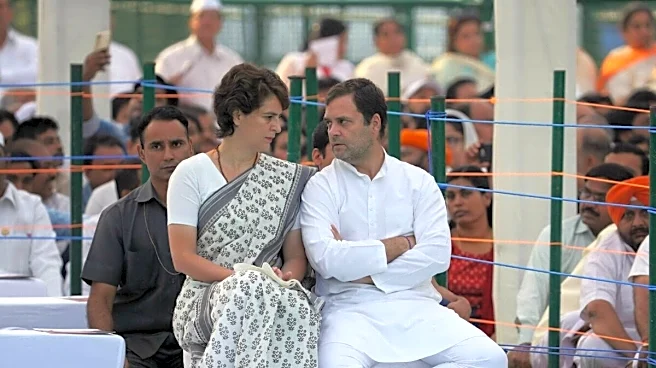
During the Parliament debate surrounding student protests and examination reforms, Priyanka Gandhi Vadra referred to an alleged “gaumutra expert” while attacking the government’s appointment of an expert to its examination-reform task force. The remark was widely understood as a reference to IIT Madras Director V. Kamakoti, whose academic credentials include work in computer architecture and national security; his team also developed the Shakti indigenous microprocessor. More than 200 academics subsequently criticised the remark as mockery substituting for reasoned engagement.
This is where the politics becomes revealing.
Would the Gandhi siblings use an equally derisive religious reference while speaking about a prominent institution associated with another faith? Would they casually use a religious practice of another community as a political insult? Or is Hindu civilisational vocabulary considered uniquely safe territory for ridicule?
Rahul Gandhi’s controversial invocation of “Shakti” during the 2024 election campaign is another example. At a rally, he said that in Hinduism there is a word “Shakti” and that he was fighting against a “Shakti”. He subsequently clarified that he was referring not to religious power but to what he described as the power of unrighteousness, corruption and falsehood.
Intent can certainly be debated. But so can impact. When a politician deliberately invokes a deeply sacred Hindu concept while attacking his political opponents, he cannot reasonably be surprised when millions of Hindus ask why their religious vocabulary has become political ammunition.
The larger concern, therefore, is not one speech or one quotation. It is the cumulative effect.
Young Indians are being told, subtly but repeatedly, that modernity requires them to distance themselves from Hindu civilisational practices; that questioning Hindu traditions is synonymous with being progressive; and that reverence for Sanatan traditions is somehow incompatible with feminism, individual freedom or scientific temper.
That is a dangerous falsehood.
India does not need a generation that is ashamed of its inheritance. Nor does it need a generation that refuses to question it. It needs a generation confident enough to do both: to inherit without being imprisoned by the past, and to reform without being contemptuous of the past.
There is nothing progressive about teaching young Indians to despise their civilisation. There is nothing liberal about applying different standards to different faiths. And there is certainly nothing empowering about telling young women that their freedom begins only when they reject their cultural inheritance.
Gen Z is smarter than that.
India’s young people deserve genuine empowerment—not ideological conditioning disguised as empowerment. They deserve politics that treats women as citizens rather than vote banks, youth as stakeholders rather than captive audiences, and every religion with the same measure of respect and scrutiny.
The Gandhi siblings may want to make Hindus question their traditions. Gen Z should instead ask the Gandhi siblings a more fundamental question: Why is the standard of freedom, reform and respect different when the religion being discussed is Hinduism?
That question may prove far more consequential than any carefully choreographed Gen Z outreach programme.
The writer is a national spokesperson of BJP and an acclaimed author. Views expressed in the above piece are personal and solely those of the author. They do not necessarily reflect News18’s views.