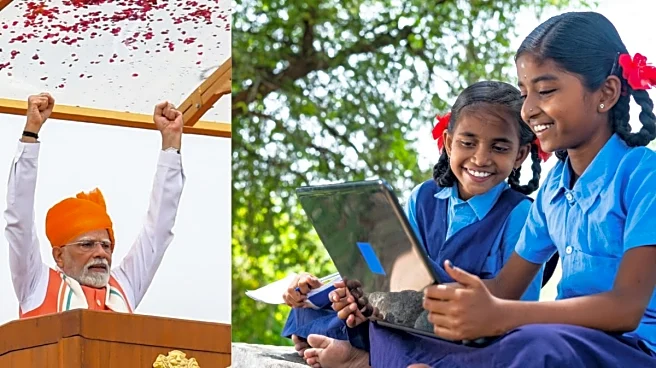

When Prime Minister Narendra Modi launched the Beti Bachao Beti Padhao scheme on a January morning in 2015, he chose not the sanitised confines of New Delhi’s bureaucracy but Panipat, Haryana, the ground
zero of India’s demographic catastrophe. The state’s child sex ratio had collapsed to 819 per 1,000 boys.
What followed was not a typical welfare programme. Over the past decade, Modi returned to the Red Fort ramparts eleven times on Independence Day to centre the girl child as emblematic of national progress. This constancy and the refusal to let the issue fade transformed BBBP from a sectoral initiative into a political movement. The results suggest something important: sustained top-level messaging can reshape how a nation sees itself and its daughters.
The data bears this out. India’s sex ratio at birth improved from 914 in 2011 to 930 by 2023, a modest improvement numerically, but seismic demographically. The most striking change was seen in Haryana’s Kurukshetra district, where the sex ratio swung from 743 to 980 in five years. Sonepat also moved from 808 to 939, showing reversals of long-term decline.
India has implemented gender-focused education programmes for over two decades. Yet enrolment gains had stalled. Girls’ secondary enrolment crept forward at a sluggish pace. What changed in 2014 was not funding, even though the resources invested did increase, but the location of the message. From the Red Fort, from the seat of national symbolism, Modi repeatedly questioned the patriarchal assumptions embedded in Indian homes. “Why do parents interrogate their daughters about where they go, but never question their sons?”
The directness mattered. By positioning gender discrimination not as a development challenge but as a constitutional and moral failure, Modi reoriented how bureaucrats, states, and communities understood their obligations. State administrators understood that sex ratio improvement would be measured as competence. Districts that improved performance would receive recognition; those that lagged would face scrutiny. The message cascaded downward.
Within a year, 422 of India’s 640 districts showed improvement in sex ratio. By 2023–24, institutional deliveries had climbed from 61 per cent to 97.3 per cent, a transformation in maternal healthcare utilisation that reflects not merely infrastructure expansion but changed expectations about women’s entitlements to safety. The first-trimester antenatal registration rose from 61 per cent to 71 per cent by 2020, suggesting that women in rural and poor households were exercising reproductive autonomy in ways the state had not previously witnessed.
Intersection of Messaging and Infrastructure
The programme’s genius lay in combining political commitment with institutional delivery. BBBP targeted the 100 most gender-unequal districts initially, with concentrated resources and monitoring. It integrated anganwadi workers, ASHA health workers, and school teachers into a multi-sectoral machinery. But the machinery alone would have failed without the political weight above it.
Girls’ secondary school enrolment has improved modestly, from 75.5 per cent to 79 per cent between 2014 and 2024. Three percentage points. Yet it’s a hard-won shift: these girls are transiting through the years when dropout, early marriage, and household pressure typically claim them. The improvement occurred alongside near-universal toilet access in schools and sustained campaigns highlighting the girl child’s economic value.
Critics derided the “Selfie with Daughters” campaign as performative, but it actually served as a normative shift, making the girl child visibly present in public spaces. The Kanya Shiksha Pravesh Utsav re-enrolled 100,786 out-of-school girls. These initiatives seem incremental, but their aggregate effect was to reorient cultural misconceptions rooted in society.
By 2021, BBBP merged into Mission Shakti, linking gender equity to economic autonomy. The Sukanya Samriddhi Yojana, a dedicated savings scheme for girls, became more than an incentive; it helped the girl child to aspire. In North Gujarat, 4.5 lakh accounts were opened. Families were not merely incentivised to preserve girls’ lives; they were offered pathways to their education and security.
Where Success Remains Contested
The limitations warrant acknowledgement. Haryana’s sex ratio declined to 910 in 2024, reversing earlier gains. Two hundred and eighteen districts either stagnated or declined between 2014 and 2019. Secondary education improvements, whilst real, remain marginal. Regional disparities persist: northern rural girls face marriage and dropout at rates substantially higher than their southern counterparts.
These gaps reflect the structural economics of the country. Where families face poverty, girls are often still derided as financial liabilities. BBBP’s gains in health and primary education required minimal adjustment, but secondary education and labour force participation demands a fundamental restructuring of household priorities, which becomes a harder sell in regions where traditional marriage patterns persist.
Yet, the movement persists. And in no small part is an acknowledgement to the government’s continuous messaging. No previous Indian Prime Minister had made gender discrimination a persistent theme across Independence Day speeches. No previous government had linked a welfare scheme so explicitly to national standing.
BBBP offers a replicable insight: sustained political commitment that is articulated from positions of symbolic authority often functions as social infrastructure. It creates space for bureaucrats to act without fear of reversal. It signals to communities that change is institutionalised, not ephemeral and generates competitive pressure among states and districts to improve outcomes.
The 12-point improvement in national sex ratio, the near-universalisation of institutional deliveries, the re-enrolment of over 100,000 out-of-school girls, and the opening of 4.5 million savings accounts for girls all bear the imprint of this commitment. Policy design alone could not have achieved this, and neither could funding alone. It was the combination of it all along with the symbolic repetition of the message from the nation’s oldest platform.
As Modi approaches his 12th Republic Day as Prime Minister, the BBBP’s decade offers an instructive case study in how messages matter. The girl child, once symbolic of a nation’s shame, has been repositioned as emblematic of its promise. That transformation is the true measure of a decade’s work.