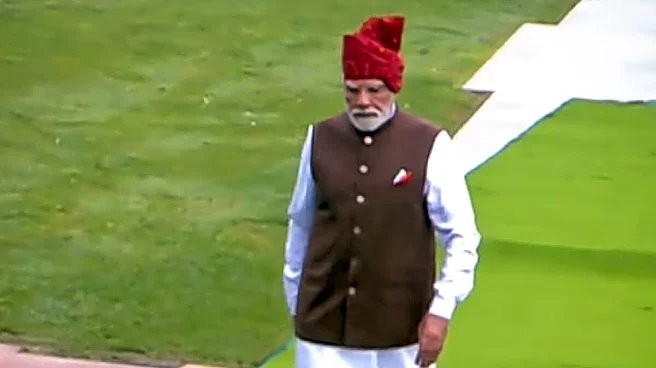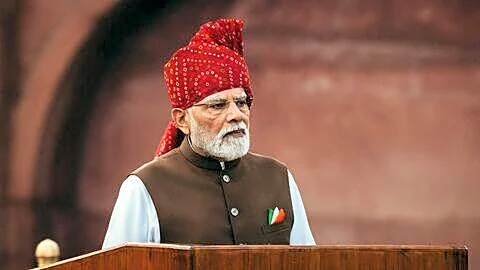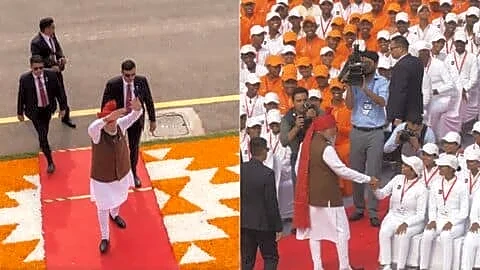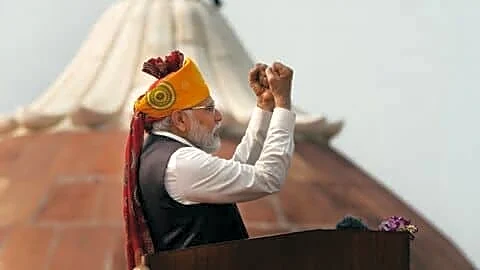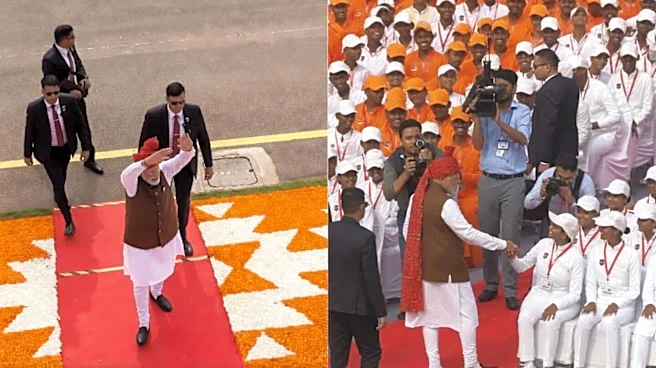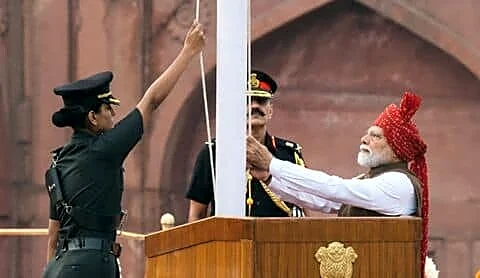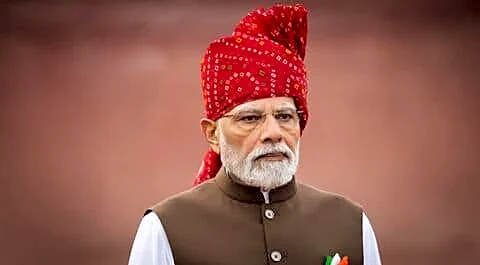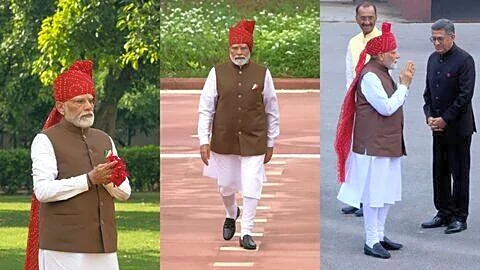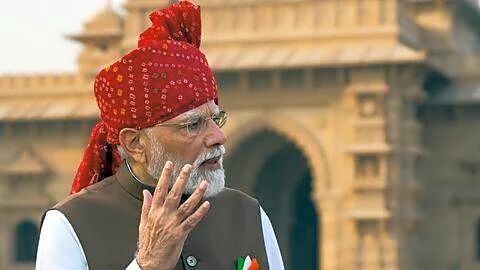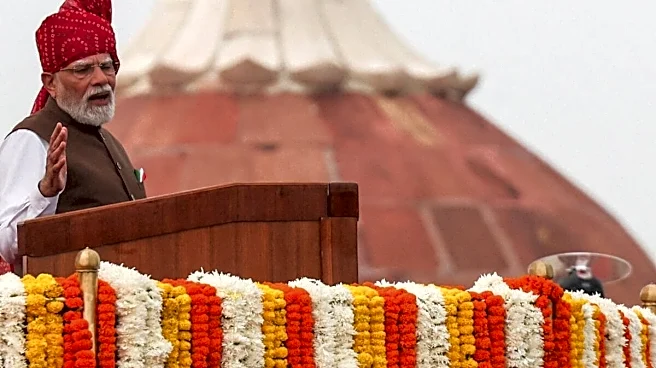

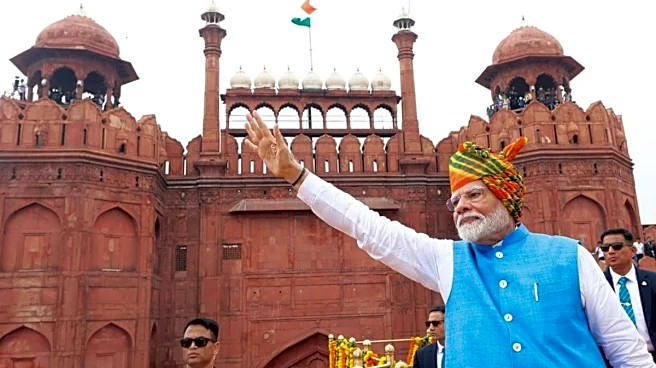
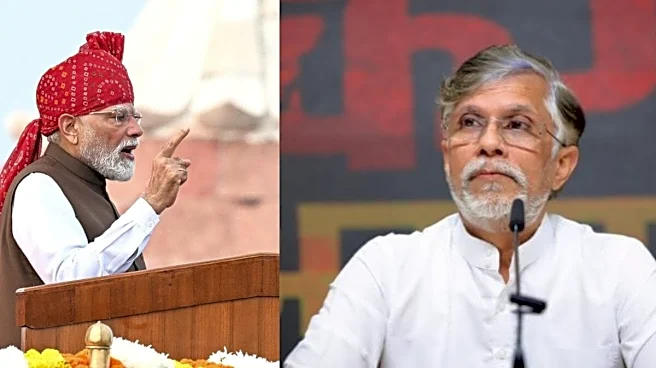
As Prime Minister Narendra Modi, donning a bright red Bandhani turban, took to the ramparts of the Red Fort on a cloudy Saturday morning, he made no direct reference to the 2029 Lok Sabha election in his Independence Day address. There was no appeal for another mandate, no explicit fourth-term pitch and no mention of the next general election.
Yet, his speech offered plenty for political watchers to read into.
From a 12-year report card and a roadmap for the next several years to ambitious targets for the next decade and the overarching goal of a ‘Viksit Bharat’ by 2047, PM Modi’s 80th Independence Day address was structured around one central idea: continuity of the trajectory he says has transformed India since 2014.
A 12-Year Report Card & A Much Longer Roadmap
PM Modi began by highlighting
what he described as the achievements of the past 12 years.
ALSO READ | PM Modi’s 80th Independence Day Speech: 7 Powers, Youth Push, Reforms And Big National Goals
He cited sharp increases in defence production, Khadi and Gramodyog, electronics manufacturing, mobile phone production and digital transactions. The prime minister’s argument was essentially that India had already travelled a significant distance under his government, but that the country should now aim much higher.
That distinction matters.
An Independence Day speech could have been used primarily to celebrate the present. Instead, PM Modi repeatedly moved from what has been achieved to what India must achieve next. And many of those ambitions extend far beyond the immediate political cycle.
The ‘50 Fortune 500’ Target
Perhaps the clearest example came when PM Modi challenged India to dramatically increase the global footprint of its companies. “We often hear about the Fortune 500. Why shouldn’t 50 of those Fortune 500 companies be from India in the coming decade? Why shouldn’t this be our goal?” he asked.
He went on to set similar ambitions for banking and pharmaceuticals, saying an Indian bank should feature among the world’s top five and an Indian pharmaceutical company should be among the world’s five largest. He also called for Indian consulting and accounting firms to become global leaders and for Indian technology companies to lead the world.
ALSO READ | Speech Decoder: The Political And Policy Messages Behind PM Modi’s Rhetoric
These are not 2029 targets. They are targets for a much longer horizon.
The prime minister is effectively asking Indians to judge the country’s progress against a series of goals that require years of policy continuity, investment and reform.
The 2047 Vision
PM Modi has repeatedly made 2047, the centenary of India’s Independence, the ultimate deadline for his ‘Viksit Bharat’ vision.
That was again at the centre of Saturday’s speech. The government has positioned youth, technology, manufacturing, energy security and self-reliance as pillars of that journey.
But the speech did not simply jump from 2026 to 2047. It established a series of nearer-term milestones.
PM Modi spoke of expanding semiconductor manufacturing, increasing nuclear power capacity and strengthening India’s energy security. He also noted the government’s ambition for seven to eight semiconductor plants and a 100 GW nuclear power target by 2047.
ALSO READ | PM Modi Hails Skyroot’s Young Team In I-Day Speech: What Made Its Space Launch Historic
The speech was thus less like an election manifesto and more like an argument for staying the course.
Youth Pitch
Another striking feature of the speech was its focus on young Indians.
PM Modi announced free online coaching for competitive examinations and said one crore young people would receive AI training over the next year.
The emphasis on Gen Z and “Yuva Shakti” was one of the defining features of the address, coming after the recent student protests over examination paper leaks.
Politically, this is significant because a large part of the electorate that will matter in 2029 is being addressed not merely as beneficiaries of welfare but as participants in India’s technology, employment and development story.
The message is essentially: the India of the future will be built around the opportunities being created today.
Reform Express
Perhaps the strongest argument for reading a continuity message into the speech came from PM Modi’s comments on reforms.
He said India cannot continue to be governed by policies and regulations of the past and argued that systems must be developed according to the “dreams of the future”. He also said reforms were being undertaken “not out of compulsion, but out of conviction”.
ALSO READ | Economy, Jobs And Growth: What PM Modi Promised From The Red Fort On I-Day
The political implication is subtle. If the government’s argument is that India needs a sustained programme of reforms to achieve its 2047 goals, then the obvious question is: who will carry that reform programme forward?
PM Modi did not answer that question in electoral terms. But the architecture of the speech implicitly places the current government at the centre of a project that stretches well beyond one election.
So, Was There A 2029 Message?
Yes, but only in the subtext.
It would be an overstatement to say PM Modi used the Independence Day speech to launch a 2029 campaign. However, there was a clear attempt to frame the next phase of India’s development as a continuation of the trajectory that the prime minister says began in 2014.
By presenting India’s transformation as a multi-stage project, from the achievements of the last 12 years to the targets of the coming decade and finally to developed India in 2047, PM Modi’s speech sought to make the political question about something larger than the next election.
The underlying proposition was: India has begun a journey, the destination is 2047, and the reforms and ambitions required to get there must continue.