
/images/ppid_a911dc6a-image-177797102769042715.webp)
Dravida Munnetra Kazhagam (DMK) or All India Anna Dravida Munnetra Kazhagam (AIADMK), which party will form the government this time? For decades, any Tamil Nadu election boiled down to this familiar question. The answer usually settled the mandate. One of the two would usually cross the halfway mark in the 234-member Assembly, or get close enough for longtime allies to make the rest irrelevant.
The 2026 Tamil Nadu verdict has unsettled that pattern.
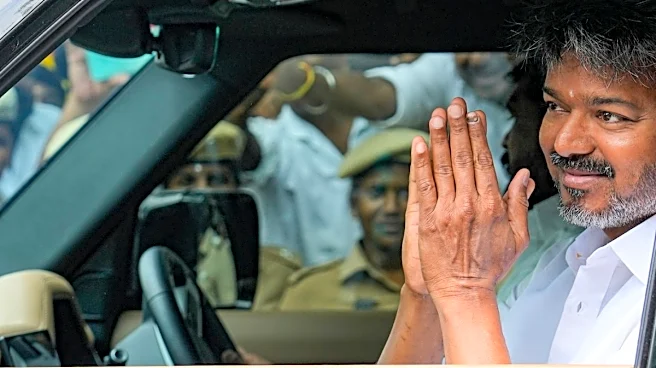
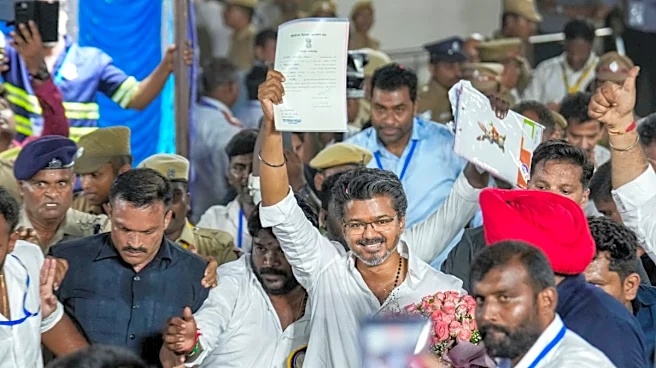
Actor-politician Vijay’s Tamilaga Vettri Kazhagam (TVK), contesting its first-ever Tamil Nadu Assembly election, has emerged as the single largest party with 108 seats. That is just 10 short of the majority mark of 118. It also secured roughly 32% of the votes, ahead of both the DMK and AIADMK, which
slipped into the mid-20s and low-20s range, respectively.
Vijay has already moved quickly, writing to the Governor and staking claim to form the next Tamil Nadu government. All eyes are now on whose help he accepts to cross the magic mark come floor test day in the Assembly.
But the bigger question for future elections is not just who wins Tamil Nadu. It’s whether anyone can still win it outright — with an absolute majority.
Tamil Nadu Rarely Produces Split Mandates
Tamil Nadu has rarely behaved like a fragmented polity, even though it has always had multiple parties in the fray. Since 1967, when the Congress dominance collapsed in the state, politics has largely revolved around the two Dravidian poles — DMK and AIADMK — with national and smaller regional parties playing supporting roles.
What made the system more stable than other states was not the absence of competition, but how that competition was structured. Parties stitched together pre-poll alliances that effectively turned multi-cornered contests into two broad camps. Under the first-past-the-post system, that consolidation mattered. A party or alliance getting around 35-40% vote share could convert that into a comfortable majority in seats.
That is why outright majorities were not uncommon. Even when they weren’t, as in 2006, the DMK was able to run a minority government with outside support that lasted its full term. The system absorbed numerical gaps before they became political instability.
How 2026 Election Result Has Changed That
This time, the disruption is not just electoral. It is structural.
Vijay’s TVK is not a marginal player eating into one party’s vote bank. It has shown a statewide presence, both in vote share and, crucially, in seats. Its tally of 108 MLAs is not the result of a few concentrated wins, it reflects competitiveness across regions.
At the same time, both the DMK and AIADMK have taken a hit. The DMK, led by MK Stalin, is down to 59 seats, while the AIADMK has 47. Beyond that, smaller parties — Congress (5), PMK (4), and others in single digits — hold the balance in a tightly packed Assembly.
For the first time in decades, Tamil Nadu has three parties with enough strength in the House to deny each other a majority on their own.
Why Three-Way Contests Make Majorities Harder
The math is straightforward, even if the politics is not.
In a largely bipolar contest, a party crossing the high 30s in vote share often translates into a majority of seats. The margins in individual constituencies tend to be wider, and victories stack up quickly.
But in a three-cornered fight, the same advantage behaves differently. Seats get split. Constituencies are won with tighter margins. A party can lead the field comfortably and still fall short of the numbers needed to govern alone.
That is what the 2026 tally captures. With 108 seats, TVK is clearly ahead — but not far enough ahead.
The same pattern, if repeated, could produce more Assemblies where the leading party falls just short of 118.
From Clear Winners to Negotiated Mandates
If this three-way competition sustains, the nature of outcomes is likely to shift.
Tamil Nadu may begin to see more elections where the leading party finishes somewhere in the 90-115 seat range — ahead, but short. Governments in such scenarios would depend on post-poll support from smaller parties, some of whom were earlier part of rival alliances.
That process is already visible. TVK needs at least 10 more MLAs to cross the halfway mark, bringing parties like the Congress and others into play.
There is also a subtler shift here. Alliances, which were traditionally stitched together before elections, may increasingly become post-election arrangements, shaped by seat arithmetic rather than pre-poll strategy.
The Big Unknown: Can TVK Sustain This?
One election, however dramatic, does not settle the future.
The real test for Tamilaga Vettri Kazhagam is whether it can hold on to this level of support in subsequent elections. Tamil Nadu has seen challengers rise before — the Desiya Murpokku Dravida Kazhagam under Vijayakanth made a strong impact in 2011 — but sustaining that momentum proved difficult.
If TVK consolidates its position as a durable force, the three-way contest becomes the new normal. If its vote share dips or gets absorbed into alliances, the system could revert, at least partially, to a two-bloc structure.
So, Are Hung Assemblies More Likely?
More likely, yes. Inevitable, not quite.
What has clearly changed is the path to a majority. Earlier, it was realistic for either the DMK or AIADMK to cross 118 on their own or come close enough for allies to make the difference quickly. With a third player of comparable scale in the mix, that path has narrowed.
No one saying that Tamil Nadu is heading towards political instability. Its party structures, leadership models and history of negotiated support make that unlikely.
But the numbers are getting tighter.
If the 2026 verdict holds over the next election cycle, the state may well move into an era where mandates are still clear in intent, but less decisive in arithmetic — and where forming the government could depend as much on what happens after the results as on the results themselves.

/images/ppid_a911dc6a-image-177804382923787581.webp)

/images/ppid_a911dc6a-image-177797892022225954.webp)
/images/ppid_a911dc6a-image-177800482859760007.webp)