
/images/ppid_59c68470-image-178028252896940294.webp)
/images/ppid_59c68470-image-178028256150629685.webp)
/images/ppid_a911dc6a-image-178028205544875226.webp)
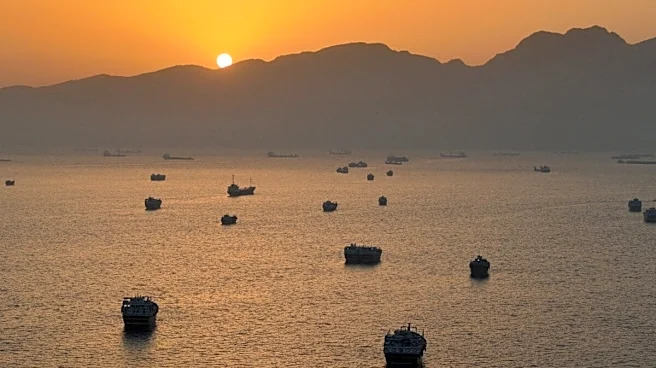
Commercial ships are quietly finding ways to sail through the Strait of Hormuz despite mounting tensions and threats in the crucial waterway, according to a report by The Wall Street Journal.
Some vessels are reportedly switching off lights and navigation systems while coordinating with the US military in an effort to avoid Iranian attacks and safely cross the strait.
The report said that a small number of ships, including massive oil and liquefied natural gas tankers, have managed to pass through the dangerous route in recent weeks, creating what it described as a “tiny relief valve for the global economy.”
According to the report, some ships are sailing in what the maritime industry calls “dark mode.”
This involves turning off Automatic Identification
Systems (AIS), the electronic tracking beacons that ships normally use to broadcast their position and prevent collisions at sea.
The report mentioned that turning off AIS makes ships harder to detect electronically and potentially less vulnerable to Iranian targeting.
“To navigate the strait, some ships stay in contact with US military officials, who use radar, drones and other tools to monitor traffic and help them transit safely,” the report said.
Shipowners and US officials told the newspaper that the US military advises vessels on “when to go dark and how to respond to Iranian threats.”
The report said some ships were moving through a section of the Persian Gulf that had earlier been cleared by the United States under an initiative called “Project Freedom.”
The operation reportedly involved US naval and air escorts aimed at helping commercial traffic move through the region.
However, the initiative was later suspended after Iran began attacking vessels and Saudi Arabia restricted US access to its bases and airspace, the report added.
Even after the operation was halted, the report said the US had already cleared a relatively safer route through the Gulf using underwater robots to remove mines.
Captain Tim Hawkins, spokesperson for the US Central Command, told the newspaper that the US was “continually communicating and coordinating with ships transiting the Strait of Hormuz.”
The report also said the US recently destroyed Iranian mine-laying boats and struck missile and drone sites, describing the actions as defensive measures.
GREEK TANKER REACHES OPEN WATERS
One of the vessels that reportedly crossed the strait in this manner earlier this week was a Greek supertanker carrying around two million barrels of crude oil.
According to the report, the ship had been stranded in the Persian Gulf since early March.
It later sailed along the coast of Oman while maintaining communication with US officials and is now heading toward India with its cargo.
The Journal reported that Greek shipowners whose vessels successfully crossed the route are now receiving requests from clients seeking similar arrangements for their cargo shipments.
FEW SHIPS MAKING THE JOURNEY
Data published by maritime intelligence firm Kpler, cited in the report, showed that fewer than five ships per day have travelled “dark” through the Strait of Hormuz since March 2.
Most vessels, however, reportedly continued to use the Iran-designated shipping route close to the Iranian coastline in the northern section of the strait.
Before the conflict intensified, more than 100 ships crossed the channel daily, the report noted.
Traffic has repeatedly slowed or nearly stopped during military exchanges in the region, including recent US strikes on Iranian drone and missile sites.
Michelle Bockmann, a maritime intelligence analyst at Windward, told the newspaper, “Everyone’s waiting for a small window to open to get their ships out.”
The report also highlighted another vessel, the Chinese-owned Vicstar, which reportedly completed a dark transit on May 17 while carrying fertiliser from the United Arab Emirates to Brazil after remaining stuck in the Gulf for nearly three months.
HIGH COSTS AND RISING RISKS
The report said there is growing financial pressure on ship operators to move vessels out of the Gulf.
According to maritime analysts cited by the newspaper, operators of large crude carriers spend between $10,000 and $15,000 daily on fuel and crew expenses while ships remain stationary. Insurance premiums have also surged, while crews are being paid extra because of war-risk conditions.
Experts quoted in the report warned that sailing without AIS carries major safety risks.
Ships travelling in the dark cannot easily identify nearby vessels electronically and instead depend heavily on radar systems and experienced crews to avoid collisions.
“There are obviously safety and security risks” associated with dark sailing, Claire Jungman, director of maritime risk and intelligence at Vortexa, told the newspaper.
Insurance companies are also divided over the dangers involved.
Some insurers reportedly charge higher premiums for vessels travelling with naval escorts, believing they may become more visible military targets, while others offer lower premiums due to the added protection.
The report said insurance rates for ships crossing the strait have climbed to between 2.5 per cent and 4 per cent of a vessel’s value, compared with roughly 0.25 per cent during peacetime.
Iran, meanwhile, has reportedly insisted during ongoing negotiations that it should continue playing a role in approving ship traffic through the waterway and could potentially impose tolls on commercial vessels, according to the report.
/images/ppid_a911dc6a-image-178028554108210509.webp)



/images/ppid_59c68470-image-178028513032614092.webp)

/images/ppid_59c68470-image-178028502994863121.webp)
/images/ppid_59c68470-image-178028503041014245.webp)

/images/ppid_59c68470-image-178028509478356600.webp)

/images/ppid_59c68470-image-17802850249156109.webp)
/images/ppid_59c68470-image-178028262802431060.webp)