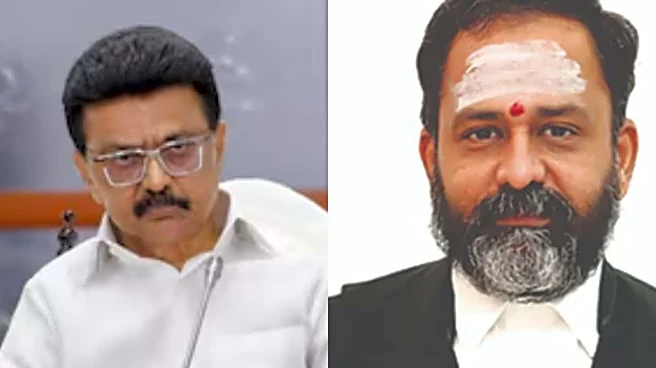



The Dravida Munnetra Kazhagam (DMK) is reportedly planning to move an impeachment motion against GR Swaminathan, the Madras High Court judge who allowed the lighting of the Karthigai Deepam lamp atop Thirupparankundram hills. The party has reached out to the MPs of INDIA block seeking support for the move.
“Tamil Nadu MPs might sign,” a Congress MP from the state told CNN-News18. Another senior leader confirmed that other MPs were also being taken into confidence on the same. “100 signatures will be needed to bring in the impeachment motion so other India block MPs are being approached,” the leader said. DMK leaders, as per sources, feel that “proven misbehaviour or incapacity” can be established under the Judges’ Inquiry Act, 1968 against Swaminathan.
The contemplated motion stems from Swaminathan’s December 2025 order permitting the lighting of the Karthigai Deepam lamp on the “Deepathoon” pillar atop the hill at Thiruparankundram hill — a site also housing a 14th-century dargah. DMK and its allies argue this order undermines a 2017 bench ruling that disallowed court interference in temple rituals, and claim the judge’s decision risks communal tension.
How Is A Judge Impeached?
The impeachment of a sitting judge in India is an extraordinary step requiring high thresholds. Critics caution that simply disagreeing with a verdict may not meet the constitutional standard for “judicial misconduct.”
The impeachment of a judge of the Supreme Court or High Court is one of the most serious constitutional procedures in India.
The procedure begins in Parliament. A removal motion can be introduced in either House, but it must carry substantial initial support: at least 100 members of the Lok Sabha or 50 members of the Rajya Sabha must sign the notice. Once submitted to the Speaker of the Lok Sabha or the Chairman of the Rajya Sabha, the presiding officer decides whether the motion deserves to be admitted. This discretionary stage often determines whether the process moves forward.
If the motion is admitted, a three-member inquiry committee is formed. It typically consists of a senior Supreme Court judge, a Chief Justice of a High Court, and an eminent jurist. This committee functions almost like a trial body — examining evidence, hearing witnesses, and giving the concerned judge an opportunity to defend themselves. Its report is crucial: only if the committee concludes that the charges are proved does the motion proceed.
If the committee finds the judge guilty of “proven misbehaviour or incapacity,” the motion is then taken up for debate and voting in both Houses of Parliament. For the removal to pass, each House must approve it with a special majority — two-thirds of members present and voting, and a majority of the total membership.
If both Houses pass the motion, it is sent to the President, who formally orders the judge’s removal.
Recent Instances Of Impeachment Motion Against Judges
In March 2025, a fire at the official residence of Yashwant Varma, a judge of the Delhi High Court, reportedly led to the discovery of a large amount of unexplained cash. A three-judge panel appointed by the Supreme Court of India then investigated and concluded that Varma could not satisfactorily explain the cash stash — finding the misconduct serious enough to warrant impeachment proceedings.
By early July 2025, the government reportedly had the support of over 100 members of the lower house to table a removal motion. Subsequently, the Speaker of Lok Sabha has reportedly initiated the process by constituting a three-member panel under the relevant law (the Judges (Inquiry) Act, 1968) to further examine the allegations.
Similarly, around 55 opposition MPs submitted an impeachment notice in the Rajya Sabha in December 2024 against Justice Shekhar Kumar Yadav of the Allahabad High Court. The motion was triggered by his controversial public remarks at a VHP event, where he allegedly advocated laws reflecting the “majority’s wishes” and supported a Uniform Civil Code. The Opposition alleged his statements violated judicial neutrality and targeted minorities. The motion later ran into procedural hurdles, including questions over duplicate or unverified MP signatures, delaying its admission. No inquiry committee has been formed yet, and the motion remains pending without formal progression.
So far, no Indian judge has been impeached.


/images/ppid_a911dc6a-image-177107062796921011.webp)



/images/ppid_a911dc6a-image-17710700586131340.webp)
/images/ppid_a911dc6a-image-177107002875928030.webp)
/images/ppid_a911dc6a-image-177107008754197673.webp)