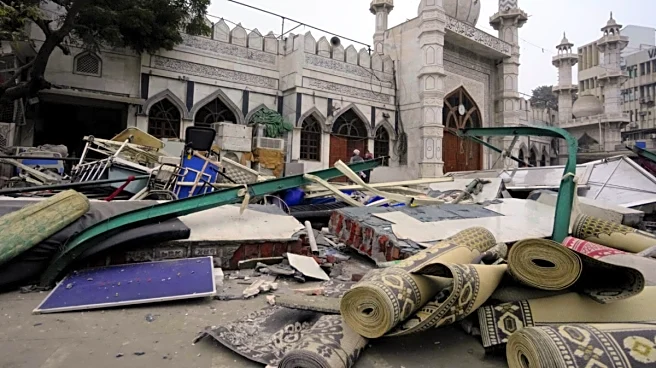

The 18th-century Faiz-e-Ilahi Mosque in Delhi’s Turkman Gate area finds itself at the centre of a major political storm after locals clashed with the police during a court-ordered demolition drive on land
adjacent to the mosque.
Five people have been arrested while 10-15 others have been detailed, and five policemen were also reportedly injured during the incident on the intervening night of Tuesday and Wednesday. News agency PTI quoted a Municipal Corporation of Delhi (MCD) official as saying that the mosque was not damaged during the demolition drive.
With the episode bringing the Faiz-e-Ilahi Mosque under the spotlight, News18 takes a look at its history and who is in-charge of its upkeep now:
When was Faiz-e-Ilahi Mosque built, who built it and how old is its history?
The history of Faiz-e-Ilahi Mosque dates back to the late 18th century. It was built by the great Sufi saint Hazrat Shah Faiz-e-Ilahi, who was a highly respected spiritual leader of his time and belonged to the Chishti order of Sufis. It is said that he built this mosque not only for prayers but also as a centre to teach spirituality and brotherhood.
What do historians say about Faiz-e-Ilahi Mosque?
Historians say the mosque is about 250-years-old. It was built during the reign of Mughal emperor Ahmad Shah Bahadur or Shah Alam II when the Mughal Empire was declining, but Delhi’s cultural and religious activities were still at their peak. Shah Faiz-e-Ilahi shaped this sacred place with his personal property and the help of his followers.
What do we know about the architecture of the Faiz-e-Ilahi Mosque?
The architecture of Faiz-e-Ilahi Mosque clearly shows the Mughal style. Although it is not as grand as Jama Masjid, its details are worth witnessing. It was build primarily using red sandstone and white marble. The arches and domes display traditional Mughal engineering.
What is inside the Faiz-e-Ilahi Mosque?
The interior is designed to stay cool even in summer, which was a major feature of architecture at the time. In the mosque’s courtyard, there is a small area for ablution, and Quranic verses are beautifully inscribed on the walls. Over time, some changes and repairs have been made to the structure, but its original spirit from the 18th century remains.
Who is responsible for its management and supervision now?
Currently, the management of Faiz-e-Ilahi Mosque falls under the purview of the Delhi Waqf Board. According to rules, the Waqf Board is responsible for its properties and maintenance. However, daily activities like prayer timings, cleaning, and organising religious events are handled by a local management committee.
What is the role of the Waqf Board?
In the mosque’s administration, the role of a ‘mutawalli’ (trustee) is important, who runs the operations smoothly with the help of the local community. Since this is a historic site, the Archaeological Survey of India (ASI) and other conservation bodies also pay attention to its upkeep.
Which historical events has this mosque witnessed?
The Faiz-e-Ilahi Mosque has witnessed many historic events in Delhi. Whether it was the First War of Independence in 1857 or the Partition of India in 1947, this mosque has always provided shelter and peace to local residents.
During the 1857 revolt, when many parts of Old Delhi were targeted by the British, these small mosques and shrines kept people’s faith alive.
Even today, the annual celebration of Hazrat Shah Faiz-e-Ilahi is held here with great devotion, attended by both Hindu and Muslim communities.
/images/ppid_a911dc6a-image-177098954007759066.webp)

/images/ppid_a911dc6a-image-177098884753017905.webp)






/images/ppid_59c68470-image-1770987582774322.webp)

/images/ppid_59c68470-image-177098761981591595.webp)
/images/ppid_59c68470-image-1770987529810585.webp)
/images/ppid_59c68470-image-177098766350256772.webp)