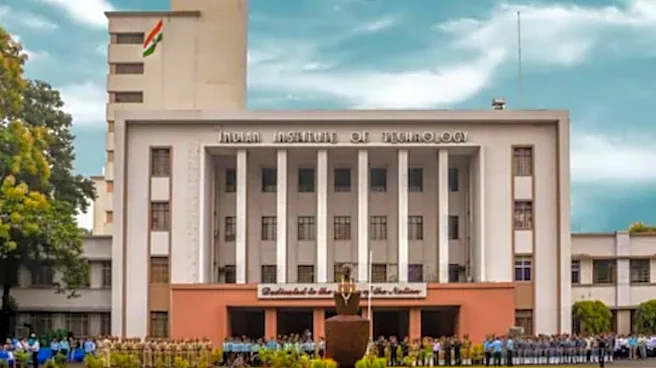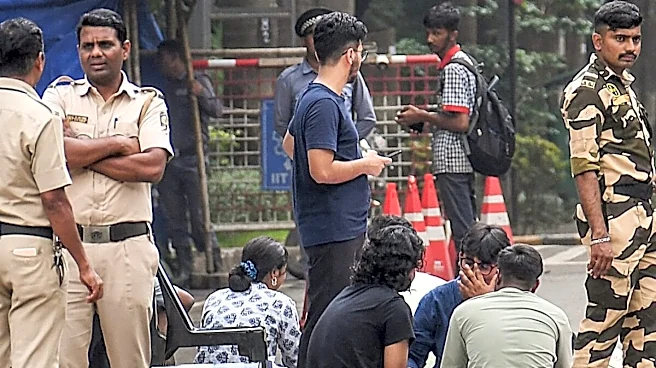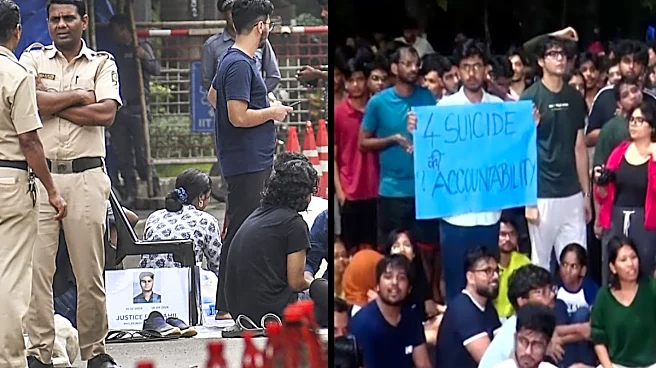



The protests at IIT Bombay following the death of 20-year-old BTech student Sahil Wakode have now moved beyond demands for answers over one incident. After three days of demonstrations on the Powai campus, students submitted an 18-point charter seeking changes to how the institute handles student complaints, examination-related disciplinary proceedings, mental health, faculty accountability and student representation.
IIT Bombay Director Professor Shireesh Kedare signed the charter following a nearly three-hour meeting with protesting students late on Sunday. The administration has, however, maintained that several matters will be subject to due process and investigation. The institute’s Board of Governors is also considering the demands.
Read
More: IIT Bombay Professor Suryanarayana Doolla, Named In FIR, Suspended As Dean Over Student’s Suicide
The charter followed Wakode’s death on September 18, hours after he was allegedly found with a mobile phone during a mid-semester examination. IIT Bombay had said he uploaded the question paper on ChatGPT to seek answers and that no disciplinary action had been initiated against him. Students, however, raised questions about what happened inside and after the examination and demanded greater transparency.
What exactly are the 18 demands put forth by students?
1. Action against those found responsible
Students have sought the immediate suspension of Professor Suryanarayana Doolla, who was invigilating the examination, and removal of any other person found guilty following an investigation.
On Monday, IIT Bombay suspended Doolla from his position as Dean of Administrative Affairs, saying further action would follow an investigation. Students have pointed out that their demand concerned suspension as a professor, not merely removal from an administrative position.
2. Apology over the institute’s initial communication
Students demanded a public apology for what they described as the “defamation” of Wakode after the institute publicly referred to the examination incident.
IIT Bombay subsequently apologised, saying it was inappropriate to characterise details surrounding Wakode’s death before they had been established through the appropriate investigative process.
3. An open house with senior administrators
The students have demanded an open interaction involving the Director, deans and Wakode’s department head, where students can ask questions directly.
The demand reflects a broader theme running through the charter that students want institutional decisions and explanations to be more transparent and accessible.
4. Director’s Resignation if reforms are not implemented
One of the strongest demands in the charter concerns accountability at the top. Students have said that IIT Bombay Director Shireesh Kedare, along with Dean AP and Dean SA, should resign if demands 5 to 14 are not implemented within one month. They have also sought weekly updates on the progress of those reforms.
5. Independent investigation into Wakode’s death
One of the most significant demands is an independent panel to examine the circumstances surrounding Wakode’s death, including the events around the examination and the subsequent emergency and hospital response.
Students have sought representation for professors, students and external members on the panel, with an interim report by September 30 and public conclusions by October 15.
The demand comes as the Mumbai Police investigates the case. An FIR was registered following a complaint by Wakode’s father, including allegations of caste-based discrimination. Those allegations are disputed by IIT Bombay and remain subject to investigation.
6. Financial and institutional support for bereaved families
Students have also asked IIT Bombay to provide fair and prompt monetary assistance, in consultation with families, to four families who have recently lost loved ones on campus, along with continued institutional support.
7. A greater student voice in decision-making
The charter seeks equal student representation and voting rights on academic and non-academic committees dealing with student issues, without an administrative veto over the student representatives.
This is one of the demands that takes the protest beyond the Wakode case and into questions about how India’s premier educational institutions make decisions affecting students.
8. Review of decisions taken without student consultation
Students want decisions affecting campus culture that were taken without prior consultation to be reconsidered after taking student views into account.
9. Formal code for complaints against professors
Another major demand is a committee to create a clear system for complaints against faculty members, including defined timelines, escalation mechanisms and procedures for examining allegations.
10. Changes to disciplinary proceedings
Students have specifically sought reforms in the handling of cases before the institute’s Disciplinary Action Committee.
They want students facing malpractice proceedings to have their mentor, student companion and a student buddy of their choice informed and involved, with interactions documented.
The demand assumes particular significance in the Wakode case because the controversy began with an examination-related allegation.
11-14. A major overhaul of mental-health support
Four demands focus directly on student wellbeing.
Students want at least one counsellor for every 250 students, counsellors in every hostel and regular independent audits of the Student Wellness Centre. They have also called for a 24/7 psychiatrist on call, better-qualified emergency and night-shift doctors, mental-health training for hospital staff and mechanisms to address student concerns.
They want mandatory mental-health sensitisation workshops for professors and staff every two months, along with such training during onboarding.
Students have also demanded that the Dean of Student Affairs’ office allocate at least 20 hours a week for one-on-one student interactions and respond to student concerns within a defined timeframe.
15. Protecting hostel support networks
The charter seeks measures to keep student “wings” and peer networks together, including adjacent rooms for wingmates in subsequent years.
The underlying argument is that peer groups can form an important support system for students living away from home.
16. A transparent student concerns portal
Students want an institute-wide portal through which concerns can be raised and administrative responses can be made visible to the wider student community.
17. Permanent student wellbeing task force
The charter proposes a standing body comprising students, faculty members, mental-health professionals and external experts to study student distress, recommend preventive measures and publish semester-wise reports.
18. No action against protesters
Finally, students have sought a written assurance that those participating in the peaceful protest will not face disciplinary, hostel, financial, legal or indirect punitive action.
The 18 demands together show that the protest is no longer limited to seeking accountability over one student’s death. It has evolved into a wider call for changes in institutional transparency, faculty accountability, disciplinary procedures, student participation and mental-health infrastructure.
For IIT Bombay, the immediate challenge is now not simply to acknowledge the charter but to translate the commitments into concrete measures. The administration has said that due process will be followed in matters requiring investigation, while students are seeking clear timelines and visible implementation.