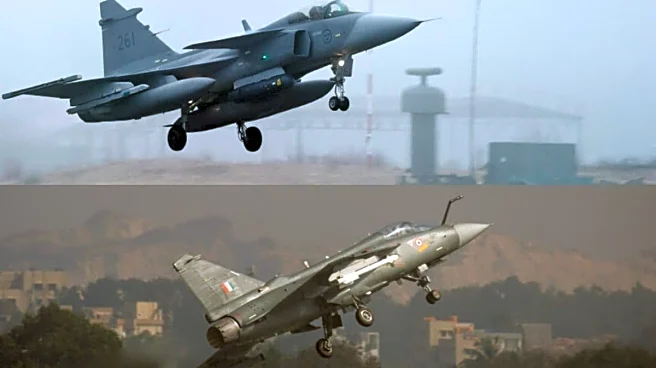




In the early 1980s, two countries set out on remarkably similar journeys. Both sought to modernise ageing air fleets, strengthen domestic aerospace capabilities, and build light, single-engine fighter jets suited to their strategic needs and industrial capacities. Sweden began work on what would become the Saab JAS-39 Gripen to replace its ageing Viggen aircraft, while India launched the Light Combat Aircraft programme that eventually produced the HAL Tejas to phase out the MiG-21 and establish indigenous capability.
On paper, the two aircraft share striking similarities. Both are modern, lightweight, multi-role fighters designed around delta-wing configurations and advanced fly-by-wire control systems. Each can perform air-to-air combat, ground
attack and reconnaissance roles, and both were intended to be agile, affordable and technologically relevant. Yet, four decades later, their journeys tell very different stories.
The Gripen has emerged as a globally recognised and operationally mature platform. The Tejas, despite being a major technological milestone for India, continues to struggle with perceptions of delay and underperformance. The difference, analysts say, lies less in engineering and more in execution, governance and systemic efficiency.
Sweden’s Gripen
Sweden’s Gripen programme began in June 1982 and entered service with the Swedish Air Force by June 1996, completing the transition in just 14 years. Backed by a strong domestic aerospace ecosystem and streamlined decision-making, the programme moved from concept to operational deployment at a steady pace. Today, more than 270 Gripens have been built across multiple variants, with production spread between facilities in Linkoping, Sweden, and Gaviao Peixoto in Brazil, together capable of producing around three dozen aircraft annually.
The aircraft has also proven successful in export markets. Colombia recently ordered 17 Gripen E/F jets for delivery between 2026 and 2032, while Thailand is expected to expand its existing fleet. Negotiations with Canada and other nations are ongoing. Saab’s strategy of quick technology transfer, consistent upgrades and reliable industrial partnerships has helped strengthen its global appeal. The aircraft’s operational performance, including deployments and exercises aligned with NATO systems, and its relatively low operating costs of around $4,000–5,000 per flight hour, have further boosted its reputation. The Gripen’s use of advanced systems such as the Raven ES-05 AESA radar and its ability to supercruise have added to its credibility as a modern, cost-effective fighter.
Observers often point to the programme’s management structure as a decisive factor. Sweden maintained clear lines of command, stable funding and strong coordination with international partners for critical components like engines. Even early setbacks, such as the crash of a prototype in 1989, were addressed swiftly without derailing long-term progress.
The Tejas
India’s Tejas programme began around the same time, receiving formal approval in August 1983. Its first flight came in January 2001, initial operational clearance followed in 2011, and the aircraft finally entered an Indian Air Force (IAF) squadron in July 2016. In total, it took more than 33 years to reach operational status.
Despite the long gestation period, the aircraft itself represents a major technological achievement. Over 70 per cent of its components in newer versions are indigenous, including the Uttam AESA radar. The Tejas Mk1A incorporates advanced avionics, modern missile integration such as Astra and ASRAAM, and is being prepared for future capabilities including compatibility with the BrahMos-NG. The programme has proven that India can design, build and fly a modern combat aircraft with significant domestic content.
As of early 2026, 40 Tejas Mk1 aircraft are operational. Five Mk1A jets are fully ready for delivery after successful trials, and nine more have been built and flown. However, several aircraft remain grounded due to shortages of GE F404 engines, highlighting continued dependence on foreign suppliers. Production, initially limited to eight to sixteen aircraft a year, is now being scaled up to 24 annually, with HAL targeting increased output by March 2026. Orders for 180 Tejas Mk1A jets have been placed, and the Tejas Mk2 is expected to roll out in mid-2026, with its first flight projected by late 2026 or early 2027.
Yet, in public discourse, the Tejas is often labelled “unsuccessful” or “underperforming”. Defence experts argue this perception stems not from flaws in design or engineering, but from systemic issues that have slowed progress. Decision-making across multiple agencies, including DRDO, ADA, HAL, certification bodies and the defence ministry, often lacked coordination and clarity. Files moved slowly, approvals were delayed, and responsibilities were sometimes diffused across institutions.
Funding instability in the early years added to the delays. The Indian Air Force’s evolving requirements for higher power, new avionics and expanded weapons integration repeatedly forced design revisions, further stretching timelines. The failure of the indigenous Kaveri engine programme was another major setback, forcing reliance on imported engines and creating long-term supply vulnerabilities.
External factors also played a role. After India’s 1998 nuclear tests, sanctions restricted access to critical technologies such as fly-by-wire components, leading to significant rework and delays. Over time, the ambition to make the aircraft fully indigenous collided with the reality of technological gaps and institutional limitations. The Air Force, meanwhile, remained firm on accepting only fully equipped aircraft with integrated weapons, radar and electronic warfare systems, which extended testing cycles.
The cumulative effect has been a programme that succeeded technologically but struggled operationally in terms of timelines and production rates. As MiG-21 squadrons retired, the slow pace of Tejas induction led to concerns over falling squadron strength, further affecting public perception.
In contrast, the Gripen’s success has been reinforced by consistent policy direction, swift execution and strong industrial coordination. By February 2026, it stands as a globally competitive platform with a growing export footprint. The Tejas, meanwhile, symbolises India’s self-reliance in aerospace and its ability to build a fighter from scratch, but continues to face challenges in production, delivery and supply chains.
Both programmes achieved their core objectives in different ways. Sweden delivered a globally competitive fighter on time through efficient management and sustained support. India built a modern indigenous aircraft against steep odds, gaining valuable technological expertise. Defence analysts believe that with centralised command structures, clearer accountability, deeper private sector involvement and diversified supply chains, the Tejas programme can still match the strategic and industrial impact that the Gripen has delivered for Sweden.