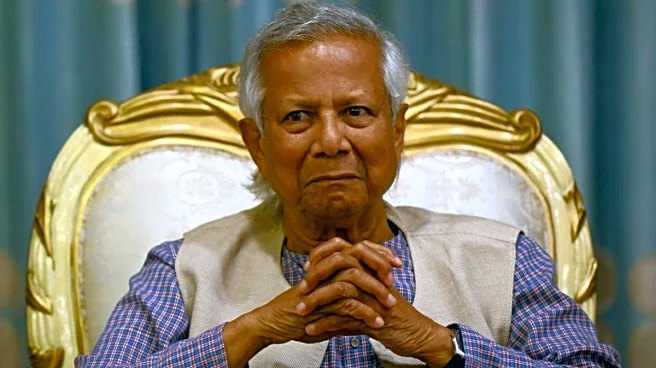

Bangladesh’s former intelligence officer and diplomat Aminul Hoque Polash, in exile since the fall of the Sheikh Hasina regime, has broken his silence on the hidden power structures, financial engineering,
and political ambitions surrounding Nobel laureate and the country’s interim leader Muhammad Yunus.
In an exclusive conversation, Polash walks News18 through classified insights, internal documents, and lived experiences inside Bangladesh’s national security system, revealing a side of Yunus the world has never seen before.
Before we get into the details about Dr Yunus, tell us how you ended up in exile.
I never pictured myself sitting in another country, talking about the collapse of the institutions I once served. I spent nearly a decade inside national security and foreign service. My work was simple in principle: follow evidence, protect the state, and protect the people.
But the moment my investigation started touching the financial arteries of Yunus’s network, everything shifted. People inside the system began warning me quietly that I had stepped into an area no one was supposed to touch. When the Yunus-led interim regime took power in an unconstitutional way, the pressure around me tightened instantly.
Intelligence colleagues told me my name was circulating in rooms where dangerous decisions get made. Words like “neutralise” and “make him disappear” were being thrown around. And these weren’t idle threats—my family was included in that danger.
Then came the abrupt recall from my diplomatic post in India. That single action told me exactly what was coming next. Going back home would’ve been like walking into a death sentence. Exile wasn’t a choice. It was the only way to protect my family and to stay alive long enough to tell the truth they wanted buried.
You published archival documents challenging Yunus’s claim of inventing microcredit. What did those documents really show?
Those papers rewrite the mythology. They show that Yunus didn’t invent microcredit—he absorbed it, rebranded it, and erased the actual creators from the story.
The rural credit project in Jobra wasn’t his personal idea. It was a Ford Foundation-funded university project designed by younger researchers—people like Swapan Adnan, Nasiruddin, and HI Latifee. Yunus was supervising a completely different section at the time. Over the years, though, every one of those names disappeared from history, and the entire narrative became “Yunus invented microcredit”.
If you want to understand the system he built later, this is where it begins. His first act wasn’t financial corruption, it was intellectual hijacking. Taking credit for something others built. That pattern never stopped.
Globally, he’s seen as a hero. What did you see from the inside that contradicts that?
The world sees a saint; Bangladesh saw a structure. A structure built on capturing institutions, moving public money into private vehicles, and ensuring that real accountability never follows the trail.
Grameen Bank, backed by donors and the government, created a fund called the Social Advancement Fund. That money was quietly shifted into a private body called Grameen Kalyan. From there, a web of nearly 50 entities emerged—Grameen Telecom, Grameen Fund, and so many others. People abroad think these bodies are separate. They’re not. Every decision, every movement of money eventually leads back to one centre of gravity.
By 2022, Grameen Telecom alone had collected more than Tk 10,890 crore in dividends from Grameenphone. Meanwhile, workers who legally owned a share of that money were denied it for years. Other entities conveniently showed “losses”, but somehow all the money stayed within the unified ecosystem he controlled.
This wasn’t charity. It was engineering—corporate engineering wrapped in the language of poverty alleviation.
When you followed the money, what shocked you the most?
The precision. The scale. And the deliberate design behind it.
Take one example: Grameen Kalyan transferred Tk 53.25 crore to Grameen Telecom for guaranteed dividends from Grameenphone. That deal alone produced more than Tk 2,222 crore across the years. Yet the actual rural borrowers—the legal owners of the money—never saw a single taka.
Or look at the Tk 437 crore “settlement” for workers. The money entered a special account and almost immediately started flowing somewhere else—into private accounts of lawyers and union leaders. It was only after Bangladesh Bank froze those accounts and the High Court flagged the transactions as “dubious” that the public even found out the truth.
Once you see the pattern, it stops looking like a mistake. It looks like a strategy.
What about tax evasion? There were many accusations around that.
The tax trail is one of the clearest indicators of intent. Yunus transferred roughly Tk 100 crore of his own wealth into trusts he personally controlled, but labelled the transfers as “loans”. Why? Because loans aren’t taxed the way asset transfers are.
The National Board of Revenue pursued him for Tk 15.4 crore. He went to court, appealed repeatedly, fought it for years. Every single court rejected his claim. The Supreme Court upheld the tax demand. He had to pay.
His network of institutions faces nearly Tk 2,000 crore in unpaid taxes. Instead of paying, dozens of legal cases were filed to stall the process for as long as possible. It’s a pattern the public never saw, but it’s all there in the paperwork.
The labour case was a major turning point. What did your investigation uncover?
The irony is painful. The man celebrated for empowering the poor wouldn’t follow basic labour law inside his own organisations.
Grameen Telecom workers fought for years to receive their lawful benefits. Many were fired unjustly—99 during the pandemic alone. The Labour Court held 21 hearings. It framed charges based on hard evidence and delivered a conviction.
That conviction disappeared almost overnight once Yunus seized power in 2024. It vanished. As if justice was optional.
For the workers, it was a betrayal. For people like me who understood how the system works, it was a clear message: the law applies only until it becomes inconvenient for him.
The Tk 437 crore settlement scandal became national news. What does that episode tell you?
It reveals the inner mechanics of the system. Workers were told, “You’ll finally get your dividends.” Money was deposited. And then, behind the scenes, a large chunk—26 crore—moved into a union account. From there, almost the entire amount flowed straight into the private accounts of lawyers and union leaders.
Bangladesh Bank froze the money. The High Court questioned the legitimacy of the transactions. The Anti-Corruption Commission started investigating.
And then Yunus took power and the entire process lost momentum. It shows how workers were used as bargaining chips, not beneficiaries.
You’ve also spoken about foreign remittances he received during the 2006-08 caretaker period. Why does that matter now?
Because it shows that his political ambitions didn’t suddenly appear. They were already in motion nearly two decades ago.
Around Tk 48 crore entered his personal account during that period, just as he was preparing to launch a political party. A large portion of that money wasn’t properly declared to the tax authorities. Some of it moved into accounts linked to a travel business.
When you align those remittances with the political timeline, it’s impossible not to see the pattern. He was positioning himself for power back then and he did the same again in 2024, but with far more sophistication.
What changed once he took over the 2024 interim government?
The speed was shocking. Within days, the entire legal landscape around him flipped.
His labour conviction disappeared. The Anti-Corruption Commission withdrew its major case against him. Five more labour cases vanished. Even a food adulteration case involving Grameen yoghurt vanished; something that had nothing to do with national politics.
A huge tax burden—Tk 666 crore owed by Grameen Kalyan—evaporated after a mysterious reversal. Grameen Bank received a five-year blanket tax exemption covering rental income, interest income, operational revenue—everything.
This wasn’t coincidence. This was a man finally in control of the machinery he had spent decades cultivating.
Critics say nepotism defines the current regime. What did you observe?
It’s not an accusation; it’s the operating system.
Yunus’ nephew, Apurba Jahangir, was suddenly the Deputy Press Secretary to the government. His long-time aide, Lamiya Morshed, secured high-level roles tied to SDGs and development priorities. Beyond these names, many people from the Grameen ecosystem now hold strategic roles inside ministries and regulatory agencies.
This is how a captured state functions. Not through flashy purges, but through quiet placement of loyalists in key positions. Once that network is in place, one man can effectively guide national policy without ever being visibly present.
Why do you think the West still doesn’t see this?
Because the world fell in love with a story—a gentle professor, the Nobel prize, and rural women. It fit perfectly into the global development narrative. It made everyone feel good.
Once a myth becomes comfortable, people stop questioning it. But myths don’t erase court verdicts. Myths don’t pay back unpaid taxes. Myths don’t explain disappearing convictions and strategic placements of loyalists.
The evidence exists. The world has just chosen not to look closely.
Finally, what would you say to people who still see Yunus as a saint-like figure?
I’d say this: judge him by what he’s doing with power today, not by the medal he won two decades ago.
Look at the cases that disappeared. Look at the institutions he captured. Look at how quickly a lifetime of liabilities evaporated once he took office.
And if he truly believes in the purity of his legacy, let him agree to a full international forensic audit—of his finances, his institutions, and every vanished case. If he has nothing to hide, he has nothing to fear.
Bangladesh deserves that clarity. And the world deserves to stop confusing myth with truth.
/images/ppid_a911dc6a-image-177088864928744173.webp)



/images/ppid_a911dc6a-image-177088805007765911.webp)




/images/ppid_a911dc6a-image-177088803864211353.webp)
/images/ppid_59c68470-image-177088756453137106.webp)