
For the second time, the Centre has ruled out a Metro Rail system for Coimbatore and Madurai, recommending a Bus Rapid Transit System (BRTS) instead. The rejection has revived a familiar question: what exactly decides whether a city gets a Metro — and why have smaller cities managed to get one when Coimbatore and Madurai haven’t?
The Ministry of Housing and Urban Affairs (MoHUA) first turned down Tamil Nadu’s proposal in November last year, citing the Metro Rail Policy of 2017, before Tamil Nadu returned with a fresh justification in May. The state argued that Coimbatore, an industrial-cum-tourist hub, and Madurai, a tourist hub, deserved a Metro given their floating population and tourist footfall, irrespective of resident numbers.
A few days
ago, the Ministry rejected the proposal again, telling the state it could instead build an elevated or at-grade BRTS, and adding that population “was not the sole criteria” — even as the population shortfall remained central to its reasoning.
What Is The Actual Rule For Getting A Metro?
Under the Metro Rail Policy, 2017, only cities with a population of at least 20 lakh (2 million), as per the 2011 Census, are considered eligible to even begin planning a Metro through a Comprehensive Mobility Plan.
Coimbatore’s 2011 population stood at around 15.84 lakh and Madurai’s at about 15 lakh — both short of the threshold, even though current estimates put both well past 20 lakh today. The Centre continues to go by the 2011 numbers since the 2021 Census has not yet been conducted.
So How Did Smaller Cities Get A Metro?
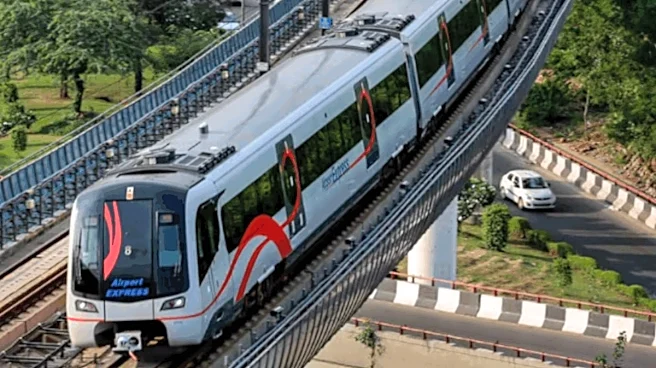
This is where it gets murkier. Nagpur (about 24 lakh) and Kanpur (about 27.6 lakh) did cross the 2011 threshold, so their Metro approvals fit the rule. But Agra, whose 2011 population was around 15 lakh — comparable to Coimbatore and Madurai — was sanctioned a Metro project in 2019, well below the 20-lakh mark.
Prayagraj (formerly Allahabad), whose city population in 2011 was only about 11–15 lakh, was approved a lighter-capacity “Metrolite” system in 2021, which the Uttar Pradesh government only upgraded to a full Metro in October 2025 — years after approval, and coinciding with the city’s Kumbh Mela-driven infrastructure push.
In other words, the population rule appears to have been applied inconsistently, and cities with strong political or event-driven cases (a Kumbh Mela, a religious tourism circuit) have sometimes found a way around it.
City-Wise Snapshot
| City | 2011 Population | Metro Status |
|---|---|---|
|
Coimbatore |
~15.84 lakh | Rejected twice; BRTS recommended |
| Madurai | ~15 lakh | Rejected twice; BRTS recommended |
| Agra | ~15 lakh | Sanctioned 2019; operational |
| Prayagraj | ~11–15 lakh (city) | Metrolite approved 2021; upgraded to full Metro, Oct 2025 |
| Kanpur | ~27.6 lakh | Meets criteria; operational |
| Nagpur | ~24 lakh | Meets criteria; operational |
What Did The Centre Say This Time Around?
The Ministry told Tamil Nadu that a Metro would not result in significant time savings for commuters in Coimbatore or Madurai, and that the DPRs submitted by Chennai Metro Rail Limited failed to establish adequate ridership demand.
It advised the state to strengthen the existing bus network instead, and said it had returned both proposals after “examining them in entirety” — a phrase that suggests factors beyond population also weighed on the decision, even if the Ministry hasn’t detailed what those are.
Is BRTS A Downgrade, And Can It Still Be Elevated?
A BRTS typically runs on dedicated road lanes rather than an independent elevated or underground corridor, making it cheaper to build but generally slower and lower-capacity than a Metro.
A report by The Hindu quoted sources indicating that the Tamil Nadu government could still build the BRTS in elevated form for both cities, since there isn’t enough right-of-way for an at-grade system — though this would mean revising the cost estimates originally worked out for a Metro.