
/images/ppid_a911dc6a-image-177501522339644870.webp)
/images/ppid_59c68470-image-177501509611737644.webp)

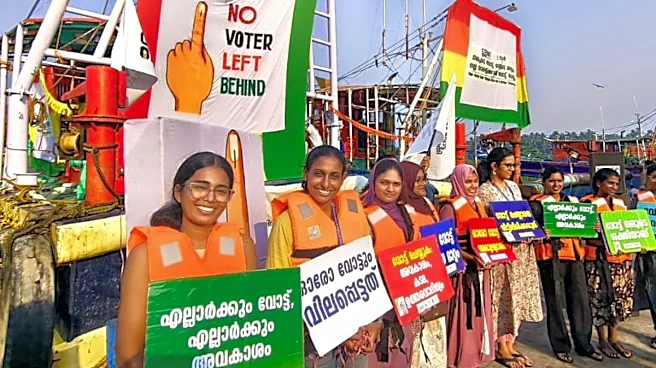
High voter turnout in Kerala: Kerala has been regularly recording voter turnout levels significantly higher than the national average. While India’s overall turnout in the 2024 Lok Sabha elections stood at 65.79%, Kerala has historically seen participation levels ranging between 70% and nearly 80% across elections.
This consistent pattern is not accidental—it is the result of a combination of social, political and institutional factors that have shaped the state’s democratic culture over decades.
Kerala has historically seen power alternate between the United Democratic Front (UDF) and the Left Democratic Front (LDF) every five years. However, Chief Minister Pinarayi Vijayan broke this long-standing trend by leading the LDF to a consecutive victory
in the 2021 Assembly elections, creating history.
It now remains to be seen whether Vijayan can once again overcome the state’s strong anti-incumbency factor in this election.
Kerala will go to voting on April 9 in a single-phased assembly election. The counting of votes will take place on May 4.
A Politically Aware & Educated Electorate
With a literacy rate of 96.2%, Kerala stands among India’s most educated states. Beyond education, its people are deeply politically aware—one of the key reasons the state consistently records high voter turnout in elections.
Analysts point out that in Kerala, voting is viewed as a civic responsibility rather than a passive act, with citizens actively engaging in political debates, public issues, and electoral processes.
Strong Grassroots Political Mobilisation
Kerala’s politics is deeply rooted at the grassroots level. From local self-government institutions to ward-level campaigns, political parties maintain strong organisational networks that actively mobilise voters.
Local body elections frequently record turnout above 70%, reflecting how political participation begins at the community level.
Bipolar Political Contest Keeps Voters Engaged
Unlike many states with fragmented political landscapes, Kerala has a largely bipolar contest between two major alliances—the Left Democratic Front (LDF) and the United Democratic Front (UDF).
This close competition ensures that elections are highly contested, giving voters a strong sense that their vote can influence the outcome. Studies show that high turnout in Kerala often coincides with tightly fought elections.
However, the BJP is trying to make inroads into the coastal state to force a triangular contest. However, the party, which rules big states like Uttar Pradesh, Rajasthan, and Madhya Pradesh, has so far failed in its attempts.
Social Development And Inclusivity
Kerala’s model of social development—marked by high literacy, better healthcare, and relatively lower inequality—has helped create a more inclusive political culture.
Participation cuts across gender and communities. In several elections, women voters have matched or even exceeded male turnout, reflecting broader social inclusion in the democratic process.
Voting Culture As A Social Norm
In Kerala, voting is not just an individual act but a collective social behaviour. Families and communities often treat polling day as an important civic occasion.
Long queues outside polling booths are common, and voter participation is often seen as a reflection of political awareness and social responsibility.
Conclusion
From high literacy and political awareness to competitive elections and strong grassroots networks, multiple factors combine to make Kerala India’s highest-turnout state.
Even when turnout dips slightly—as seen in parts of the 2024 elections—it still remains well above the national average, underlining the state’s deep-rooted democratic culture.
Kerala’s voting pattern shows that informed citizens, competitive politics, and strong institutions can together drive high electoral participation—offering a model for the rest of India.
/images/ppid_a911dc6a-image-177501455952182982.webp)



/images/ppid_a911dc6a-image-177501462998762175.webp)

/images/ppid_59c68470-image-177501503169041220.webp)

/images/ppid_59c68470-image-177501503628396623.webp)
/images/ppid_59c68470-image-177501506541813481.webp)
/images/ppid_59c68470-image-177501513429425796.webp)