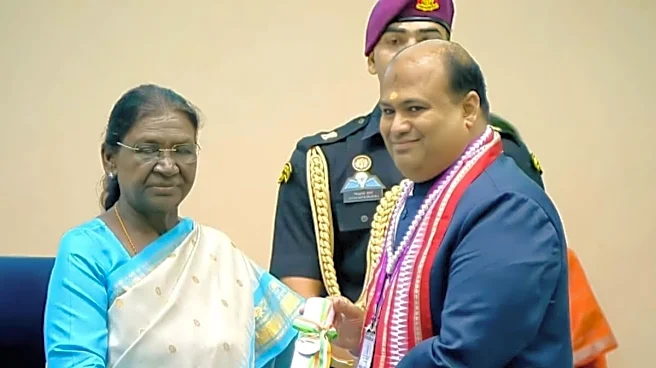




For Kiran Prakash Zarkar, the purpose of education is not simply to produce students who can score high marks. It is to ensure that young people leave the education system with something they can use to build a livelihood.
A Craft Instructor at Bhai Uddhavrao Patil Government Industrial Training Institute (ITI), Dharashiv, Maharashtra, he has spent 17 years working in the vocational education and skills space. He has authored 16 books and several articles, and says much of his work has been centred on students and improving the systems around them. His contributions have now earned him the National Teachers Award 2026.
What few know about him is he is the grandson of freedom fighter Devidas Madhav Zarkar, who actively participated in India’s Independence
Movement.
In 2014, he wrote a research article on a vocational training project and submitted it to the President, Prime Minister and Maharashtra Chief Minister. He says several initiatives were subsequently implemented following a committee’s review, including the NCVT portal, Apprenticeship portal, student stipend scheme, reservation for women and girls in ITIs and online ITI admissions.
He also mobilised 250 Gram Panchayats to pass resolutions on facilities for students and proposed initiatives such as the “Smart Gram Yojana” and “Smart ITI Yojana”.
‘A Single Day’s Test Cannot Judge Students’
For Zarkar, one of the biggest problems in the education system is the excessive dependence on high-stakes examinations to determine a student’s future.
“You cannot judge a brilliant student based on a single day’s test,” he says, arguing that Class 10 and Class 12 performance should also be given appropriate weightage alongside entrance examination scores.
His concern is particularly strong when it comes to competitive examinations for professional courses. A student may score 99% in Class 10 and 98% in Class 12 but still lose an opportunity because of performance in a single entrance examination.
Zarkar believes a more comprehensive system could prevent such students from being overlooked. “We cannot simply disregard school or college marks,” he says.
He also wants India’s examination system to become more transparent and predictable, with a clearly defined academic calendar and faster declaration of results. In his view, entrance examinations should follow a uniform system and be conducted transparently across the country.
‘Teachers Need To Teach Skills’
His central message to teachers and students is that skills must become an integral part of education. “Don’t make students chase after marks excessively. Instead, focus on imparting skills,” he says.
“If a student possesses even one practical skill, they won’t have to go looking for a job,” he added.
That philosophy is reflected in his own work. Zarkar holds a patent for a product called “Skill Book: Connecting Trainees through Skills”. He describes it as an effort to create a reliable, India-made platform through which students can learn skills, access practical demonstrations, attempt MCQs and examinations, study syllabi and books, and find information about job opportunities.
His experience in vocational education has also shaped his view of employment data. Zarkar believes official figures on the number of skilled young people who subsequently find employment may not capture the full picture because not every trainee enters formal employment.
“If there are 20 students in an ITI course, perhaps only five or six will go into formal employment; the rest will open their own shops or factories,” he says. “They don’t have the time to inform the government about the specific work they are doing.”
He believes this gap in follow-up can make skill-training outcomes appear weaker than they actually are.
For young people, however, his message remains simple. “Every skilled youth should find employment, self-employment, a job, or an apprenticeship,” he says.
He wants teachers to approach their classrooms with the same seriousness they would expect for their own children and ensure that teaching is both technically and professionally sound.
“Whatever work is assigned to you must be technically and professionally sound,” Zarkar says. “If it is a 45-minute lecture, you must teach for the full 45 minutes.”
For him, the larger goal is to create young people who are not merely qualified on paper, but capable of standing on their own feet.
His advice to teachers is therefore built around three things: knowledge of Ayurveda, Yoga and proficiency in at least one practical skill. “If a young person masters a single skill, they can build a livelihood around it,” he says, pointing to fields ranging from welding, painting and carpentry to driving, plumbing and beauty services.
In Zarkar’s vision of education, marks may open a door. But skills, he believes, are what help a young person build a future once they walk through it.