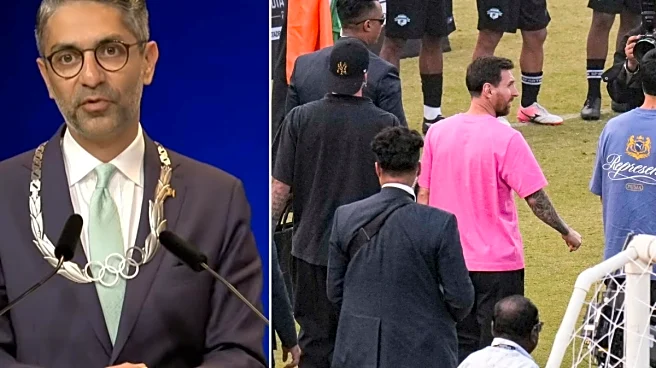



Olympic gold medalist shooter Abhinav Bindra expressed his unease over the handling of Lionel Messi’s GOAT India Tour. Messi’s arrival in New Delhi was delayed due to foggy conditions, and he went directly to the Leela Palace Hotel for an hour-long meet-and-greet session. Bindra voiced his quiet sadness on social media, criticising the millions of dollars spent on fleeting moments of proximity and photographs, suggesting that these funds could have been better utilised for grassroots initiatives to promote sports in India.
“Lionel Messi is one of those rare athletes whose story transcends sport. His journey from a child fighting physical odds to a footballer who redefined excellence has moved millions across the world. As someone who has lived
the life of an athlete, I hold profound respect and admiration for what he represents: perseverance, humility, and an uncompromising pursuit of greatness. Yet as his recent visit to India unfolded, parts of it felt chaotic and left me quietly uneasy,” Bindra posted on X.
“It compelled me to pause and reflect not in judgment but in genuine concern about what we were really trying to achieve. I fully understand the economics of sport. I understand commercial realities, global branding, and the magnetism of icons. I do not fault Messi in any way. He has earned every opportunity that comes his way, and admiration for greatness is natural, even beautiful. But admiration must also invite introspection.”
Messy Tour!
Messi’s tour experienced a rough start due to poor management at Salt Lake Stadium, where his presence with Luis Suarez and Rodrigo de Paul attracted thousands of fans. The mismanagement turned their excitement into frustration. In Telangana, Messi participated in photo ops, played with children, and interacted with an official. He briefly appeared on the stadium’s big screen and broadcast visuals during a match at Uppal Stadium, waving from a VIP box.
“As a society, are we building a culture of sport, or are we simply celebrating individuals from afar. Millions were spent on moments of proximity, photographs, and fleeting access to a legend. And yes, it is people’s money earned honestly and theirs to spend as they choose.”
“Still, I can’t help but feel a quiet sadness, wondering what might have been possible if even a fraction of that energy and investment had been directed toward the foundations of sport in our country. Playgrounds where children can run freely. Coaches who can guide young talent. Grassroots programmes that give opportunities to those who may never otherwise be seen. Spaces where sport is not a spectacle but a daily habit, a teacher, and a source of dignity. Great sporting nations are not built by moments; they are built by systems. By patience. By belief in the ordinary child with an extraordinary dream. Icons like Messi inspire us, and that inspiration matters deeply. But inspiration must be met with intent.”
“With long-term commitment. With choices that reflect not just what excites us today but what will strengthen us tomorrow. If we truly wish to honour legends like Messi, the most meaningful way to do so is not through grand gestures but by ensuring that somewhere in India, a young child has a field to play on, a coach to believe in them, and a chance to dream. That is how sporting cultures are born. And that is how legacies endure.”
(With inputs from Agencies)

/images/ppid_a911dc6a-image-177105042575465447.webp)

/images/ppid_a911dc6a-image-177105033328862095.webp)
/images/ppid_a911dc6a-image-177105037137039801.webp)



/images/ppid_59c68470-image-177105003415990657.webp)

/images/ppid_59c68470-image-177105003432353455.webp)
/images/ppid_a911dc6a-image-177104902795770968.webp)