

What began as a technical tweak to recruitment rules has snowballed into a political flashpoint over identity, access, and history in Jammu and Kashmir. A proposed amendment to the Revenue Service Recruitment Rules, currently open for public feedback, has triggered sharp reactions, with the Peoples Democratic Party alleging an attempt to sideline Urdu, and the National Conference-led government dismissing the charge as premature and misleading.
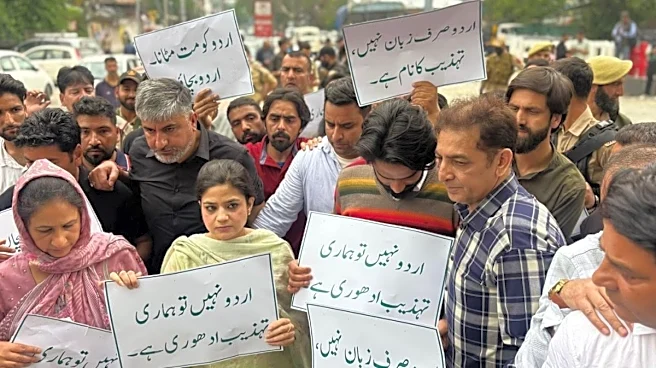
The controversy reached the streets on Tuesday, when PDP leader Iltija Mufti led a protest in Srinagar, framing the issue as more than a policy debate. For her party, the question is whether altering Urdu’s role in recruitment risks weakening a language that has historically underpinned administration
and connected diverse communities across the region. The government, however, insists no final decision has been taken and that Urdu’s place in revenue systems remains intact.
“Urdu is being sidelined in government services… Urdu connects villages and cities across Jammu and Kashmir. It is our linguistic heritage, our identity, and a repository of knowledge,” Mufti said, accusing the National Conference-led government of failing to protect the language and questioning chief minister Omar Abdullah’s priorities. “While the chief minister runs marathons in different states, his government is busy sidelining the language that binds us,” she added.
In response, Advisor to the chief minister, Nasir Aslam Wani, said there was no move to drop Urdu from the Tehsildar examination or revenue services. “The department concerned merely issued a notification inviting public objections. This is part of a democratic process… No notification has been issued to remove Urdu from the syllabus or recruitment process,” he said.
Emphasising Urdu’s continued relevance, Wani noted that a large number of revenue records in J&K are historically maintained in Urdu. “If revenue officers cannot read or examine documents in Urdu, they will be of no utility. Rest assured, Urdu will never be excluded from the syllabus,” he declared.
The History Of Language
Urdu became the court language in 1889 under Maharaja Pratap Singh, who gave Urdu its official foundation in the state, replacing Persian. It served as the sole official language of the erstwhile state of J&K for over 131 years. The Dogra dynasty also saw the longest-serving Maharaja of Jammu and Kashmir and Urdu was seen as a link language across diverse linguistic groups—Kashmiri, Dogri, Punjabi etc—especially in revenue records, land documents, and administration.
Undivided Jammu and Kashmir is linguistically diversified with Kashmiri spoken in the Valley, Dogri in Jammu, Balti and Ladakhi in Ladakh, plus Pahari, Punjabi, Gujjari, and other dialects. Persian was a foreign language understood only by a small section, including officials.
There were multiple factors behind the introduction of Urdu as official language. To begin with, Persian had been the court language for centuries under Mughals, Afghans, and early Dogras, but it was increasingly seen as inaccessible to the common people. Historians record that Urdu was seen as a more convenient language for communication across various groups and between the British and the Dogra rulers.
After the abrogation of Article 370 and following J&K’s reorganisation into a Union Territory, the Union government added Kashmiri, Dogri, Hindi, and English alongside Urdu as official languages. This ended Urdu’s exclusive status.
Urdu was long mandatory for posts like Patwari and Naib Tehsildar because revenue and land records are historically in Urdu. In 2025, notifications and a Central Administrative Tribunal order removed the mandatory Urdu requirement. The BJP supported this, calling it non-discriminatory since there are now five official languages and arguing it opens opportunities for Hindi, Dogri, and Punjabi speakers.
Revenue documents of Jammu and Kashmir remain in Urdu language, so removing the requirement could cause administrative issues, but those supporting the removal of Urdu want records digitised and translated into all languages for diverse reading.

/images/ppid_a911dc6a-image-177753808063590236.webp)

/images/ppid_a911dc6a-image-177753806350649408.webp)
/images/ppid_a911dc6a-image-177753803645279762.webp)



/images/ppid_a911dc6a-image-177753762492471267.webp)